



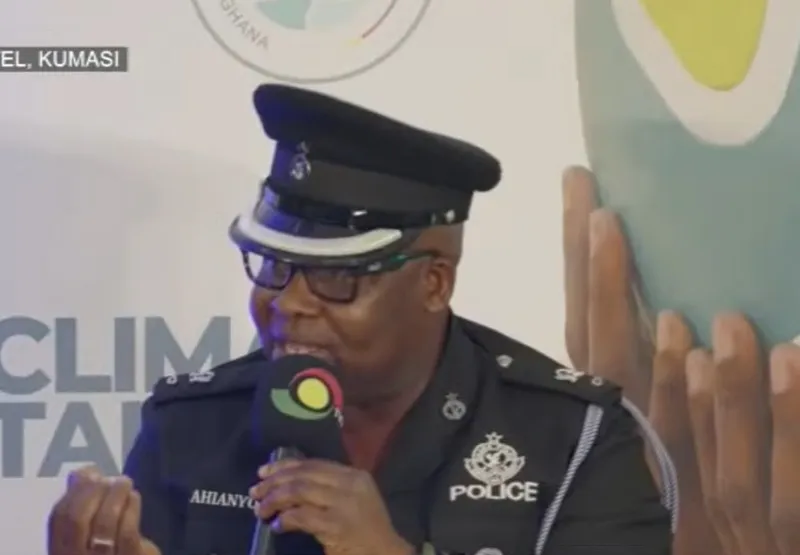
The Ashanti Regional Police Command has urged miners to report any police officers who visit mining sites to demand or extort money, insisting that the Ghana Police Service has not been tasked with conducting illegal mining enforcement operations.
Head of the Public Affairs Unit of the Ashanti Regional Police Command, Superintendent Godwin Ahianyo, said the National Anti-Illegal Mining Operations Secretariat (NAIMOS) is currently responsible for leading the government’s fight against illegal mining.
He made the statement during a panel discussion on TV3’s Climate Talks 2026, Kumasi edition, on Wednesday, September 23.
“We know that when it comes to fighting illegal mining, the core responsibility lies on NAIMOS. Now we know that nationally it is NAIMOS fighting illegal mining,” Supt. Ahianyo said. “No police team is supposed to go to a mining site. It is solely the responsibility of NAIMOS, so when they come, report them to the appropriate authorities and I can assure you that action will be taken against those officers.”
Supt. Ahianyo was responding to allegations by the Ashanti Regional Secretary of the Ghana National Association of Small-Scale Miners, Michael Adu Gyamfi, that some police officers and other taskforces extort money from miners during enforcement operations.
The police spokesperson said any officer found independently operating at a mining site and demanding money should be reported to the Regional Police Command.
“If you see any police team coming to your site to demand or extort money, report that police to the Regional Police Command. We have the vehicle numbers,” he said.
He stressed that police personnel had been repeatedly informed that they were not authorised to conduct illegal mining enforcement operations at mining sites.
“We always tell them that no police team has been tasked to go to any mining site,” Supt. Ahianyo said.
He assured miners that complaints against officers involved in such conduct would be investigated and appropriate action taken.
Background: A History of Allegations
The allegations raised by Adu Gyamfi are not isolated. In May 2026, five high-ranking police officers were interdicted after a viral video allegedly showed them extorting money from individuals at an illegal mining site. The suspects included Chief Inspector Matthew Blay, Chief Inspector Francis Arthur, Inspector Eric Osei, Sergeant Amos Dery of the National Protection Unit, and Inspector Joseph Okyere Asabre. In the video, one officer was seen folding two GH¢200 notes into his pocket, telling the miners that if they did not settle half of the amount charged, they would have to leave the site. The officers were referred to the Police Professional Standards Bureau for investigation.
In April 2026, eight confirmed National Security operatives were granted police inquiry bail after allegedly robbing illegal miners of gold, cash, and mobile phones at Awisam in the Assin Fosu Municipality. Two of the suspects were reported to be sons of prominent politicians from the ruling government. Community members confronted the personnel, deflated their vehicle tyres, and attempted to lynch them before the Mmrantehene intervened and handed them over to police.
Adu Gyamfi alleged that the problem had become systemic. “It is an open secret that every designated taskforce takes money from miners. NAIMOS, I cannot say that for a fact, but for other taskforces, I can make it point blank that they take money,” he said. “The police is part, party people are also involved and the District Assemblies.”
He also questioned the deployment of multiple police units to the same mining sites, arguing that the pattern raised concerns about whether the operations were solely focused on enforcement or extortion. “One mining site in a day, three police units will move to that site for the same purpose,” he said. “When you enquire from them, they will tell you they are from Region. In about three hours later, another unit will come, when you ask them, they will tell you they are from Division. Now even those mandated to take care of highway robberies are all moving into mining sites.”
He also alleged that a District Assembly he was familiar with regularly deployed a taskforce to seize mining equipment, after which miners were required to pay money before the equipment was released.
NAIMOS: The Lead Agency
NAIMOS was established in June 2025 by the Ministry of Lands and Natural Resources as a central coordinating body to lead Ghana’s fight against illegal mining through intelligence-led, multi-agency operations. It operates under a ministerial advisory group chaired by the Lands Minister and comprising the Ministers for the Interior, Defence, Finance, and Local Government, the Attorney-General, the National Security Coordinator, and the Executive Secretary to the President.
The Secretariat has developed a unified command structure bringing together the military, police, immigration, and intelligence agencies under a single operational framework across seven operational regions, structured into 21 zones to enhance surveillance and enforcement. Four of the zones cover the Western, Central, Eastern, and Ashanti regions, while the Western North Region has been divided into three sectors — Enchi, Bibiani, and Sefwi. The remaining zones cover the Bono and Ahafo enclave, as well as the northern Savannah belt.
According to NAIMOS Director of Operations Colonel Dominic Buah, the Secretariat achieved an 87.7 per cent operational strike rate between July 2025 and March 2026. During that period, NAIMOS conducted 122 operations, leading to 237 arrests — including 144 foreign nationals — the seizure and immobilisation of 94 excavators, the destruction of 2,647 chanfang platforms, and the recovery of 59 firearms and 208 rounds of ammunition. The recovery of firearms, Colonel Buah noted, pointed to the growing militarisation of illegal mining activities.
He also disclosed that early signs of environmental recovery had been recorded along rivers such as the Ankobra and Ayensu where sustained enforcement was maintained, and that more than 800 acres of degraded land had been restored in the Manso Adubia area of the Ashanti Region.
Looking ahead, NAIMOS announced plans for the phased deployment of nine permanent field task forces across key hotspots to ensure sustained operational presence rather than sporadic raids. Colonel Buah also said regular rotation of task force members would be implemented to prevent compromise and corruption.
The Scale of the Crisis
The allegations of extortion come against the backdrop of a deepening environmental crisis. According to the Ministry of Lands and Natural Resources, Ghana has lost approximately 8,900 hectares of forest reserves to illegal mining, with nine of the country’s 288 forest reserves severely affected. As of July 2026, 258 people had been arrested in connection with illegal mining activities in forest reserves, while 200 excavators had been seized and another 34 immobilised.
More than 60 per cent of the country’s water bodies are polluted by illegal mining activities, according to research scientists, exposing the country to environmental, health, and livelihood hazards. Former Lands Minister John Peter Amewu has warned that reclaiming and restoring degraded lands could cost Ghana approximately $21 billion, with about 10 per cent of the country’s total surface area — roughly 23,853 square kilometres — already degraded.
Speaking at the same Climate Talks event, Ashanti Regional Minister Dr. Frank Amoakohene called for sustained, intelligence-led enforcement targeting not only workers at galamsey sites but also financiers, equipment owners, and facilitators. “We must sustain enforcement and not allow illegal mining to be addressed through occasional operations,” he said. “Enforcement must be continuous, intelligence-led, and focused not only on workers at mining sites, but also on financiers, equipment owners, and those who facilitate illegal operations. Nobody should be protected because of political, traditional, economic, or social connections.”
The German Ambassador to Ghana, Frederik Landshöft, also weighed in, urging stakeholders to consider the livelihoods of the estimated one million people engaged in artisanal and small-scale mining when addressing illegal mining in Ghana. The event was organised in partnership with the German Embassy and brought together MMDCEs, traditional leaders, security services, small-scale miners, technocrats from KNUST, Tropenbos Ghana, and community representatives.
A Fragmented Fight
Adu Gyamfi’s allegations echo earlier warnings from the miners’ association. In July 2025, the Ashanti Chapter of the Ghana National Association of Small Scale Miners raised concerns over multiple unregulated task forces operating under the pretext of combating illegal mining. The association called on the Inspector-General of Police to check police excesses in anti-galamsey operations, citing numerous complaints from members.
In August 2026, the Small-Scale Miners Association of Ghana threatened a two-month strike over extortion and harassment, alleging that rogue elements among police officers, soldiers, immigration officers, and politicians were using their positions to intimidate miners and extort money.
Adu Gyamfi also cited political interference and a lack of coordination among state agencies as key obstacles. “Until the politicians stop their interference in small-scale mining issues and illegal mining, we will still encounter the issues,” he said. “Sadly, those tasked with fighting illegal mining are compromised. They are accepting bribes and making money instead of dealing with the issue of galamsey. We cannot continue this way and expect the galamsey fight to succeed.”
He challenged authorities and the public to visit Kumasi to see what he described as the reality of the enforcement regime. “The fight against galamsey has turned into a field day for security officials. We are witnessing sanctioned and unsanctioned operations by the security agencies to the point that we have officers from the Anti-Robbery Unit of the Ghana Police Service storming sites. Come to Kumasi and witness the situation for yourself.”
Broader Enforcement Context
The Ghana Police Service has also been involved in anti-galamsey operations through a special task force constituted by the Inspector-General of Police, which has retrieved over 100 excavators, bulldozers, weapons, and chanfang machines used in illegal mining in Samreboi and surrounding communities. In December 2025, the IGP urged officers of the Special Anti-Galamsey Task Force to stand firm against crime and galamsey.
However, the existence of multiple overlapping task forces — including those from the police, military, National Security, and district assemblies — has created what critics describe as a fragmented and uncoordinated enforcement landscape that enables extortion and undermines the credibility of the fight against illegal mining.
The government has also deployed Blue Water Guards to protect water bodies, with deployment reaching 2,069 personnel as of July 2026, and has designated 13 blocked-out areas across the country for allocation to Ghanaians interested in legal small-scale mining as part of efforts to provide alternative livelihoods and curb illegal operations.
As the Ashanti Regional Police Command urges miners to report extortion, the effectiveness of that channel — and the willingness of miners to use it — will be a critical test of the government’s commitment to rooting out corruption within the enforcement chain.
About NAIMOS
The National Anti-Illegal Mining Operations Secretariat (NAIMOS) is a special-purpose unit established under the Ministry of Lands and Natural Resources to coordinate, monitor, and lead intelligence-led field operations against illegal mining across Ghana. It serves as the operational nerve centre for Ghana’s fight against illegal small-scale mining and its associated environmental destruction, particularly in water bodies and forest reserves.
Key Operational Metrics (July 2025 – March 2026):
· Operations conducted: 122
· Arrests: 237 (including 144 foreign nationals)
· Excavators seized/immobilised: 94
· Chanfang platforms destroyed: 2,647
· Firearms recovered: 59
· Ammunition recovered: 208 rounds
· Operational regions: 7 (structured into 21 zones)
· Land restored: 800+ acres (Manso Adubia, Ashanti Region)
· Operational strike rate: 87.7%


