



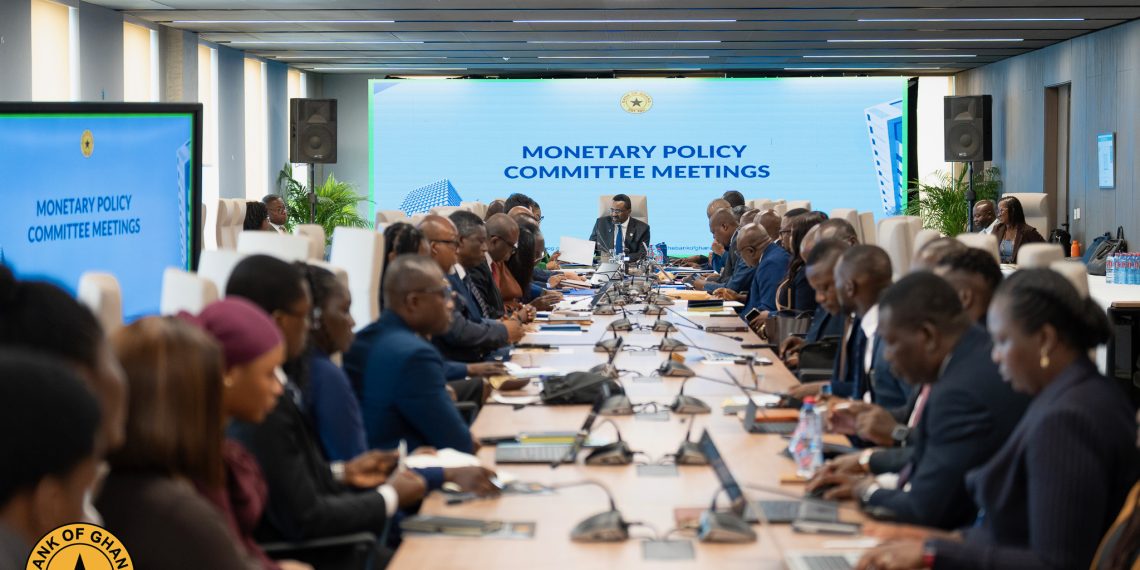
The Bank of Ghana (BoG) has kept its Monetary Policy Rate unchanged at 14%, the third consecutive hold this year, after the Monetary Policy Committee (MPC) voted unanimously to maintain the benchmark rate, saying risks to inflation and growth are broadly balanced.
The decision was taken at the MPC’s 132nd regular meeting, which concluded on Thursday, September 24, 2026. The policy rate is the rate at which the central bank lends to commercial banks and influences borrowing costs across the economy.
Governor Dr. Johnson Pandit Asiama said the Committee considered resilient domestic economic activity, moderating underlying inflationary pressures and robust external-sector performance, even as global uncertainty remains elevated.
“Based on these considerations, the Monetary Policy Committee viewed the balance of risks to inflation and growth as broadly balanced, and the committee voted by a unanimous decision to maintain the monetary policy rate at 14.0 percent,” he said.
Inflation pressures persist
The MPC noted an uptick in headline inflation in August, which it attributed largely to the pass-through of utility tariff adjustments and higher crude oil prices. It said underlying inflation pressures were moderating, with inflation expectations and core inflation measures pointing to an easing trend.
“Despite this, all the inflation expectations and core inflation measures are indicating a moderation in underlying inflation,” the Governor said.
Headline inflation remains below the lower bound of the BoG’s medium-term target band but is projected to move into the target band over the next few quarters. The Committee listed upward revisions to utility tariffs, rising ex-pump petroleum prices and their potential impact on transport fares, a stronger US dollar amid higher US interest rates, and possible spillovers from global supply-chain disruptions as key upside risks.
On the downside, it said continued fiscal consolidation, improved food supply conditions and exchange-rate stability could help contain inflationary pressures.
Trade surplus rises to $8.85bn
The external sector recorded stronger performance in the first eight months of 2026. The trade surplus increased to $8.85 billion in the year to August 2026, from $6.69 billion over the same period in 2025.
The improvement was driven by stronger export receipts, particularly from gold, cocoa and crude oil. Total exports rose to $22.4 billion in the first eight months of 2026, from $17.9 billion in the corresponding period last year.
Imports, however, also increased significantly, reaching $13.58 billion, a 20.8% increase from $11.24 billion a year earlier. The Bank attributed the rise largely to higher oil and gas import values, driven by increased crude oil purchases for domestic refining activities.
Resilient activity, global risks
The BoG said economic activity remained resilient during the first half of 2026, supported by easing credit conditions, increased private-sector credit allocation and positive business and consumer sentiments.
Still, the Committee warned that heightened global uncertainty—including energy-market volatility and supply-chain disruptions—could pose risks to the outlook. It said it would continue to monitor developments and adjust policy as needed to anchor inflation expectations and support sustainable growth.


