

The National Anti-Illegal Mining Operations Secretariat (NAIMOS) has reaffirmed its commitment to sustaining the fight against illegal mining, describing the campaign as a marathon that requires persistent effort to remove illegal mining infrastructure from Ghana’s rivers.
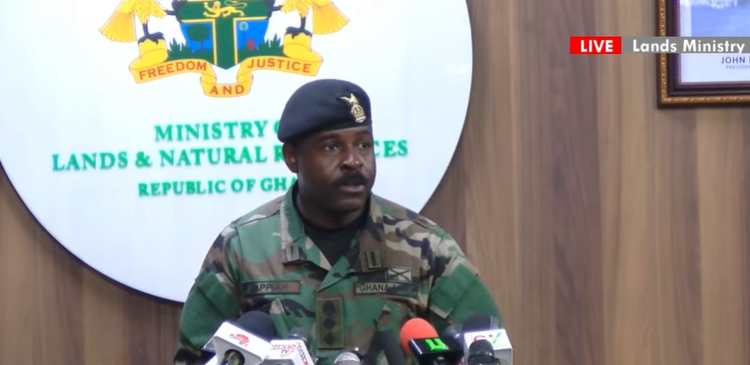
Colonel K.S. Appiah, Director of Operations at NAIMOS, said the secretariat remained determined to dismantle structures and equipment used for illegal mining despite the difficult conditions its task forces encounter during operations. Addressing the media on Thursday, October 22, at the secretariat’s first press conference on its operations, he warned that the continued presence of such equipment in water bodies would worsen environmental damage if enforcement efforts were abandoned.
“As has been mentioned on many occasions, the fight against illegal mining is a marathon, and we are poised to go through this race to ensure that we take out all illegal mining infrastructure on our river bodies,” Appiah said.
Colonel Appiah acknowledged that removing illegal mining equipment from rivers was a demanding task, particularly because of the size and weight of the machinery and the difficulty of accessing some mining sites. Task force personnel often had to dismantle or burn makeshift mining platforms and chanfangs because transporting them out of river bodies was difficult, with some locations lacking accessible roads for trucks and other heavy vehicles.
“It is very difficult to move them out of the rivers because road access and access for trucks to the areas are almost impossible. So, we need to destroy and burn them, and later, in coordination with the GSDC, which has the capability to lift them from the river bodies,” he said.
Operational Data: 738 Activities, Nearly 2,000 Chanfangs Destroyed
The press conference provided the most detailed public accounting of NAIMOS’ operations since Colonel Appiah assumed office on June 13, 2026. Between that date and September 30, the secretariat conducted 738 operational activities covering approximately 50,662 kilometres nationwide, including reconnaissance missions, mobile and riverine patrols, raids, special operations, and community engagement .
The operations spanned the Western, Western North, Central, Eastern, Ashanti, Bono, Ahafo, Savannah, and Northern operational zones. During the period, NAIMOS recovered 74 firearms and 551 rounds of ammunition, and seized excavators, pumps, vehicles, and other machinery used in illegal mining. About 1,970 chanfangs and 863 makeshift structures linked to illegal mining were destroyed, significantly disrupting illegal mining infrastructure and operations .
Colonel Appiah said the secretariat would shift focus to the equipment suppliers and facilitators who enable illegal mining, adding that operations would no longer be limited to miners at the sites. “Our operational focus will continue to target the equipment, suppliers, and facilitators who sustain illegal mining operations,” he said .
He also disclosed that NAIMOS had received a significant number of reports from the public over the past two months, including GPS locations and contact details that enabled teams to respond to potential threats. “We’ve received a lot of whistleblowing from various quarters where people call, send GPS locations, provide points of contact, and we have sent teams to prevent illegal mining in certain areas,” he said .
Background: A Centralised Command Against a Longstanding Crisis
NAIMOS was officially launched on June 26, 2025, by the Minister for Lands and Natural Resources, Emmanuel Armah-Kofi Buah, as a centralised, intelligence-led body tasked with coordinating all anti-galamsey operations nationwide. The secretariat was established to address longstanding challenges associated with fragmented and uncoordinated responses to illegal mining, bringing together the Ministries of Interior, Defence, National Security, the Narcotics Control Board, and the National Investigations Bureau .
At the launch, Buah disclosed that 16 per cent of Ghana’s land reserves had already been degraded by illegal mining activities. “NAIMOS will provide the focused leadership required to win this fight,” he said .
The scale of the challenge remains immense. President John Dramani Mahama revealed on October 19, 2026, that illegal mining had affected 48 of Ghana’s 288 forest reserves, with about 12,000 acres of land destroyed. Nine of the affected reserves had been declared red zones because illegal miners operating there were heavily armed. The President said more than 8,200 pieces of equipment, 135 excavators, and nearly 200 firearms had been seized in the fight, and that GH¢200 million had been set aside for the reclamation of 5,000 acres of degraded land .
Expanding Operations: Water Shield and Green Shield
Colonel Appiah announced that NAIMOS’ interventions had been expanded to include illegal sand winning and stone mining activities, noting that such operations posed serious threats to land, water bodies, and surrounding communities .
Under Operation Water Shield, which began along the Birim River in July and has since moved to the Ankobra River, NAIMOS plans to extend operations to two additional major river systems before the end of the year. “For good reasons, I will not mention which river bodies, but before the end of the year, we will be tackling two major river bodies as part of Operation Water Shield,” he said .
The next phase of the operation will focus on securing reclaimed areas to prevent illegal miners from returning after enforcement operations. In collaboration with the Ghana Navy, NAIMOS intends to deploy a dedicated riverine unit on the Ankobra River to sustain patrols, deter the return of chanfang operators, and consolidate the gains achieved .
The secretariat also plans to launch Operation Green Shield, a forest protection intervention beginning at the Atiwa Forest Reserve, following a three-stage approach of clearing and disrupting illegal activities, stabilising affected areas, and eventually transitioning protection responsibilities to the Forestry Commission. “The intended outcome is a reserve in which priority hotspots have been cleared and stabilised, with routine protection progressively transferred to Forestry Commission guards,” Appiah said .
The Human and Environmental Cost
The enforcement campaign unfolds against a backdrop of severe environmental degradation. Illegal mining has polluted major river systems, threatening water security for millions of Ghanaians and devastating agricultural livelihoods in communities that depend on these water bodies for irrigation and daily use.
Colonel Appiah maintained that despite the logistical challenges, NAIMOS would continue its operations to remove illegal mining infrastructure from rivers and strengthen efforts to protect Ghana’s water bodies from further degradation. He stressed that success would be measured not solely by the number of operations conducted but by whether cleared areas remained secure, illegal activity declined, cases advanced through the justice system, and environmental recovery became measurable .
“Professionalism and public trust are essential to our operational success. I remain committed to accountability, integrity, and disciplined conduct,” he said .