



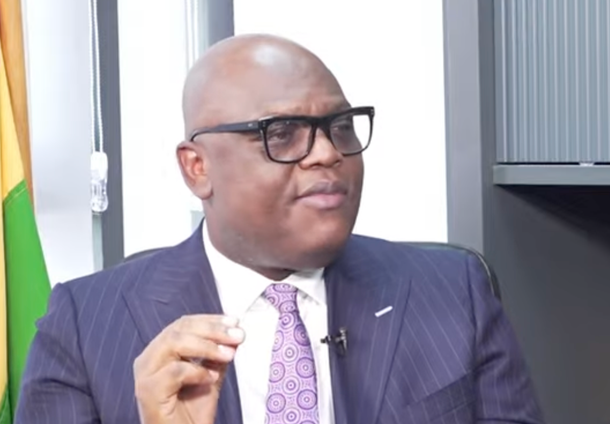
The head of Ghana’s investment promotion agency has delivered an unequivocal message to foreign investors: no amount of money can buy entry into the country’s informal retail sector, which is legally reserved for Ghanaians.
Simon Madjie, Chief Executive Officer of the Ghana Investment Promotion Authority (GIPA), said on Joy News’ PM Express Business Edition on Thursday that the restriction is non-negotiable, even as enforcement remains the central challenge.
“The law reserves it for Ghanaians. So regardless of whatever amount of money you bring in, you are not expected to be there,” Madjie said. “The informal retail space by law is reserved exclusively for citizens of Ghana, and that is non-negotiable. Regardless of the amount of money you bring, you cannot enter the informal retail space because that market is reserved for Ghanaians.”
A Legal Barrier, Not a Financial One
The restriction is enshrined in the Ghana Investment Promotion Authority Act, 2026 (Act 1117), which replaced the GIPC Act of 2013. The law reserves informal retail activities — including open-market trading, small shops, and kiosks — exclusively for Ghanaian citizens. Foreign investment remains welcome in formal retail, such as malls and supermarkets, but must comply fully with the country’s investment laws.
The penalties for violation are substantial. Under Section 56(3) of Act 1117, a non-citizen or non-wholly Ghanaian-owned enterprise engaging in a reserved activity faces an administrative penalty of between 5,000 and 10,000 penalty units, with an additional monthly penalty of 500 to 1,000 penalty units for as long as the violation continues. At the statutory rate of GH¢12 per penalty unit, that translates to an initial fine of GH¢60,000 to GH¢120,000, plus up to GH¢12,000 for each month the breach persists.
Furthermore, Section 55(1)(a) makes it a criminal offence for any person or enterprise to let or sublet a market stall or store to a foreigner for trading purposes, with a conviction carrying a fine of between 2,000 and 4,000 penalty units.
The Fronting Problem
Madjie acknowledged that the real difficulty lies not in the law but in its enforcement. A key obstacle is the practice of “fronting,” where Ghanaian citizens lend their names or companies to conceal foreign ownership or control of businesses operating in reserved sectors.
Trade Minister Elizabeth Ofosu-Agyare has previously pointed to this dynamic, stating: “The ministry is aware that there is the presence of foreigners in the retail trade, but that is because Ghanaians front for them”.
The Ghana Union of Traders Association (GUTA) has also issued stern warnings to its members against the practice. GUTA President Clement Boateng said in September that the new law has provisions dealing with fronting, and “whoever is caught fronting for foreigners will have him or herself to blame”.
Madjie described the confusion between trade and investment as a broader conceptual problem blurring public understanding. “There’s a whole world of confusion between trade and investment,” he said, explaining that trade involves exchanging goods and services, while investment involves committing resources, establishing an entity, and creating value with the prospect of earning and repatriating profits.
A Collaborative Enforcement Push
The enforcement challenge has prompted GIPA to forge a closer partnership with GUTA. In August, the two bodies agreed on a set of measures to protect Ghanaian-owned informal retail businesses, including stronger monitoring, public education on investment regulations, and the establishment of a direct reporting mechanism for suspected breaches.
That agreement followed a strategic meeting convened under the directive of the Ministry of Trade, Agribusiness and Industry (MoTAI), chaired by Madjie and attended by GUTA national executives and senior GIPA officials.
The measures include reviving an inter-agency task force involving GIPA, MoTAI, local government authorities, security agencies, and other regulatory bodies to coordinate enforcement efforts. The two organisations also proposed joint public education campaigns and diplomatic engagement, with the Trade Minister expected to work with the Ministry of Foreign Affairs to sensitise diplomatic missions on Ghana’s investment laws and ECOWAS obligations.
Model Markets as a Structural Solution
Madjie pointed to the government’s 24-hour model market initiative under President John Mahama as a structural remedy to the enforcement problem. The model markets — designed to operate around the clock and equipped with banking services, storage facilities, fire and security protection, restaurants, crèches, and clinics — aim to formalise and regulate trading spaces.
“And so I see that as the solution to these major issues that we’ve had for a very long time,” Madjie said, noting that organised, regulated markets would give authorities greater control over trading spaces.
The government has committed to building one 24-hour model market in each of Ghana’s 261 districts, with construction beginning across all districts by mid-December 2025. Local Government Minister Ahmed Ibrahim has said the markets are expected to reflect Ghanaian cultural aesthetics while boosting productivity and formalising the informal sector.
No Rule-Bending for Investors
Madjie rejected any suggestion that Ghana should relax its rules to attract foreign capital. “Look, the state of Ghana is not bending the rules for investors to come in,” he said. “Ghana is not bending the rules for investors. Ghana has just levelled the playing field to bring in more people to partner with our businesses.”
He noted that some international investors are listed on foreign stock exchanges, meaning their conduct in Ghana could affect their share prices — making compliance critical. He also acknowledged that growing local businesses can make mistakes, particularly regarding VAT and tax collection, but said such issues are addressed through GIPA’s aftercare system.
The GIPA CEO’s remarks come amid a broader continental trend. Several African countries — including Tanzania, Botswana, and Kenya — are enforcing restrictions preventing foreign nationals from operating small-scale businesses reserved for citizens, while remaining open to larger foreign investments. Tanzania in July 2025 barred non-citizens from 15 business activities, while Botswana has long protected selected sectors such as general dealerships, clothing shops, and fresh-produce businesses.
Ghana’s approach reflects what Madjie framed as a deliberate distinction between welcoming investment that brings capital, technology, and jobs, and protecting low-capital livelihoods for its citizens.


