In a decisive response to the devastating floods that recently submerged large swathes of the Greater Accra Region, the government’s Flood Mitigation Taskforce has launched a comprehensive phased operation involving dredging, desilting, and demolition of structures obstructing the city’s drainage networks.
The exercise, which commenced this week, is being spearheaded by Deputy Chief of Staff (Operations) Stan Xoese Dogbe and Works, Housing and Water Resources Minister Kenneth Adjei, with Brigadier General Forster Okae-Yeboah serving as the Taskforce Coordinator. Military engineers from the Ghana Armed Forces are providing critical technical support, with Major General Annan Glover, Deputy Chief of Staff at the Army Headquarters, and Brigadier General Richard Kinny, Commander of the Engineer Brigade, overseeing the engineering components.
Strategic Locations Targeted in First Phase
The initial phase of the operation focused on three critical flood-prone areas: New England, behind Airport Hills and Mayfair Garden Estates; the Tesa Dam in East Legon; and Oyarifa. These locations were identified following extensive assessments of flood hotspots across the capital.
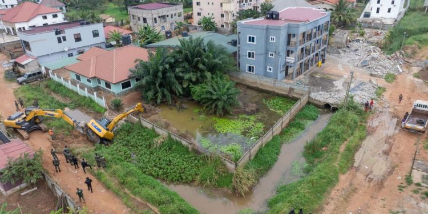
At the Tesa Dam, situated adjacent to Boundary Road in East Legon, taskforce personnel moved forcefully against illegal encroachments that had severely compromised the facility’s functionality. Developers had constructed unauthorized retaining walls and other structures directly along the dam’s banks, while squatters living in makeshift settlements had turned the surrounding area into a dumping ground for plastic waste and other refuse, resulting in heavy siltation.
Military Engineers Lead Demolition Operations
Before demolition commenced, Lieutenant Colonel Frank Osei Amponsah, Commanding Officer of the 48 Engineer Regiment, addressed affected residents in a tense but orderly gathering. He explained the operation’s purpose—to restore the waterway’s natural capacity and protect downstream communities from catastrophic flooding.
“We understand this is difficult for those affected, but the safety of thousands of residents depends on restoring these waterways to their original function,” Lt. Col. Amponsah stated, appealing for cooperation.
In a gesture of consideration, occupants were granted time to remove their personal belongings before heavy machinery moved in to demolish the illegal structures.
Dredging Operations Underway
Following the demolition of unauthorized buildings, dredging operations at the Tesa Dam commenced immediately. The dam serves as a critical flood retention basin designed to temporarily store stormwater during intense rainfall events before gradually releasing it into the broader drainage network.
However, authorities say years of neglect, combined with encroachment and indiscriminate waste dumping, have drastically reduced the dam’s storage capacity. Heavy silt deposits have raised the reservoir floor, rendering it incapable of holding the volumes of water required to prevent flooding downstream.
The dredging exercise involves removing these accumulated sediments using specialized equipment deployed by the Engineer Brigade, with the aim of restoring the dam’s original depth and storage capacity.
Officials Explain Rationale Behind Operation
Speaking to journalists at the Tesa Dam site, Brigadier General Okae-Yeboah provided a stark explanation of the flooding dynamics that necessitated the intervention.
“The fundamental problem is that people have built within the channel corridor, narrowing it significantly,” he explained. “Water cannot flow freely to the holding area downstream where it belongs. When the channel is blocked, it cannot accommodate sufficient water volume. The water backs up, and surrounding communities experience flooding.”
The Taskforce Coordinator emphasized that the exercise extends beyond demolition to include long-term monitoring and enforcement.
“After clearing the debris and completing dredging, we will establish a buffer zone where construction will be permanently prohibited. We will also require the municipal assemblies to maintain vigilance so that any attempt to encroach on these protected areas is addressed immediately,” he stated.
Government Commits to Year-Round Exercise
Minister Kenneth Adjei revealed that the dredging and desilting campaign would become a continuous, year-round initiative under a presidential directive from President John Mahama.
“The President has been clear that this cannot be a one-off exercise. What you see today is not the end—it is merely the beginning. After demolitions, we will continue dredging throughout the year so that whenever rains come, water will have adequate space to collect and flow freely. This will be sustained through all seasons,” Adjei affirmed.
He stressed that the directive aims to prevent a recurrence of the severe flooding that recently devastated communities across the Greater Accra Region, causing property damage, displacement, and loss of life.
Similar Operations Conducted Elsewhere
The Tesa Dam operation follows enforcement actions carried out on Thursday in Oyarifa and around Mayfair Gardens, demonstrating the taskforce’s coordinated approach to addressing flood risks across multiple locations.
In Oyarifa, taskforce personnel discovered that a developer had constructed an entire apartment complex directly over a natural watercourse, effectively blocking the waterway. Additionally, another developer had diverted the watercourse, altering the natural drainage pattern and increasing flood vulnerability for downstream communities. The taskforce demolished the offending structures and restored the original channel alignment.
Around Mayfair Estates, the operation targeted a concrete-reinforced bridge constructed by residents and developers that had obstructed a natural waterway. Dredging of the channel is now underway to restore its carrying capacity, with additional encroaching structures slated for demolition in the coming days.
Phase Two to Target Weija, Mallam, Laboma
Authorities have confirmed that Phase Two of the operation will address flood challenges in Weija, Mallam, and the Laboma area—all identified as critical flood zones requiring immediate intervention.
The taskforce has indicated that subsequent phases will be announced as operations progress, with the ultimate goal of restoring the integrity of all major waterways and drainage channels across the capital.
Background: A City Under Threat
Accra has experienced increasingly severe flooding in recent years, with experts attributing the worsening situation to rapid urbanization, poor waste management practices, and widespread encroachment on natural waterways. The recent floods, which affected thousands of residents and caused extensive property damage, prompted renewed calls for decisive government action.
Urban planning experts have long warned that Accra’s drainage infrastructure is inadequate for the city’s growing population and expanding built-up areas. Illegal structures erected within waterways and drainage channels have compounded the problem, reducing the capacity of natural drainage systems to handle heavy rainfall.
The government’s current operation represents one of the most comprehensive flood mitigation efforts undertaken in the capital in recent years, combining engineering interventions with enforcement actions against illegal developments.