



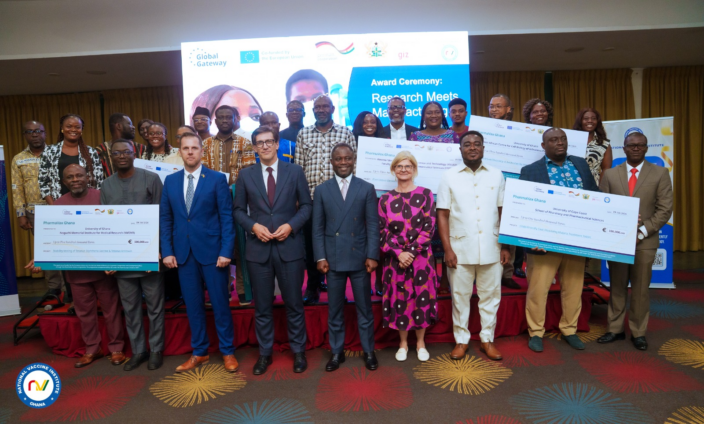
Eight research partnerships have been awarded a total of €2 million in grants under the PharmaVax Ghana programme, a bold initiative aimed at transforming Ghana into a hub for homegrown vaccine and pharmaceutical innovation. The funding, announced at a ceremony in Accra on 19 August, is designed to bridge the critical gap between laboratory discoveries and commercial manufacturing for both local and regional markets.
The winning projects span a diverse array of pressing health challenges, including the development of child-friendly malaria medicines, plant-based therapies for chronic non-communicable diseases, and the deployment of artificial intelligence to accelerate the discovery of antibodies against malaria and Mpox. These priorities reflect Ghana’s heavy disease burden—malaria remains a leading cause of child mortality, while Mpox outbreaks have highlighted the continent’s vulnerability to emerging pathogens.
A Strategic Push for Local Manufacturing
The PharmaVax Ghana programme is jointly funded by the German Federal Ministry for Economic Cooperation and Development (BMZ) and the European Union, with implementation led by the German development agency GIZ in partnership with Ghana’s National Vaccine Institute (NVI). Beyond the €2 million in seed funding, the programme offers extensive technical assistance, networking opportunities, and commercialisation support to ensure that promising research translates into tangible health products.
Significantly, Ghanaian partner institutions are contributing an additional €425,000 in counterpart funding, underscoring the country’s strong ownership of the initiative. The NVI, established under the government’s broader push for vaccine self-sufficiency following the COVID-19 pandemic, has been tasked with coordinating local research and fostering public-private collaboration to reduce dependence on imported medicines.
Rigorous Selection Process
The eight awardees were chosen from a competitive pool of 43 applications, following a call for proposals jointly organised by the NVI and GIZ. An independent committee of nine Ghanaian experts assessed each submission on four key criteria: technical merit, potential public health benefit, active involvement of a local manufacturing partner, and long-term financial and operational sustainability. This rigorous vetting process ensures that only the most viable and impactful projects receive backing.
High-Level Support and Regional Ambition
The award ceremony drew a distinguished gathering of government officials, academics, and industry stakeholders. Health Minister Kwabena Mintah Akandoh delivered remarks reaffirming the government’s commitment to achieving self-reliance in critical health supplies. German Ambassador to Ghana, Frederik Landshöft, lauded the partnership as a model for sustainable development cooperation, while Jonas Claes, Chargé d’affaires at the EU Delegation to Ghana, emphasised the EU’s unwavering support for strengthening African health systems.
The grants come at a pivotal moment for Ghana’s pharmaceutical sector. With the African Continental Free Trade Area (AfCFTA) now operational, locally manufactured vaccines and drugs could find ready markets across the continent, reducing Africa’s reliance on external suppliers—currently estimated to supply over 70% of the continent’s medicines. PharmaVax Ghana is thus not merely a research fund; it is a strategic investment in long-term health sovereignty, economic diversification, and the creation of high-skilled jobs in Ghana’s burgeoning life sciences industry.
As the eight projects move from benchtop to bedside, the programme’s success could serve as a blueprint for other African nations seeking to build resilient, locally-led pharmaceutical ecosystems.


