



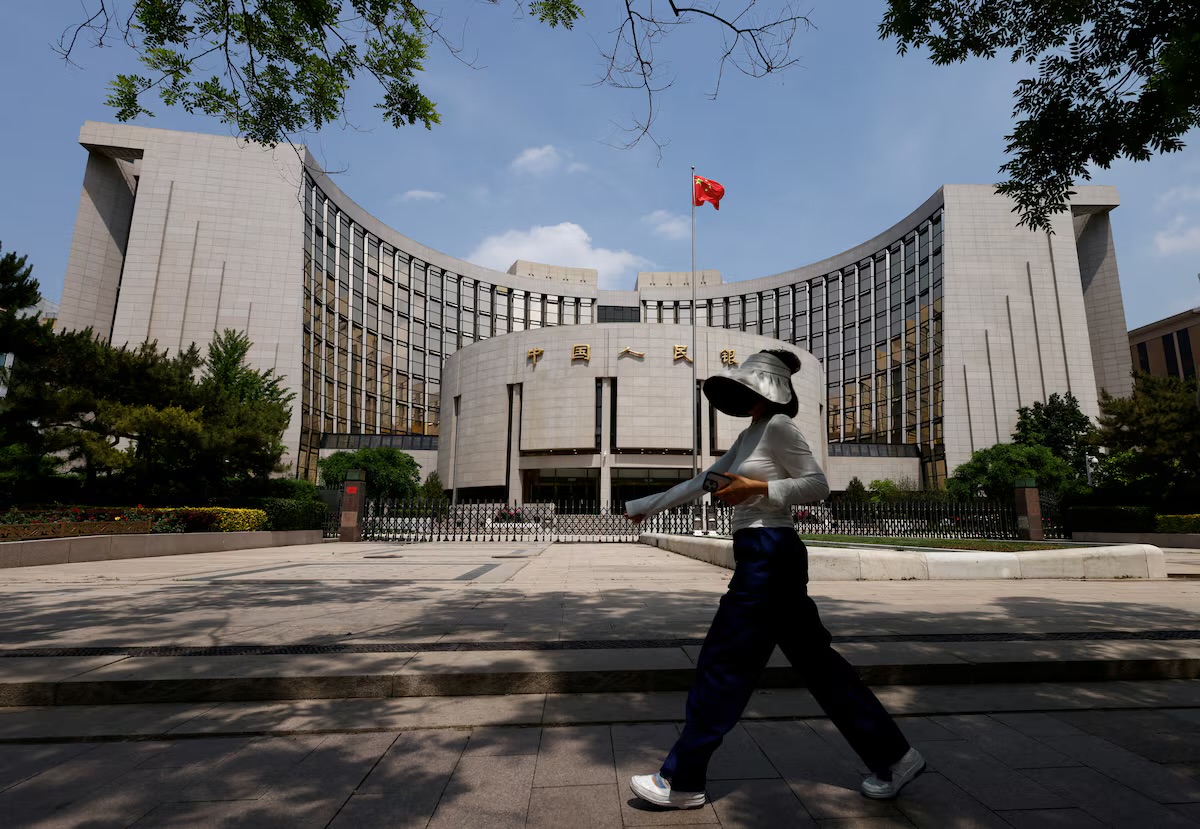
China is widely expected to leave its benchmark lending rates unchanged for the 15th consecutive month at Thursday’s fixing, a Reuters survey showed, even as a raft of July data pointed to renewed softening in domestic demand across the world’s second-largest economy.
All 25 market participants polled this week projected that the one-year loan prime rate (LPR) and the five-year LPR would remain at 3.00% and 3.50%, respectively. The LPR, which serves as the reference for banks’ most creditworthy corporate and household borrowers, is calculated monthly based on quotes from 20 designated commercial banks and the People’s Bank of China’s (PBOC) medium-term lending facility rate.
Weak July Data Underscore Demand Shortfalls
The expectation of a steady LPR comes on the heels of disappointing economic indicators for July. Industrial output growth slowed to 4.5% year-on-year, below the 4.8% forecast and down from June’s 5.3%. Retail sales expanded by a mere 0.6%, sharply missing the 1.3% consensus and marking a continued deceleration from 1.0% in the previous month. Fixed-asset investment contracted 6.7% in the first seven months, worse than the projected 6.1% decline.
Credit data also showed flagging appetite. New yuan loans unexpectedly turned negative in July, with a net reduction of 340 billion yuan (about $47 billion), compared with a modest increase in the same period last year. Analysts attributed the slump to weak corporate medium- and long-term borrowing and softer consumer credit demand, reflecting broader caution among both businesses and households.
Exports remained a rare bright spot, rising 23.9% year-on-year in July, though that too eased from June’s pace. The overall picture suggests that the recovery is losing momentum, with only the external sector still providing meaningful support.
Fiscal Spending Takes Priority Over Monetary Easing
Against this backdrop, policymakers appear more inclined to lean on accelerated fiscal implementation rather than further monetary loosening in the near term, analysts said.
“The focus should remain on fiscal policies, with little sign of an outright LPR cut from the PBOC this month,” Citi strategists wrote in a note.
The signal was reinforced at the July 30 meeting of the Politburo, China’s top decision-making body, where leaders pledged to shore up the slowing economy by speeding up the disbursement of already-budgeted funds for infrastructure projects in the second half of the year, rather than unveiling major new stimulus packages. The meeting also reiterated a commitment to a “more proactive” fiscal policy and a “moderately loose” monetary stance, but stopped short of calling for explicit rate or reserve-requirement cuts.
The PBOC echoed that tone in its second-quarter monetary policy report released on August 12, saying it would maintain appropriately loose conditions and roll out practical measures as needed, but offered no clear guidance on imminent policy rate adjustments or reserve-requirement ratio reductions.
Bank Margins Show First Quarterly Uptick Since 2022
One factor constraining the central bank’s room for rate cuts is the persistently thin net interest margin (NIM) of commercial banks. According to the National Financial Regulatory Administration, the sector’s NIM edged up 0.01 percentage point to 1.41% in the second quarter from 1.40% at end-March – the first quarterly increase since 2022. Still, that level remains near a record low, limiting banks’ ability to absorb further reductions in lending yields.
Analysts noted that the modest improvement in NIM was largely driven by falling deposit costs, as high-interest time deposits matured and were re-priced at lower rates. However, weak loan demand continued to weigh on asset-side returns, partly offsetting the benefit.
Rates on Hold, but Market Watching for Future Moves
With LPRs unchanged for 14 straight months, economists widely view the current stance as a wait-and-see approach. Market participants say the central bank is closely monitoring external risks, including potential trade headwinds and global monetary policy shifts, before deciding on its next move. If overseas demand weakens significantly or domestic growth shows further signs of stress, a rate cut could be back on the table later this year.
Meanwhile, the PBOC is pushing ahead with interest-rate reform. The latest policy report highlighted efforts to expand the use of DR (deposit institution bond repurchase rate) as a benchmark for loan pricing, moving away from the traditional single anchor of LPR. That shift is seen as a long-term step toward a more market-driven interest-rate system, though it is unlikely to alter the immediate LPR decision.
The LPR fixing will be announced on Thursday morning. Market participants will be watching not only the numbers but also any accompanying statement from the PBOC that might signal a change in its policy trajectory.


