



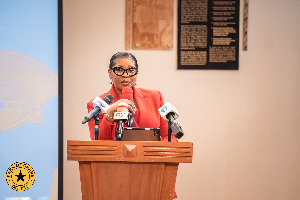
The Bank of Ghana has thrown its weight behind a restructured framework for the Committee of Law Enforcement Agencies and Banks (COCLAB), as the country moves to strengthen its defences against financial crime amid a sharp rise in fraud.
Matilda Asante-Asiedu, Second Deputy Governor of the Bank of Ghana, endorsed the revised architecture at the 2026 COCLAB Technical Committee workshop held in the Eastern Region. The new structure establishes two working groups focused on public awareness, information sharing and investigations, with a steering committee of heads of member institutions providing strategic direction.
From newsroom to central bank
Asante-Asiedu’s own career reflects an unusual breadth of experience. She was appointed Second Deputy Governor by President Mahama in April 2025 under the Bank of Ghana Act, becoming the third woman to hold the position.
Before joining the central bank, she served as Group Head of Retail Banking at Access Bank Ghana, where she led the “W Initiative” supporting women entrepreneurs and partnered with MTN on digital lending programmes. Her career began in journalism — she worked as a reporter and editor at Joy FM and JOYNEWS from 1997 to 2009, and also spent time at BBC World Service. She holds an MBA in Marketing from GIMPA Business School, an MA in Journalism from Cardiff University, and qualified as a Chartered Banker in 2024.
Fraud figures sound the alarm
In her remarks, Asante-Asiedu disclosed stark figures: fraud cases in Ghana’s financial ecosystem rose from 16,733 in 2024 to 24,778 in 2025 — a 48 per cent increase — while digital fraud incidents climbed 98 per cent between 2022 and 2025.
She warned that Ghana must tighten its financial crime controls to avoid being returned to the Financial Action Task Force (FATF) grey list. “We definitely do not want to go back to the grey list,” she said.
Success measured by outcomes, not meetings
Asante-Asiedu was explicit that COCLAB’s effectiveness should not be judged by activity alone. “Success should not, and cannot, be measured by how many committee meetings we hold or how many technical reports we produce,” she said. “It should be measured by stronger intelligence sharing, successful investigations and prosecutions, asset recovery, improved regulatory compliance, greater customer awareness, and a quantifiable reduction in financial crime.”
She acknowledged past enforcement wins, including the arrest of 430 illegal online operators in a 2023 intelligence-led operation and the 10-year conviction of a bank employee who embezzled GHS 1.2 million.
“We should be so efficient that when fraudsters are planning their next move, they think, ‘Oh my God, what if these people catch me?’ — that is deterrence,” Asante-Asiedu said.


