



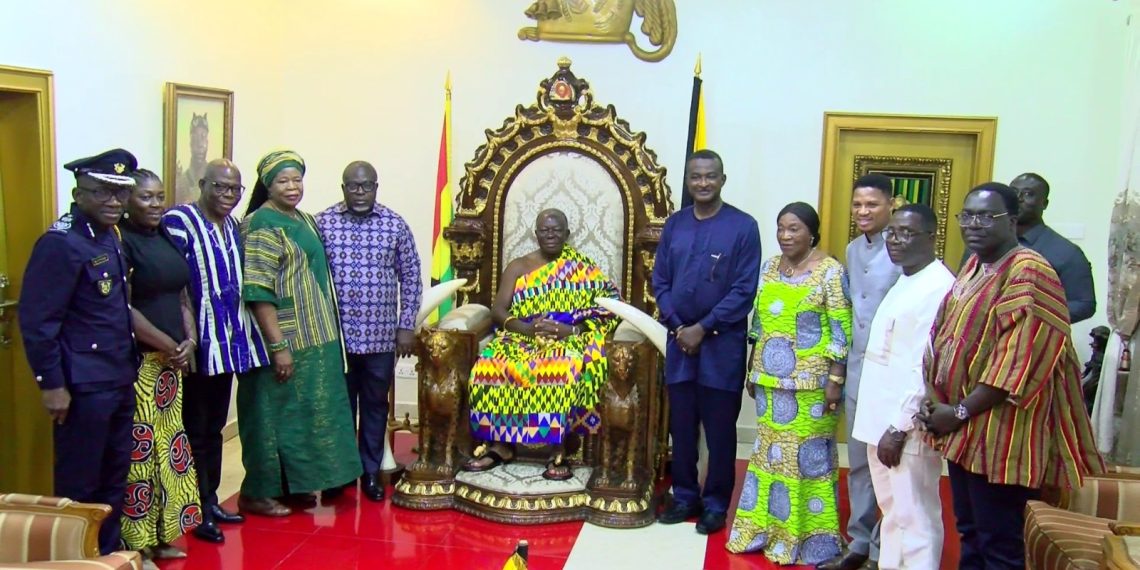
The Asantehene, Otumfuo Osei Tutu II, has issued a sweeping directive to the Ghana Revenue Authority (GRA), urging the tax collector to aggressively expand its net to capture the nation’s vast informal sector. Hosting the GRA Board and management at the Manhyia Palace on Friday, the traditional ruler emphasized that domestic revenue mobilization must replace the country’s historical reliance on external borrowing to fund development.
While commending the current administration for measurable upticks in collection efficiency, Otumfuo Osei Tutu II cautioned that systemic leakages persist, demanding “innovative and unconventional” strategies to seal them.
‘Untapped Goldmine’ in the Informal Economy
In his address, the Asantehene turned a critical lens on the formal-informal divide, noting that salaried workers in the public and corporate sectors bear a disproportionate tax burden.
“The focus has always been on workers in the formal sector, while there are many others in the informal sector who can be educated on the need to pay taxes to support national development,” he stated.
He specifically pinpointed artisans and tradespeople—hairdressers, mechanics, and commercial drivers—as a massive untapped revenue pool. Crucially, the Asantehene proposed integrating these groups through community-based cooperatives. This suggestion carries significant cultural resonance in Ghana, mirroring the longstanding indigenous Susu savings and micro-finance structures. By organizing into cooperatives, these informal operators can be systematically registered, making tax compliance a communal rather than punitive exercise—an approach that leverages traditional social trust networks.
Fiscal Pressures and the IMF Context
The call comes as Ghana navigates a stringent International Monetary Fund (IMF) bailout program, which has placed immense pressure on the government to boost domestic revenues and reduce the fiscal deficit. According to recent Ghana Statistical Service data, the informal sector accounts for over 70% of the nation’s workforce yet contributes a disproportionately minuscule fraction of total tax revenue. Analysts have long warned that without formalizing this sector, Ghana’s debt sustainability targets remain elusive.
Reforms and Stakeholder Friction
Responding to the Asantehene’s charge, GRA Board Chairman Ricketts Hagan acknowledged the authority’s modernization drive, particularly the rollout of new digital systems, including the Publican AI platform. This AI-driven solution is designed to enhance tax compliance and detect evasion patterns.
However, the transition has not been frictionless. Hagan admitted to public skepticism, referring to the “noise” over the new system’s comprehension and implementation. “I’m sure you heard noise about not being able to comprehend, but people are beginning to understand the system,” he assured the gathering.
A Commissioner-General of the GRA, also present, outlined additional reforms aimed at streamlining administration, while reiterating a plea for public cooperation.
The Weight of Traditional Authority
In Ghanaian cultural context, the Asantehene’s intervention is significant. As the custodian of the Golden Stool, his moral authority extends far beyond the Ashanti Region, influencing national discourse. His endorsement of the GRA’s mission—and his direct appeal to grassroots artisans—acts as a powerful legitimization of fiscal policy. By urging the tax authority to “strengthen measures” and address leakages, the King is effectively bridging traditional governance with modern statecraft, signaling that tax compliance is not merely a legal obligation but a patriotic duty for national self-reliance.
The GRA is now expected to leverage this royal backing to intensify public sensitization campaigns in the informal sector, potentially rolling out pilot cooperative tax registration schemes in the Ashanti Region before a national rollout.


