



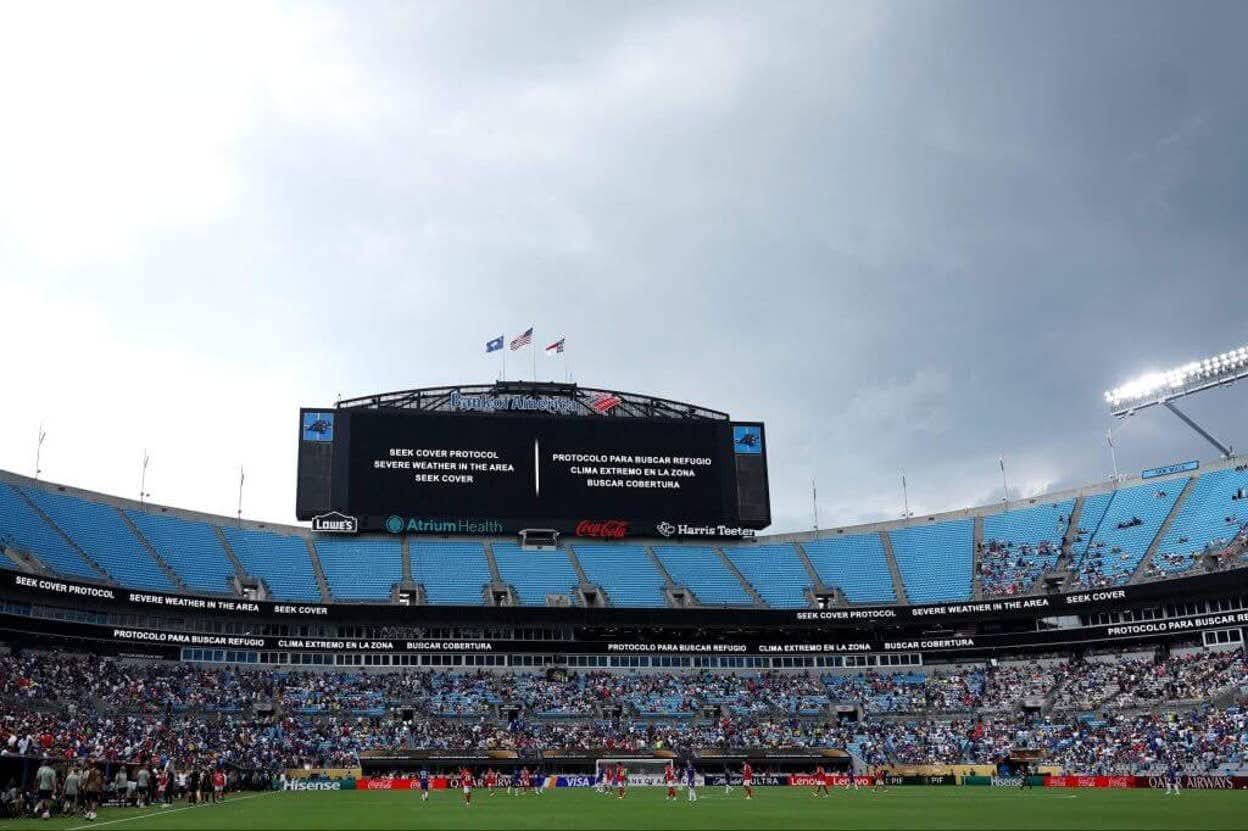
As the FIFA 2026 World Cup kicks off across North America, tournament organizers are facing an unexpected threat that has nothing to do offside traps or penalty shootouts — the volatile summer thunderstorms of the United States.
Due to strict U.S. safety regulations that FIFA cannot override, matches at this summer’s tournament could face indefinite delays lasting several hours if lightning is detected near stadiums, raising logistical nightmares for teams, broadcasters, and the 5 million fans expected to attend .
The ‘30-Minute Reset’ Nightmare
Under the U.S. thunderstorm protocol, which is enforced by local legislation and OSHA obligations, the moment a lightning strike is detected within an eight-mile radius of a stadium, play is immediately suspended .
Players and match officials are rushed off the pitch to their dressing rooms, while fans in the stands must be evacuated to sheltered areas inside the venue. Unlike rain delays common in other parts of the world, the resumption of play is not determined by when the rain stops, but by a strict, unrelenting clock .
Once a strike is detected, a 30-minute countdown clock begins. Play can only resume if that entire 30-minute window passes without another lightning strike. However, if a single lightning bolt strikes within that radius at 29 minutes and 59 seconds, the clock resets to zero. This cycle repeats indefinitely until the sky clears .
“Although FIFA is not responsible for U.S. thunderstorm protocol, nor can they override it, this could lead to World Cup fixtures being delayed for hours,” a recent analysis of the regulations noted .
A Glimpse of the Chaos
For a preview of the potential chaos, one need only look to last summer’s Club World Cup. A match held in Charlotte, North Carolina — one of the 16 host cities for 2026 — was delayed for nearly two hours due to severe weather. The match ultimately stretched past the four-and-a-half-hour mark .
With the 2026 tournament taking place during the peak of the North American summer, meteorologists warn that the threat is widespread. Host cities such as Miami, Kansas City, Philadelphia, and the New York/New Jersey region are particularly susceptible to the “pop-up” thunderstorms that characterize the season .
Florida is statistically the lightning capital of the United States, meaning a knockout match in Miami could theoretically be frozen indefinitely by a passing storm system .
The Indoor ‘Safe Havens’
For fans hoping to avoid the weather lottery, only a handful of venues offer guaranteed protection. The 16 host stadiums are predominantly open-air, leaving them vulnerable to the elements.
The four stadiums equipped with fixed or retractable roofs — AT&T Stadium (Dallas), Mercedes-Benz Stadium (Atlanta), NRG Stadium (Houston), and SoFi Stadium (Los Angeles) — will effectively be immune to the lightning rule, providing a safe haven for matches scheduled there .
The ‘No Cut-Off’ Point Loophole
Complicating matters further is a regulatory gap. Unlike time limits for other types of delays, FIFA does not currently have a specific regulation that stipulates how long a weather delay must last before a match is officially abandoned or postponed .
Because postponing a game creates massive scheduling conflicts in a 48-team tournament spread across three time zones, FIFA has remained vague on what happens if a storm lasts for three, four, or five hours. The governing body has stated it will assess situations on a “case-by-case basis” .
Contingency Plans
In response to the growing concern, FIFA has attempted to reassure stakeholders. The organization’s emergency preparedness team is meeting regularly with meteorological authorities in the United States, Canada, and Mexico.
“Stadiums are required to maintain robust risk management and evacuation procedures, including lightning and severe weather protocols aligned with local legislation,” FIFA stated last month. The organization added that it would be monitoring conditions in real-time and is ready to apply “established contingency protocols” should extreme weather occur .
For now, as the world turns its eyes to North America, the weather forecast — and the lightning detector — have become just as important as the final score.


