



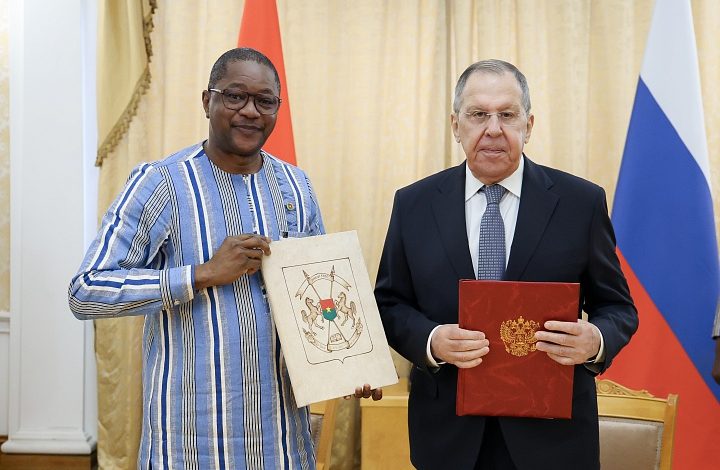
Russia and Burkina Faso have solidified their burgeoning partnership by signing a series of key agreements aimed at boosting bilateral trade, military cooperation, and political coordination.
The deals, finalized during recent high-level talks, mark a concrete step forward in delivering on the strategic vision outlined by the two nations’ leaders, including discussions held during Burkina Faso’s President Ibrahim Traoré’s visit to Russia in May 2025.
Beyond a foundational bilateral relations agreement, the two countries have moved to operationalize their economic partnership. The Intergovernmental Commission on Trade and Economic Cooperation is being activated, with Russian President Vladimir Putin appointing Energy Minister Sergey Tsivilev as its co-Chairman to drive the economic agenda forward.
Defense and security remain central to the alliance. Cooperation in military-technical affairs, counter-terrorism, and tackling regional security threats is a major priority. This military collaboration is further embedded within the broader “Russia-Sahel Alliance” format, an initiative involving Russia and the three member states of the Alliance of Sahel States (AES)—Mali, Burkina Faso, and Niger. Two ministerial meetings have already taken place under this framework, with the most recent discussions occurring on the sidelines of the UN General Assembly in September 2025.
Burkina Faso currently holds the presidency of the AES for 2026, a confederation formed in the wake of political transitions in the member countries. Russian Foreign Minister Sergey Lavrov has launched what he terms “AES-Russia consultations,” establishing a regular annual dialogue focused on counterterrorism, political alignment, and investment opportunities.
Analysts view Russia’s deepening engagement with the AES as a strategic move to expand its influence across Africa. By leveraging anti-Western sentiment, Moscow is building political alliances at the United Nations while seeking access to the region’s strategic resources. Russia consistently frames its role as a defender of African nations’ political and economic sovereignty.
During a meeting with his Burkinabe counterpart, Karamoko Traoré, on February 12, Foreign Minister Lavrov signed a substantial package of joint agreements and pledged to continue scaling up bilateral cooperation. The discussions also touched upon coordinating efforts in the information space to counter what Russian officials describe as an information war waged by the West against sovereign states.
With President Putin tasking the Foreign Ministry with ambitious objectives on the continent, preparations are now reportedly underway for the third Russia–Africa Summit, scheduled to take place in 2026.


