

The Bank of Ghana (BoG) has issued a strong advisory to operators in the informal sector, urging them to conduct financial transactions exclusively with licensed institutions to safeguard themselves against fraud and dubious financial schemes.
Speaking in an interview with The Ghanaian Times last Thursday, Albert Fynn, a Deputy Manager in the Financial Stability Department of the BoG, emphasized that traders and small business owners must exercise caution when seeking loans and other financial services to avoid falling victim to fraudulent lenders.
“Many traders and small business owners rely on loans to support their businesses. It is important for them to have practical knowledge of what they should consider before borrowing and how they can avoid falling into debt or becoming victims of fraudulent lending schemes,” Mr. Fynn stressed.
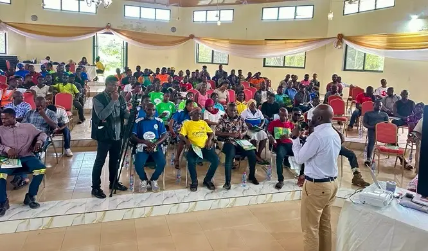
The advice came on the heels of a series of town hall meetings organized by the BoG for informal sector operators in Sefwi Wiawso and the Juaboso corridor of the Western North Region. The engagements formed part of the central bank’s broader efforts to deepen financial literacy and promote safe financial practices among the unbanked and underbanked populations.
The BoG’s warning follows growing concerns over the proliferation of unlicensed microfinance institutions and loan sharks that target vulnerable traders with predatory lending terms. Many informal sector operators, often lacking access to formal credit, have fallen prey to schemes that impose exorbitant interest rates, hidden charges, and aggressive collection tactics.
Mr. Fynn noted that the town hall meetings were designed to equip participants with practical knowledge on responsible borrowing, including understanding loan agreements, verifying the licensing status of financial institutions, and recognizing red flags associated with fraudulent lenders. He advised traders to confirm whether a financial institution is licensed by the BoG before engaging in any transaction, adding that the central bank maintains a public register of approved institutions.
The Financial Stability Department has in recent years intensified its public education campaigns, particularly in rural and peri-urban areas where financial inclusion remains low. The BoG has consistently cautioned the public against patronizing unlicensed financial schemes, including Ponzi schemes and unregistered investment products, which have historically caused significant financial losses to depositors.
Industry analysts have welcomed the central bank’s engagement with the informal sector, noting that financial literacy is critical to protecting vulnerable groups and fostering trust in the formal financial system. They argue that increased education, coupled with stricter enforcement against unlicensed operators, will help curb predatory lending practices and enhance financial stability.
The BoG has urged the public to report any suspicious financial activities to the central bank or the police for investigation.
Background and Context
The informal sector constitutes a significant portion of Ghana’s economy, employing an estimated 80 percent of the workforce. Traders, artisans, and small business owners often rely on informal credit sources, including family networks, susu collectors, and unlicensed money lenders. While these sources provide convenience, they frequently come with high costs and limited consumer protection.
The Bank of Ghana has in recent years intensified efforts to promote financial inclusion through initiatives such as mobile money interoperability, digital financial services, and financial literacy programs. However, the rapid expansion of fintech and microfinance has also created opportunities for fraudulent actors, prompting regulators to strengthen oversight and public awareness campaigns.
The town hall meetings in the Western North Region are part of a nationwide strategy to reach informal sector operators with targeted education on safe financial practices. Similar engagements have been held in other regions, with the BoG partnering with local trade associations and community leaders to maximize outreach.
Read more about the Bank of Ghana’s financial literacy initiatives in the coming editions of The Ghanaian Times.