

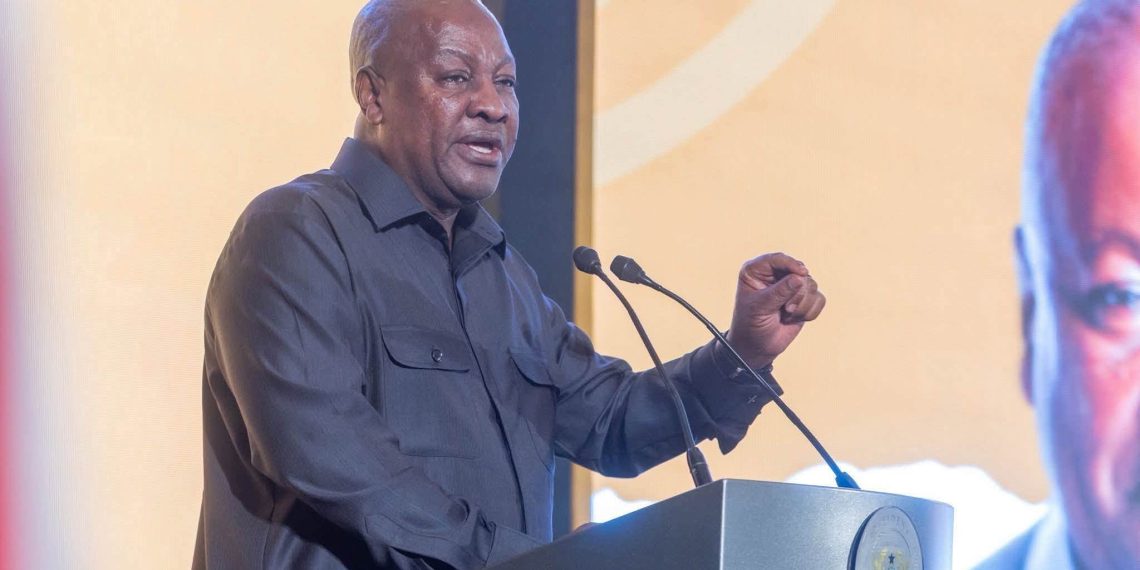
President John Dramani Mahama has urged investors from around the world to explore opportunities in Ghana, assuring them that the country remains open to partnerships with all nations regardless of their political and economic affiliations.
Speaking at the Financial Times Africa Summit 2026 in London, Mahama said Ghana’s foreign policy of non-alignment continues to guide its international relations, allowing the country to maintain friendly ties with different countries while pursuing investment opportunities that promote economic growth and deliver mutual benefits.
The President stressed that Ghana was not interested in choosing sides in the competition among global powers but rather in attracting investments that would contribute to its development. He emphasised that the central consideration for Ghana is not which country an investor comes from, but whether the investment can generate fair returns for both the investor and the country.
“We are friends to all and enemies to none. And Ghana’s policy of non-alignment has served us well and so we welcome investors from all over the world. It is not about competition. It is about investment and a fair return to everybody, including ourselves,” he said. “And so that is the condition. There is no competition. We are as friendly to America, to EU, to China, and to Russia.”
Summit Background and Ghana’s Economic Agenda
The 13th Financial Times Africa Summit was held at the Landmark in London on October 21–22 under the theme “Mobilising Growth in a New Global Order,” bringing together African heads of state, global business executives, and institutional investors.
Mahama’s London visit is part of a broader international itinerary. Following the summit, he was scheduled to travel to Bahir Dar, Ethiopia, to chair the 12th High-Level Forum on Security in Africa in his capacity as Chair of the Tana Forum, and to present the State of Peace and Security in Africa report on October 24.
At the summit, Mahama outlined several key directions for Ghana’s economic transformation. He said Ghana had successfully completed its International Monetary Fund programme and transitioned from the Extended Credit Facility to the Policy Coordination Instrument (PCI), meaning there would be no external financing support, making domestic resource mobilisation and prudent fiscal management critical. The government is implementing a five-year, $10 billion “Big Push” infrastructure programme, allocating $2 billion annually, starting with road construction and expanding to schools, hospitals, and irrigation projects.
On minerals policy, Mahama set a target to halt the export of raw minerals by 2030 and called on investors to partner with Ghana in establishing an alumina refinery to capture more value-chain value domestically.
Historical Roots and Contemporary Practice of Non-Alignment
Ghana’s non-aligned stance is not a personal position of Mahama’s but is rooted in the diplomatic legacy of the country’s first president, Kwame Nkrumah. Nkrumah’s declaration at the height of the Cold War that “we face neither East nor West; we face forward” became the defining expression of Ghana’s independent foreign policy. In August this year, Mahama called for a revival of the Non-Aligned Movement at its 65th anniversary commemoration in Belgrade, emphasising that non-alignment should not be understood as silent indifference to injustice and conflict.
Analysis by Chatham House notes that amid intensifying great-power rivalries, Ghana is shifting from traditional “active non-alignment” toward a strategy of “multi-alignment,” leveraging diversified partnerships to advance national and continental interests.
Beyond Investment: Regional Security and Diplomatic Mediation
Mahama also addressed regional security at the summit. He called on the Alliance of Sahel States (AES) to open counter-terrorism cooperation to international partners, citing Ghana’s intelligence-sharing and joint training arrangements with the United Kingdom, Germany, France, and the United States as a model of effective cooperation. He said West Africa needs a new regional cooperation framework to address security challenges.
On diplomatic mediation, Mahama disclosed that he would attempt to persuade Russian President Vladimir Putin to agree to a ceasefire at the upcoming Russia-Africa Summit. “I will go to Russia for the summit and, if I can, try to persuade President Putin to cease fire,” he said.
Mahama’s London remarks conveyed a clear message: in a context of intensifying global power competition, Ghana chooses to place economic development above geopolitical alignment. Whether this strategy delivers the investment inflows and job creation the country expects will depend on international capital’s confidence in Ghana’s policy continuity and business environment—a confidence that must ultimately be tested in the delivery of concrete projects and returns.