



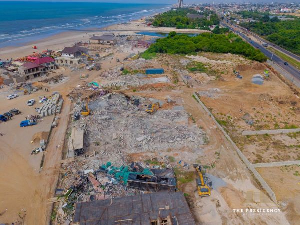
The Social Security and National Insurance Trust (SSNIT) has outlined what the proposed redevelopment of the Labadi beachfront means for residents of La and neighbouring communities, saying the project will create jobs, support local businesses and expand economic opportunities in the area.
In a background document on the project, SSNIT said the redevelopment aims to transform the beachfront into an organised leisure and tourism destination with restaurants, beach lounges, water sports, wellness facilities, retail outlets and landscaped recreational spaces. The project is expected to shift economic activity in the area from fragmented informal operations towards a more organised local economy, creating opportunities for residents to benefit from the tourism value chain.
According to SSNIT, these opportunities could include employment, supplying goods and services, and establishing businesses linked to tourism and leisure activities. Young people from Labadi and neighbouring communities will be considered for employment arising from the development and subsequent operations of the enclave, subject to relevant recruitment requirements.
A New African Market and Reintegration Plans
The Director-General of SSNIT, Mr Kwasi Afreh Biney, has said the Trust has begun documenting traders and workers displaced by the recent demolition of structures along the Labadi beachfront, with plans to provide alternative trading space before Christmas.
Speaking on JoyNews’ Newsfile programme on Saturday, October 10, 2026, Mr Afreh Biney said a committee had been set up to gather detailed information on affected persons — including hotel staff, food vendors, artisans and independent traders — to determine appropriate support and reintegration measures.
“We set up a committee to work together on the matters to be addressed,” he said. “How do we settle especially some of our young folks who had opportunity to work there, whether as employees or entrepreneurs?”
He noted that the two SSNIT-owned hotels — Labadi Beach Hotel and La Palm Royal Beach Hotel — would consider absorbing some displaced workers as part of their new operational plans. For traders and small business operators, the revised beachfront design includes a dedicated African market for Ghanaian and African food, crafts and artefacts. A new Meetings, Incentives, Conferences and Exhibitions (MICE) centre is also planned for the nearby La Trade Fair site.
Mr Afreh Biney added that SSNIT would fast-track clearing debris, restoring access routes, and providing washrooms and other essential facilities to enable operators to resume business activities before the Christmas season.
Background: The Demolition and Its Aftermath
The redevelopment plans follow the controversial demolition of structures at La Pleasure Beach and the adjoining Polo Beach Club in the early hours of Friday, October 2, 2026. A joint team of military and police personnel, including personnel from the 48 Engineer Regiment of the Ghana Armed Forces, carried out the exercise.
SSNIT had sought the urgent intervention of the National Security Council Secretariat to address what it described as persistent unlawful occupation, encroachment and unauthorised activities on the beachfronts directly in front of the two hotels. The Trust listed several risks posed by the continued encroachment, including threats to the safety and security of hotel guests, employees and visitors; unauthorised access to sensitive guest areas; increased exposure to fire, sanitation and public health hazards; degradation of the coastal ecosystem; and reputational damage to the hotels and Ghana’s tourism industry.
The demolition drew strong reactions. The Member of Parliament for La Dadekotopon, Mrs Rita Naa Odoley Sowah, confronted military personnel at the site, saying she had been assured by authorities that structures around the Labadi Beach Hotel would not be demolished. NPP flagbearer Dr Mahamudu Bawumia condemned the demolition as “wanton” and pledged to rebuild the beach economy if elected, calling on the government to compensate affected traders, artisans and small business owners.
Land Ownership Dispute
The La Traditional Council has challenged SSNIT to produce official documents proving ownership of the disputed La beachfront land. SSNIT has claimed the land was acquired by the government in 1967 for the development of the Trade Fair and the two hotels.
The 4th La Shikitele, Nii Adjei Koofe IV, said the Council, as a traditional landowner and major stakeholder, should have been informed before the exercise. He said the Council has since held discussions with SSNIT, management of the Labadi Beach Hotel and National Security over the matter. The Council is expected to establish a committee to examine SSNIT’s redevelopment proposals and help find an acceptable resolution.
Mr Freddie Blay, former National Chairman of the NPP, has disputed SSNIT’s claim, insisting the land for the Polo Beach Club was legally acquired from the La Traditional Council by his son. He said the La Traditional Council has indicated that several operators in the area pay rent to the traditional authorities.
Compensation Committee Established
The government has announced plans to establish a committee to determine compensation packages for people affected by the demolition. The Member of Parliament for La Dadekotopon and Deputy Minister for Local Government, Chieftaincy and Religious Affairs, Mrs Rita Naa Odoley Sowah, revealed that a committee would be established to determine appropriate compensation for people whose businesses and property were affected.
The proposed compensation committee is expected to examine the circumstances surrounding the affected properties and determine appropriate compensation packages.
Commitment to Stakeholder Engagement
SSNIT acknowledged that the people of La and surrounding communities have a legitimate interest in the future of the beachfront, given its significance to their traditional and residential environment. The Trust stressed the importance of engaging chiefs, traditional authorities, community leaders and residents to explain the project’s objectives, address concerns and identify practical ways for local people to participate in the redevelopment.
“The success of the redevelopment will depend, in part, on meaningful engagement with the people who live and work in the area,” SSNIT said, adding that the engagements would help identify opportunities for local participation and ensure the community understood how it could benefit.
Public Beach to Remain Accessible
SSNIT has assured the public that the beachfront will remain accessible as a public beach despite the redevelopment plans. “The beachfront will remain a public beach,” the Trust said, noting that the project would focus on restoring the area into a cleaner, safer and properly managed environment, with attention to sanitation, environmental management, security, accessibility and the overall visitor experience.
“For SSNIT, the ultimate objective is to transform the area into an asset that works better for Ghana — for visitors, the surrounding community, the tourism industry and, importantly, for members whose contributions underpin the Scheme,” the Trust said.
SSNIT also stressed that the properties being protected and redeveloped form part of its investment portfolio, which ultimately belongs to workers and pensioners whose contributions underpin the Scheme. “These assets belong to the workers and pensioners whose contributions form the foundation of the Scheme,” SSNIT said, adding that its responsibility was to ensure that they were “properly protected, managed and developed” to generate sustainable returns for members.


