



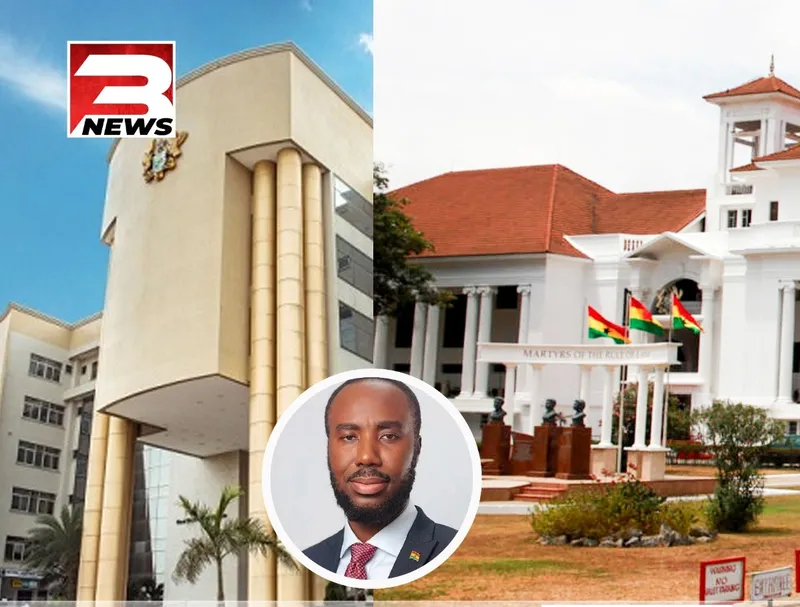
The prosecution in the GH¢49.1 million cybersecurity software theft trial has urged the High Court to dismiss a submission of no case to answer by former National Signals Bureau Director-General Kwabena Adu-Boahene, his wife Angela Adjei Boateng, and their company, Advantage Solutions Limited.
In an affidavit opposing the submission, Deputy Attorney-General Dr. Justice Srem-Sai argues that the evidence led by the prosecution is sufficient to require the accused persons to open their defence. The filing was made pursuant to an order of the High Court dated September 8, 2026.
The case, one of Ghana’s high-profile state-funds prosecutions, centres on three cheques totalling GH¢49.1 million allegedly diverted from funds intended for the Bureau of National Communications (BNC) into a privately owned bank account and spent on the accused, their families, friends and associates.
Adu-Boahene, Boateng and Advantage Solutions Limited face charges of stealing, conspiracy to steal, defrauding by false pretences, wilfully causing financial loss to the State, using public office for profit, obtaining public property by false statements, and money laundering, including conspiracy to commit money laundering. They were arraigned on April 30, 2025. The charges remain allegations, and no final judicial findings have been made.
According to the prosecution, Adu-Boahene, who was then Director of the Bureau of National Communications, deposited a cheque for GH¢27.1 million on February 6, 2020, into an account at Universal Merchant Bank (UMB). The account was held in the name of BNC Communications Limited – Operations. However, the prosecution says the account-opening documents identify the owner as BNC Communications Bureau Limited, a private company it refers to as the “Private BNC.”
Two additional cheques — for GH¢1 million and GH¢21 million — were later deposited into the same account, bringing the total to GH¢49.1 million, the Republic alleges. Although the cheques were intended for “BNC – Operations,” the prosecution says the money ended up in an account belonging to the private company.
The prosecution further states that the private company was owned and controlled by the accused persons. Advantage Solutions Limited was its sole shareholder, Adu-Boahene and his wife were directors, and Boateng was identified as the sole beneficial owner of Advantage Solutions Limited.
Central to the case is the alleged purchase of a cyber defence system. The prosecution says that on February 6, 2020, Adu-Boahene requested the transfer of GH¢9,537,500 from the private account, explaining that the money was intended to purchase a cyber defence system. He presented a sale contract and an invoice as supporting documents, after which UMB approved the transfer.
However, the prosecution says the National Signals Bureau has denied having a contract with ISC Holdings Limited in January 2020 for the supply of such a system. It also relies on testimony from the bureau’s Director of Finance, identified in the filing as the second prosecution witness, who told the court that the invoice number cited by the accused persons differed from the bureau’s records. The witness said the bureau’s corresponding invoice was dated March 30, 2020, and related to the purchase of a digitised investigative audit system — not a cyber defence system.
The prosecution further points to the bureau’s inventory, which it says shows that no such cyber defence system was purchased or delivered to the agency. Two prosecution witnesses described the sale contract and invoice relied on by the accused persons as not genuine, according to the filing.
The Republic also alleges that the GH¢49.1 million was spent on the accused persons and people connected to them, with the account balance reduced to GH¢683,609.65 by August 3, 2020. The prosecution says the funds were not used for official transactions.
The prosecution’s account is set out in its affidavit in opposition to the no-case submission. Such submissions are typically made at the close of the prosecution’s case, asking the court to dismiss the charges on the basis that the prosecution has not produced enough evidence for the accused to answer. The prosecution contends that the evidence already before the court meets that threshold.
The High Court is expected to rule on whether the accused have a case to answer. Until then, all allegations remain unproven, and the accused are presumed innocent.


