



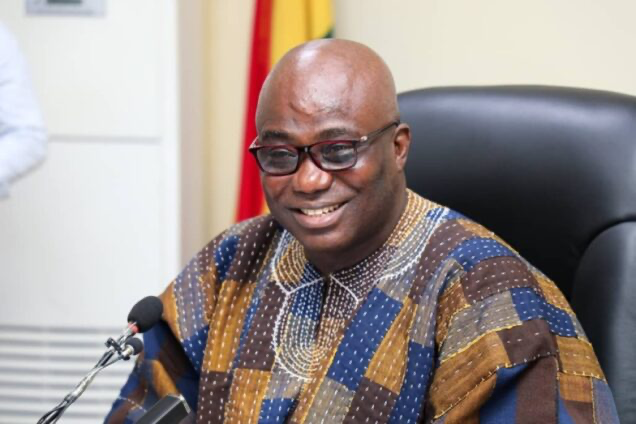
Ghana’s domestic poultry production has surged from 4.6 per cent to 22 per cent within the first year of implementing the government’s Nkoko Nketenkete programme, Minister for Food and Agriculture Eric Opoku has disclosed, describing the achievement as unprecedented in the country’s history.
Speaking during an inspection of the poultry, meat and feed processing factory under construction at Bechem in the Ahafo Region by President John Dramani Mahama, Mr Opoku said the figures were recorded as of May 2026.
“Your Excellency, after one year of the implementation of the programme, Ghana’s domestic poultry production has increased from 4.6%, as we inherited, to 22% as of May 2026. Twenty-two per cent. This has never happened in the history of our country,” he said.
Background: A Sector Long Dependent on Imports
The Nkoko Nketenkete initiative was launched by President Mahama in Kumasi as part of the broader Feed Ghana Programme, aimed at revitalising the poultry industry and reducing Ghana’s heavy dependence on imported chicken. The programme seeks to distribute three million birds to approximately 60,000 households across all 276 constituencies nationwide, with each selected household receiving 50 resilient chicks, starter feed, and technical support from agricultural extension officers.
The initiative forms part of the Poultry Industry Revitalisation Initiative under the Feed Ghana Programme, which has set yearly targets of 12 per cent sufficiency in 2025, 25 per cent in 2026, 48 per cent in 2027, 76 per cent in 2028, and 104 per cent by 2029 — the point at which Ghana would become a net exporter of poultry.
The stakes are significant. Ghana currently spends between $300 million and $600 million annually importing poultry products, with frozen chicken imports accounting for between 95 and 98 per cent of total chicken consumption. The country consumes an estimated 300,000 to 460,000 metric tonnes of poultry annually, with imports largely sourced from Brazil, the United States, and the European Union. The government’s broader ambition is to save over $350 million in foreign exchange through increased local production.
The programme has already shown tangible results beyond production figures. Beneficiaries have reported that birds matured within six weeks, enabling them to make profits within a short period. Some have used the proceeds to improve household income, while others have sold part of their stock to food vendors. The initiative particularly targets women, youth, and vulnerable households to promote sustainable livelihoods and economic empowerment.
The Egg Glut: A Victim of Success
The production surge, while welcome, has created a new challenge: a sustained surplus of eggs in the local market for almost a year. The glut was exacerbated in early 2026 when Burkina Faso imposed restrictions on egg imports from Ghana over quality concerns, a ban that lasted over two months and left farmers, traders, and distributors struggling with perishable stock.
At the height of the glut, a crate of eggs sold for between GH¢50 and GH¢55, down from GH¢70 to GH¢80 previously. The Minister said the evidence of the oversupply was visible on the streets.
“The evidence is seen on our streets. Everywhere you go in this country today, eggs are being sold two for five cedis. And even that, the sellers add pepper and onion free of charge,” Mr Opoku said.
Following a directive by President Mahama, Mr Opoku and the Minister for Trade, Agribusiness and Industry, Elizabeth Ofosu-Adjare, travelled to Burkina Faso for negotiations. Upon the conclusion of talks, over 20 trucks of eggs that had been stranded at the border were allowed entry.
“Since then, Ghana has been exporting eggs to Burkina Faso. But that is insufficient to clear the glut that we are witnessing now,” the Minister said.
The government is now working with the Ministry of Education to implement the President’s directive to include eggs in meals served under the School Feeding Programme. The government has also explored converting excess fresh eggs into powdered products that can be stored longer and distributed more easily, as part of a longer-term strategy to improve value addition.
Bechem Factory: Building the Full Value Chain
The Bechem processing facility represents the government’s strategic bet on value addition. President Mahama cut the sod for the project on November 27, 2025, and it is now approximately 50 per cent complete, with the contractor assuring completion by the end of the first quarter of 2027.
The facility will have two processing lines — one for broilers and another for layers — with a combined capacity of 6,000 birds per hour. It will also include three cold rooms, a feed mill, and a hatchery to support production and improve the sustainability of the poultry programme.
To ensure a steady supply of birds, the government plans to establish contractual arrangements with poultry farmers in the Ashanti, Bono, Upper East and surrounding regions, under which the factory will purchase and process their output for the market. The hatchery will produce birds for distribution to farmers, who would in turn supply the processing facility. The government is also procuring two trucks to distribute the factory’s packaged and branded products.
Mr Opoku said the feed mill would also use eggshells in feed preparation, providing an additional use for a by-product that would otherwise go to waste.
President Mahama, who inspected the facility as part of his two-day Resetting Ghana Tour of the Ahafo Region, outlined his vision for a complete poultry value chain in which farmers have a reliable market, processors have a steady supply of birds, traders have opportunities to distribute finished products, and young people can find jobs throughout the chain.
“It is in the right direction to first put measures in place to secure a reliable supply of birds for processing before constructing the factory,” the President said, noting that farmers can rear birds for about eight weeks before selling them to the factory for cash. He encouraged young people in Bechem and surrounding communities to participate in the programme, adding that those interested in trading could acquire small refrigerated vans and purchase processed chicken for distribution to towns including Tamale and Bolgatanga.
When completed, Bechem is expected to become Ghana’s chicken capital, with President Mahama projecting that people from different parts of the country would come to purchase locally processed chicken.
Looking Ahead
The coming months will test whether the combination of cross-border trade, institutional procurement through the School Feeding Programme, egg powder processing, and the Bechem factory can restore equilibrium to a sector that has become a victim of its own success. The government’s long-term goal remains achieving poultry self-sufficiency by 2029 — a target that, if met, would transform Ghana from one of Africa’s largest poultry importers into a net exporter and deliver significant savings in foreign exchange while creating jobs across the value chain.


