



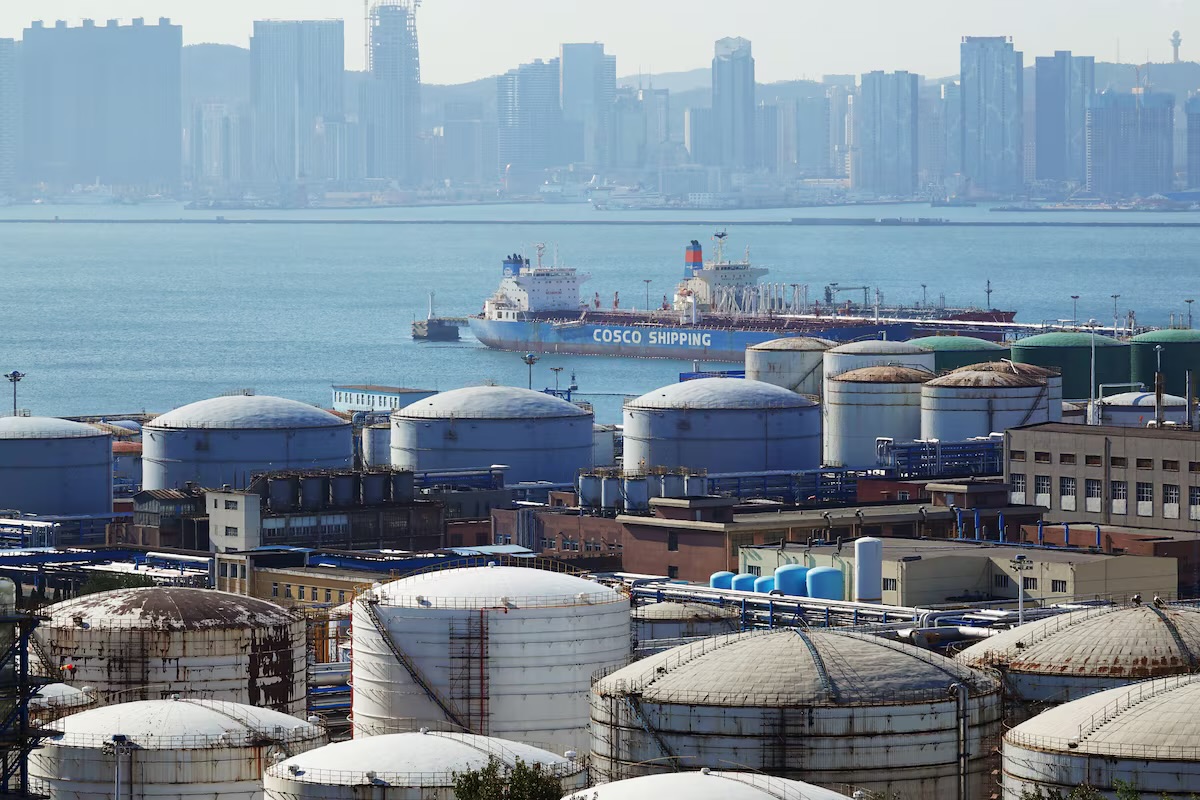
China is set to resume refined fuel exports for October after a brief halt during its Golden Week holiday, four traders familiar with the matter said on Friday, a move that will provide modest relief to a global diesel market squeezed by war and sanctions.
Beijing began curbing fuel exports in March to safeguard domestic supplies as the U.S.-Israeli war on Iran disrupted crude oil flows and refinery production across the Middle East. While controls were relaxed between July and September, the curbs have contributed to tighter global supply and forced Asian buyers to seek alternatives.
The world’s biggest oil importer and home to its largest refining industry has approved October exports of gasoline, diesel, and jet fuel at around 3.7 million metric tons combined, two other industry participants said. By comparison, Chinese refiners were expected to export slightly more than 4 million tons of the three fuels in September.
“It will be limited as markets remain tight overall and Middle Eastern supplies are still disrupted,” said Stuti Jhunjhunwala, an oil market analyst at Energy Aspects, based in Kolkata. June Goh, senior analyst at Sparta Commodities, noted the resumption was expected but volumes were lower than anticipated.
China’s National Development and Reform Commission and the commerce ministry did not immediately respond to requests for comment.
A Global Diesel Crisis
The resumption comes amid an unprecedented global fuel crunch. The U.S.-Israeli war on Iran, which began in February 2026, has severely disrupted Iranian oil production and transport, with energy infrastructure coming under attack and shipping traffic through the Strait of Hormuz—a chokepoint for roughly 20 percent of the world’s oil—sharply curtailed. Saudi Arabia, Kuwait, and Qatar have all been forced to cut production or declare force majeure.
The Ukraine-Russia conflict has compounded the crisis. Ukraine has for months targeted Russian oil and gas infrastructure with long-range strikes, prompting Moscow to ban diesel exports in July and removing supplies from an already tight market. According to the International Energy Agency (IEA), net exports of diesel and gasoil from the Gulf in August stood at “just over a quarter” of pre-war levels, while combined Gulf and Russian diesel exports—which accounted for almost 45 percent of global seaborne trade in February—have collapsed.
The impact on prices has been stark. Diesel prices in the U.S. hit a record above $6 a gallon on average, while Germany and France saw record retail prices of €2.471 and €2.41 per liter respectively. The diesel crack spread—the profit margin from refining crude into diesel—has surged to $100 per barrel, compared to a normal range of $15 to $30.
China’s Quota System and Export Trends
Beijing typically regulates fuel exports through a quota system designed to balance domestic supply and demand. In late December 2025, China issued its first batch of 2026 export quotas, allocating 19 million metric tons for gasoline, diesel, and jet fuel—unchanged from the previous year—with state-owned Sinopec and CNPC receiving over 70 percent of the allocation.
A second batch of 13 million metric tons followed in June 2026, bringing the total to 32 million metric tons. The third batch, released in early October, totaled 4.55 million metric tons, bringing the yearly quota to 36.55 million metric tons—lower than the same period in 2025.
Between January and August 2026, Chinese exports of the three fuels combined were 19 million tons, down 21 percent from the year-earlier period. In August 2026, the most recent month for which details are available, China sharply increased exports to 4.6 million tons, including 648,000 barrels per day (bpd) of jet fuel, 320,000 bpd of diesel, and 191,000 bpd of gasoline.
China started its week-long National Day holiday on October 1 without giving refiners approval to export fuel products to regions other than Hong Kong and Macau in October. PetroChina cancelled several gasoline and jet fuel cargoes, while Zhejiang Petrochemical did not schedule exports during the holiday period. The pause followed a sharp deterioration in China’s own fuel-stock position, with commercial diesel and gasoil inventories estimated at around 20 million barrels below pre-war levels.
China’s Role as a Swing Supplier
Although China’s fuel export volumes have typically lagged India and South Korea among Asian processors, it is regarded as a key swing supplier for regional markets. China is Asia’s No. 4 exporter of clean fuels and is known for ramping up exports when local demand dips and export margins are attractive. It supplied about a third of Australia’s jet fuel last year and about half for the Philippines and Bangladesh in 2024.
The export curbs have had significant geopolitical implications, deepening China’s influence with fuel-starved neighbours. Vietnam appealed to Beijing over its looming jet fuel shortage, and the Philippines asked China not to restrict fertiliser exports. Beijing granted limited waivers to Bangladesh, Myanmar, Vietnam, and Sri Lanka in late March 2026.
IEA Accelerates Emergency Stock Release
Amid the refined fuel tightness, the IEA this week agreed to accelerate the release of oil stocks pledged under a March 2026 emergency action, prioritising diesel supplies. The IEA’s 32 members unanimously agreed in March to make 400 million barrels of oil available to the market—the largest coordinated release in the agency’s history. To date, about 325 million barrels have been released, with approximately 100 million barrels still to come.
IEA member governments still hold about 1.1 billion barrels of publicly controlled emergency oil stocks, including more than 200 million barrels of diesel, and the agency said it stands ready to release more if required.
Market Outlook
Analysts cautioned that China’s resumed exports would provide only limited relief. “The resumption is welcome but the volumes are lower than anticipated, and the fundamental tightness in the diesel market remains,” said June Goh of Sparta Commodities. With Middle Eastern supplies still disrupted and Russian exports curtailed, the global fuel market is expected to remain strained in the coming months.
(Reporting by Chen Aizhu and Trixie Yap; Additional reporting by Sam Li in Beijing, Mohi Narayan in New Delhi, and Jeslyn Lerh in Singapore; Editing by Shri Navaratnam, Christian Schmollinger and Clarence Fernandez)


