



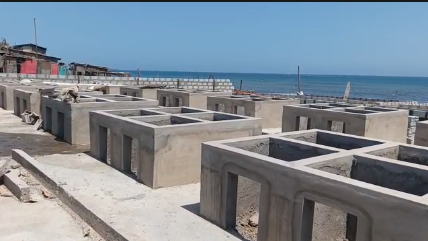
The Tema Metropolitan Assembly (TMA) has commenced construction of a modern fish processing facility at the Tema Newtown fish processing site, featuring 150 kilns and 30 fish-drying slabs, as part of a broader effort to improve hygiene and sanitation at the coastal enclave.
The facility will also include washroom facilities, addressing long-standing concerns over unsanitary practices at the site. The project follows the demolition of temporary structures at the shoreline in July 2026, which authorities said was necessary to make way for a clean-up exercise and create a healthier environment for fish processing activities.
Completion Targeted for November 2026
Speaking to Citi News on Wednesday, September 30, the Tema East Sub-Metro Director, Abdul Latif Amin, said the facility is expected to be completed and ready for use by November 2026.
Grace Nkum, a fish processor who travels from Ashaiman to operate at the site, welcomed the project, saying it would improve conditions for fish processors.
A History of Sanitation Concerns
The Tema Newtown fish processing site has long been plagued by sanitation challenges. In July 2026, a viral video exposed unhygienic fish handling at the enclave, showing fish being stored near a refuse dump where open defecation was also taking place . The video, shared by volunteer group Buzzstop Boys, prompted the Food and Drugs Authority (FDA) to dispatch a rapid response team to the area in collaboration with the TMA and the Ghana Police Service .
The FDA subsequently confiscated smoked and salted fish that had been exposed to unhygienic conditions, while educating fish processors on the health risks associated with poor handling practices .
Authorities said inspections revealed that fish was being processed close to overflowing refuse dumps, while open defecation along the shoreline posed a serious health risk to residents and consumers .
Demolition and Clashes with Fishmongers
The demolition exercise began on Tuesday, July 28, 2026, and entered its second day amid resistance from fishmongers who said they had not been given adequate notice . A confrontation erupted between officials of the Tema East Sub-Metro and some fishmongers, leading to the arrest of several individuals accused of engaging in open defecation at the site .
The Chairman of the Tema East Sub-Metro said fishmongers had been given prior notice before the exercise was carried out. “The work they do is important, but the environment is not conducive. They were duly notified. The area must be cleaned before they can resume their business. The demolition is intended to pave the way for a major clean-up exercise,” he said .
However, many traders disputed this, saying they were away when the demolition started and were unable to rescue their belongings despite pleading for more time . Enock Sam, a Winneba native who had helped his mother at the site since his school days, said the demolition had destroyed the family business and that many affected traders were considering returning to their hometowns .
Some fish processors argued that the sanitation problems were largely caused by poor waste management rather than their activities. “If you go around the area, you’ll see that the refuse container is overflowing and has not been emptied. What are we supposed to do with the waste? If the bin is full, people will end up dumping it elsewhere, probably into the sea,” Mr Sam said, urging authorities to ensure refuse containers are emptied regularly .
A Broader Redevelopment Initiative
The demolition and reconstruction form part of a wider redevelopment plan for the Tema Newtown beachfront. The TMA, working alongside the FDA and the Environmental Protection Agency (EPA), said the operation targeted temporary structures along the shoreline where fish was being processed and dried under conditions that fell short of acceptable public health standards .
Frank Asante, Public Relations Officer of the TMA, explained that fish processed in unsanitary environments poses a potential risk to consumers, making the enforcement action necessary to safeguard public health .
The TMA also assured the FDA that new hygienic processing platforms would be built to provide fish processors with cleaner and safer spaces for drying and smoking fish .
The redevelopment of the Tema Newtown site is part of a larger effort to transform the area’s fish processing infrastructure. In July 2025, a major demolition exercise was carried out at the Canoe Basin within the Tema Fishing Harbour as part of efforts to decongest the area, remove unauthorized structures, and address sanitation concerns. That exercise was a joint effort by the Ghana Ports and Harbours Authority (GPHA), the Tema Traditional Council, the TMA, the Ghana Police Service, and the Ghana Navy .
Authorities said the broader redevelopment initiative aimed to transform the enclave into a state-of-the-art fish processing and preservation facility that complies with European Union (EU) food safety standards . The Chief Fisherman of Tema, Nii Odametey, denied rumours that the land had been sold to private developers, assuring the community that the project was designed to benefit local fish workers .
Wider Implications for Ghana’s Fishing Industry
Tema Newtown is one of Ghana’s most important fish processing hubs, supporting thousands of livelihoods in the coastal community. The area has faced persistent challenges, including a worsening sanitation crisis in the densely populated Bankuman community, where open defecation remains rampant due to the absence of toilet facilities in almost every household .
The FDA has indicated that further engagements would be carried out with fish processors and fishmongers in coastal districts to promote proper hygiene standards . The Authority also advised the public to buy smoked and dried fish only from clean and reputable sources and to inspect fish before buying .
The completion of the 150-kiln facility by November 2026 will be a critical test of whether the government’s redevelopment agenda can deliver improved sanitary conditions for fish processors while safeguarding public health and sustaining the livelihoods that depend on the trade.


