



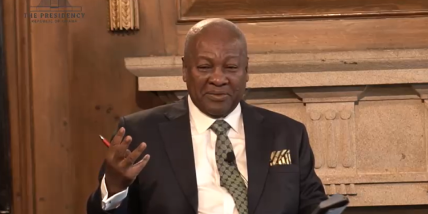
President John Dramani Mahama has announced that his government will sign an agreement before the end of 2026 to build a state-owned 1,200-megawatt (MW) gas-fired thermal power plant, a facility that would become Ghana’s largest single power plant by installed capacity, surpassing the 1,020MW Akosombo Hydroelectric Power Station.
The President made the announcement at a town hall meeting with the Ghanaian community in New York on Friday, September 25, 2026, on the sidelines of the 81st United Nations General Assembly.
“We are going to build the biggest thermal capacity in Ghana. Before the end of this year, we’re going to sign 1,200 megawatts of gas thermal power,” President Mahama told the gathering.
A Strategic Bet on State-Owned Capacity
The decision to add the new thermal capacity reflects a significant shift in Ghana’s power generation strategy. President Mahama said the move was informed by changes in the global energy landscape, including the transition towards renewable energy and the growing adoption of electric vehicles. He explained that the government wanted to avoid investing in power assets that could become stranded as the energy mix evolves.
Notably, the President revealed that some Independent Power Producers (IPPs) that had previously threatened to suspend power generation are now prepared to invest in an additional 500MW of capacity. However, the government has opted to prioritise state-owned generation rather than relying on private producers, in a bid to retain greater control over the country’s energy security.
The new plant is expected to offtake additional gas from the Offshore Cape Three Points (OCTP) partners and the Gas Processing Plant (GPP 2), providing reliable fuel supply for large-scale power generation. Finance Minister Dr Cassiel Ato Forson has previously stated that the state-owned facility is designed to conserve foreign exchange as part of Ghana’s renewed Gas-to-Power transformation policy.
Energy Debt Cleared, ECG Reorganised
On the financial health of the energy sector, President Mahama said the government had cleared the sector’s legacy debts and reorganised the Electricity Company of Ghana (ECG) to prioritise payments to power generators.
“We brought IPPs, and everybody was threatening to switch off power. Today, I can tell you, we have paid off our energy debts. And we are current with the payments,” he said.
He explained that ECG’s collection system had been restructured so that payments to power generators now take precedence over other expenditures. “The first charge on any money they collect is to pay the power generators. Instead of procurements, buying cables, street lights that we cannot even use for 10 years, we are measuring their procurements. We are paying the IPPs first,” the President stated.
The government’s claims are backed by figures from the Ministry of Energy and Green Transition. Energy Minister Dr John Abdulai Jinapor disclosed in August 2026 that the government had paid off approximately $1.47 billion in legacy debt within the energy sector. This included $597.15 million to restore the depleted World Bank partial risk guarantee for the Sankofa gas project, approximately $480 million in arrears owed to ENI and Vitol for gas deliveries, and $393 million in legacy debts owed to IPPs—including $120 million to Karpower, $59.4 million to Cenpower, and $54 million to Sunon Asogli.
Reforms to the Cash Waterfall Mechanism have also significantly improved payments to IPPs. Before the current administration, only about 16 per cent of funds declared into the mechanism reached IPPs, who received approximately 42 per cent of their invoices. Today, the government declares close to GH¢15 billion every month into the mechanism, and IPPs receive about 100 per cent of their invoice bills.
The Minister also disclosed that renegotiations with IPPs had unlocked approximately $250 million in savings, while the shift from liquid fuel to natural gas had saved the country about $500 million.
Background: A Decade of Power Crises
The new thermal plant represents a decisive attempt to address the structural deficiencies that have plagued Ghana’s power sector for decades. The country has experienced multiple power crises since independence, with the 2012–2016 episode—famously dubbed “Dumsor” (Twi for “off and on”)—inflicting major economic damage, with GDP losses estimated at between $320 million and $924 million, or 2 to 6 per cent of Ghana’s GDP.
The immediate trigger for that crisis was the rupture of the West African gas pipeline, which knocked out the gas-fuelled Sunon Asogli plant (200MW) until the pipeline was repaired in 2014. Compounding factors included below-average rainfall that reduced hydropower generation, and critically, insufficient financing to purchase alternative liquid fuels for thermal plants. Ghana had enough installed capacity to cover demand, but the utilities and government could not afford to buy the fuel to run the plants at full capacity.
By the time the previous government left office in January 2025, the energy sector’s arrears had accumulated to approximately GH¢80 billion, and the sector was characterised by chronic payment delays, particularly for gas used in electricity production. The World Bank’s $500 million partial risk guarantee had been depleted, threatening nearly $8 billion in private investment in the Sankofa gas project.
Oil and Gas Sector Revival
President Mahama also linked the planned thermal expansion to renewed investment in Ghana’s oil and gas sector. He said oil production had increased by almost 38 per cent since 2025, following major investments by oil producers. Jubilee Partners are investing $2 billion to drill 20 new wells, while Eni is investing $1.5 billion to bring the remaining portion of its Sankofa field into production.
He added that major international oil companies, including ExxonMobil and Shell, are now exploring opportunities in Ghana—a stark contrast to the situation when the government took office, when investors such as Eni had moved their operations to Côte d’Ivoire and Jubilee production had dwindled to about 60,000 barrels per day.
The increased gas from these renewed investments would feed the new thermal plants and boost revenue for national development, the President said.
Broader Economic Context
The announcement comes amid signs of broader economic stabilisation. Ghana’s debt-to-GDP ratio has fallen from 61.8 per cent at the end of 2024 to 45 per cent by June 2026, bringing the country into compliance with its statutory debt ceiling. Headline inflation eased to 3.8 per cent in January 2026, the lowest level in three decades.
President Mahama said his administration inherited an International Monetary Fund programme that was off-track but had worked to restore it. “We had to work before the next IMF mission came to bring the programme back on track, which we did. We had to take various scale measures, which were difficult, but Ghanaians cooperated, we all sacrificed,” he said.
What Happens Next
While the proposed 1,200MW plant would significantly boost Ghana’s generating capacity, questions remain about the timeline for construction, the source of financing, and the specific contractors involved. The government has not yet disclosed the estimated cost of the project or the identity of the companies expected to build it.
The project faces scrutiny from energy analysts who have questioned whether Ghana needs additional thermal capacity, given that the country has historically struggled to pay for fuel to run existing plants. The Institute of Energy Security (IES) has previously argued that Ghana’s challenges have been financial rather than capacity-related, and that adding more generation without addressing the underlying financial sustainability of the sector could create new fiscal burdens.
Nevertheless, the government’s decision to build state-owned capacity signals a clear policy preference: rather than relying on IPPs and their associated payment obligations, Ghana intends to own and operate its own generation assets. Whether this approach delivers cheaper, more reliable power—or reproduces the financial difficulties that led to the collapse of state-owned enterprises in the past—will depend on the execution of the deal expected before year-end.


