



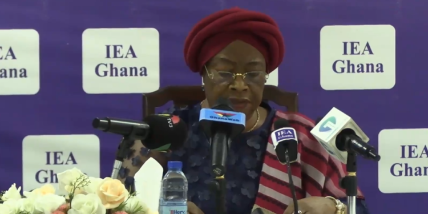
The Institute of Economic Affairs (IEA) has firmly rejected a proposal to extend the tenure of Ghana’s President and Members of Parliament from four to five years, arguing that the existing mandate is sufficient for any well-prepared government to implement its programmes.
Former Chief Justice and IEA Fellow, Justice Sophia Akuffo, said the proposed extension should not be pursued without compelling evidence that the current four-year term is inadequate. She made the remarks at a press briefing ahead of an IEA seminar under its “Views and Reflections” series, which is examining recommendations of the Prempeh Committee and the government’s position on proposed constitutional reforms. The seminar, held on Wednesday, September 23, 2026, brought together legal practitioners, former public officials, and governance experts to scrutinize the most significant constitutional reform package in a generation.
The Prempeh Committee and Government’s Position
The Constitutional Review Committee (CRC), chaired by Professor H. Kwasi Prempeh, submitted its report to President John Dramani Mahama on December 22, 2025, recommending an extension of the presidential term from four to five years as part of broader reforms. The government, on July 30, 2026, accepted the recommendation, along with a corresponding extension of Parliament’s tenure. Attorney-General and Minister for Justice, Dr. Dominic Ayine, announced the government’s position, arguing that the current four-year cycle leaves limited time for policy formulation and implementation.
The government’s acceptance of the five-year term was part of a sweeping constitutional reform package that also included the election of District Chief Executives, abolition of the death penalty, a citizen-initiative mechanism for constitutional amendments, and a reduction in the minimum age for presidential candidates from 40 to 35 years. The government also proposed capping the number of ministers at 60, down from the CRC’s recommended 57, and removing the constitutional requirement that a majority of ministers be selected from Parliament.
Justice Akuffo: “Four Years You Prepare Before You Come Into Office”
Justice Akuffo argued that political parties and prospective governments have considerable time to prepare their programmes before assuming office and should therefore be capable of commencing governance promptly once elected.
“Four years you prepare before you come into office. In fact, you prepare before you even vie for power, so that on the day you come to power, from that day you’re on your feet and running,” she said.
She criticised the delays frequently encountered in the establishment of governments, particularly the appointment of ministers, regional ministers, and governing boards of public institutions.
“It shouldn’t take six months to appoint ministers and people into key positions as has been our experience in times past,” she said.
Justice Akuffo also emphasised that the IEA does not support the extension, stating: “I think we did mention that the proposal by the Prempeh Committee, which of course is acceptable to the Executive, that the term should be five years rather than four years and the IEA says no, we do not support such an extension.”
The Accountability Question
The IEA said the debate should consider the balance between effective policy implementation and democratic accountability. While proponents of a five-year term argue that longer mandates would give governments more time to implement long-term programmes, opponents maintain that shorter electoral cycles strengthen citizens’ ability to hold elected officials accountable.
The institute said the central question should be whether policy discontinuity is genuinely caused by the four-year electoral cycle or is instead linked to weak institutions, inadequate planning, and successive governments abandoning or redesigning programmes initiated by their predecessors.
Inusah Fuseini: “I Don’t See Any Rational Basis for Five”
Former Tamale Central MP Inusah Fuseini, speaking at the same press briefing, questioned the rationale for extending the tenure. He argued that the current four-year term already provides sufficient time for an elected government to implement its policies.
“And if you are running four years, the last year is used for campaigning for re-election. Probably you can have three years if you have been re-elected a second time,” he said. “So why do you say five? If the argument is that you have the first year to set up your government and the last year to run a campaign, what is the rationale for five? Because from that argument, you see that two years have been lost. So why five? I don’t see any rational basis for five.”
Fuseini also rejected the argument that a five-year term would improve policy continuity, pointing to the Directive Principles of State Policy in the 1992 Constitution, which already provides for continuity in governance.
“Talk about continuity. The Constitution already anticipated that. That is why in the Directive Principles of State Policy, every succeeding President must, as far as possible, continue with ongoing projects,” he said.
NPP and TUC Oppose Extension
The IEA’s position aligns with that of the opposition New Patriotic Party (NPP), which on September 17, 2026, declared its opposition to the proposed extension. Member of Parliament for Gushegu, Sulemana Tampuli Alhassan, said the NPP prefers the existing four-year mandate because it allows citizens to regularly assess the performance of elected governments within shorter periods.
“The CRC recommended that the presidential term be extended from four to five years. Now, we have taken a different position from the position of government and the CRC. We do not support the extension, and we support the retention of the existing four years,” he said.
The Trades Union Congress (TUC) has also opposed the extension, calling for stronger governance reforms to accompany any change and warning that a longer term could weaken democratic accountability.
NDPC and Long-Term Development Planning
The IEA argued that the issue should be considered alongside proposals to strengthen the National Development Planning Commission (NDPC). A credible long-term national development framework, the institute said, could allow successive governments to implement substantial programmes within four-year mandates while contributing to a common national development direction.
The NDPC, currently an executive body under the Office of the President, is the subject of current calls for constitutional reform to enhance its autonomy, technical capacity, and partisan independence. Proposals include amending Article 86 of the Constitution to decouple the Commission from the Executive and entrench national development planning as a constitutional mandate.
Broader Constitutional Reform Debate
The debate over the five-year term is part of a wider national conversation on constitutional reform. At the same IEA seminar, legal practitioner Victor Anku-Tsede urged caution, arguing that not every governance challenge requires a constitutional amendment.
“The fact that we have identified many problems does not mean that every problem requires a constitutional amendment… We are not merely changing words. We are changing the rules under which public power is exercised. We are changing relationships between institutions. We may be changing the rights and obligations of citizens and, in some cases, we may be changing the legal consequences of government’s action for generations to come,” he said.
Former Deputy Lands Minister George Mireku Duker questioned the rationale behind the proposed reforms, noting that the government had accepted only 22 of the 147 recommendations made by the CRC.
“It’s critical for us to observe that a committee that has been set up by a government could slate 147 recommendations and government takes only 22 out of those recommendations. Isn’t it worrying? We have to know what we are doing, what we intend doing, understand it and not necessarily have the Constitution being crafted. Let’s amend our conscience as a country. Let’s amend our attitude, and that is critical. Until that, let’s forget about amendments,” he said.
Justice Akuffo called for a broad, consultative, and nationally owned process, with sufficient time to assess the implications of each proposed change.
“The 1992 Constitution has made significant contribution to democratic stability and its achievements should be preserved. The experience of more than three decades provides substantial evidence that where the constitutional framework has worked effectively and where it has generated weaknesses, these must be addressed dispassionately,” she said.
As the government prepares to present its constitutional reform package to Parliament, the IEA’s rejection of the five-year term adds a significant voice to a growing coalition of opposition parties, civil society organisations, and governance experts urging caution. The coming months will determine whether the government’s proposal can secure the broad consensus needed for constitutional amendment — or whether the four-year term, which has defined Ghana’s electoral cycle for over three decades, will be retained.
About the Prempeh Committee
The Constitutional Review Committee (CRC), chaired by Professor H. Kwasi Prempeh, was established by President John Dramani Mahama on January 19, 2025, to review Ghana’s 1992 Constitution. The eight-member committee included civil society representatives, a former Supreme Court judge, and governance experts. After a nationwide tour and consultations with stakeholders, the committee presented its report to the President on December 22, 2025, with 147 recommendations across the executive, legislature, judiciary, and other governance sectors.
Key CRC Recommendations Accepted by Government:
· Extension of presidential and parliamentary terms from four to five years
· Reduction of presidential candidate minimum age from 40 to 35 years
· Election of District Chief Executives
· Abolition of the death penalty
· Citizen-initiative mechanism for constitutional amendments
· Cap on ministerial appointments at 60
· Holding general elections in November instead of December
· Fixed 10-year non-renewable tenure for the Chief Justice
Key Stakeholder Positions:
· Government: Supports five-year term; argues longer mandate allows for better policy formulation and implementation
· IEA: Opposes extension; four years sufficient if governments prepare adequately before assuming office
· NPP: Opposes extension; four-year term ensures regular accountability
· TUC: Opposes extension; calls for stronger governance reforms to accompany any change
· Former MP Inusah Fuseini: Opposes extension; sees no rational basis for five years


