



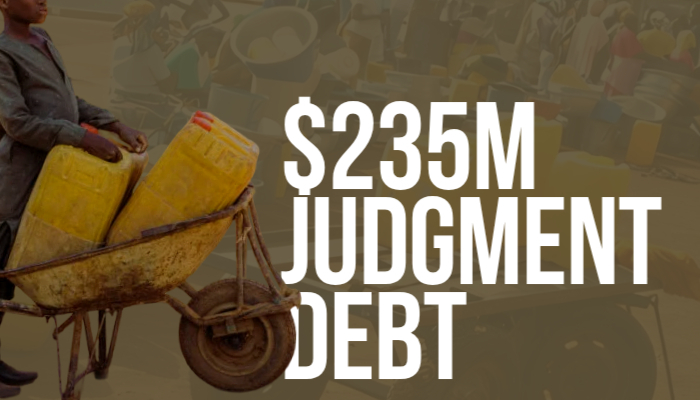
Fifteen years after Ghana signed a contract to convert seawater into drinking water for Teshie and Nungua, the Teshie-Nungua desalination plant sits silent, its gates locked and its machines idle. Residents who were promised relief from chronic water shortages now buy from tankers at exorbitant cost. And on 17 September 2026, two final arbitration awards from the International Chamber of Commerce ordered Ghana Water Company Limited (GWCL) to pay $235 million, net of taxes, to Befesa Desalination Developments Ghana Limited (BDDG), the Spanish-owned company behind the plant.
The Republic of Ghana is liable for the money under a sovereign guarantee Parliament approved in 2012. The award is nearly twice the $126 million the plant cost to build. Interest has been running from 1 April 2026 until payment, and the utility must also partially reimburse the company’s legal costs. Ghana Water’s own counterclaims, including one for $144.5 million, were substantially dismissed. The basis of that counterclaim has not been made public.
A plant built for the tail end of the network
The Teshie-Nungua desalination plant was designed to produce 60,000 cubic metres of water a day for about 500,000 people in Teshie, Nungua and neighbouring communities that had long suffered from poor supply. Its service area stretched across Teshie, Nungua, Spintex, Baatsona and Sakumono.
When the contract was signed in 2011, the Minister for Water Resources, Works and Housing explained that Teshie and Nungua suffered because they sat at the tail end of Ghana Water’s distribution network. He argued that desalination was the best option given how close the communities were to the sea and how much more efficient the technology had become.
An unsolicited offer
The project began with a proposal nobody had asked for. After an earlier contract with Aqualyng Ghana Limited was abrogated for non-performance, Ghana Water received an unsolicited proposal from Befesa Ghana Limited on 29 April 2010, and its board approved the signing on 25 August 2010.
The minister, Alban Sumana Kingsford Bagbin, now Speaker of Parliament, signed the contract on 25 February 2011. At the ceremony, Goosie Tanoh spoke as Befesa’s legal advisor and consultant. He announced that the company would spend $500,000 on a dedicated power line to be owned by the Electricity Company of Ghana, pay for a 1.5 km pipeline linking the plant to the Ghana Water grid, and deliver the first trial water in August 2012.
That date slipped. Construction started in November 2012, and President John Mahama commissioned the plant in April 2015, two years and eight months after the promised first water.
Parliament’s approval and its warnings
The Ministry of Finance issued a Letter of Comfort on 3 October 2011, and the parties signed an addendum on 20 February 2012. The deal went to Parliament on 13 March 2012 and returned two days later in a joint report of the Finance and Works and Housing Committees, signed by James Klutse Avedzi and Simon Edem Asimah.
The committees recommended a $110 million Water Purchase Agreement, a government guarantee assuring Befesa of payment for water delivered, and tax and duty waivers worth $72,827,330. The waiver covered $30,327,330 in duties on equipment over 25 years, plus $42.5 million in VAT, NHIL, corporate tax and withholding tax over the first ten years of operation. Befesa would finance the plant alone, run it for 25 years and then hand it to the state.
The same report carried two early warnings. The Public Utilities Regulatory Commission had found Befesa’s proposed tariff of $1.716 per cubic metre uncompetitive and set an indicative $1.37, subject to verification of actual costs. Some committee members also noted that the Spanish parent company, Abengoa, was not a party to the agreement, and that Befesa Ghana was a new company with no tax history and no record of executing a project of this kind. The shareholding presented to them was Abengoa 51 percent, Sojitz of Japan 44 percent and Hydrocol Ghana Limited 5 percent. The price of the water and the question of who stood behind the contract would later sit at the centre of the dispute.
A price tag that kept moving
Parliament approved a $110 million agreement in 2012. The government’s 2024 report on public-private partnerships puts the project at $125 million, while most reporting uses $126 million. Over its full life, the deal was expected to earn about $1.3 billion over 25 years.
Insured by the World Bank
The investors secured protection early. On 25 October 2012, the World Bank Group’s Multilateral Investment Guarantee Agency issued $179.2 million in guarantees covering the equity and shareholder loans of Abengoa Water Investments Ghana and Daye Water Investment, as well as a loan and interest rate swap from Standard Bank of South Africa. The cover protected against transfer restriction, expropriation, breach of contract, and war and civil disturbance, with terms of 20 years for the equity, 14 years for the shareholder loans and 12 years for the bank loans.
That meant the investors were insured against the Ghanaian state failing to honour the contract. Ghana Water had no such protection against the cost of the water it was obliged to buy.
Paying for capacity, not water
The arithmetic worked against Ghana Water from the start. The utility bought desalinated water at GH¢6.75 a unit while the approved tariff allowed it to sell at GH¢1.47, a loss of GH¢5.28 on every unit. It also owed a fixed monthly capacity charge of about $1.4 million, due whether the plant ran or not.
The 2024 accounts show how that played out. Befesa invoiced $16.93 million that year, made up of $14.94 million in capacity charges, $1.54 million in variable water charges and $457,650 in delay charges. The plant delivered an average of 43,009 cubic metres a day against the 60,000 contracted, about 72 percent of capacity, yet the capacity charge did not fall.
The same report recorded frequent power outages and an electricity bill of $6.98 million in 2024 alone.
The taxpayer picked up the bill
Ghana Water paid only a sliver of its own bill. Of the $16.92 million settled in 2024, the utility paid $800,000 and the Ministry of Finance paid $16.12 million, which means the taxpayer covered more than 95 percent.
That pattern ran for years. Government support on the project stood at $13.92 million in 2020, $9.54 million in 2021, $8.22 million in 2022, $9.58 million in 2023 and $16.12 million in 2024, a total of $57.38 million. Despite those payments, $9.77 million was still owed to Befesa at the end of December 2024.
PURC also approved an annual average of GH¢170.42 million for the 2022 to 2025 tariff period to cover the plant’s capacity payments and operating costs. Of the $72.83 million tax exemption, $31.55 million had been used by the end of 2024.
Shutdowns, complaints and a contract no one could exit
Criticism came early. In 2017, the Public Utility Workers’ Union said the agreement was draining Ghana Water. On New Year’s Day 2018, the utility shut the plant and said it would renegotiate the terms, with its then head of communications, Stanley Martey, saying the plant had become very expensive to run and was draining the company’s limited resources.
The plant was shut again in October 2019 after excess chemicals were found in the water, at a time when the contract was reportedly costing the government GH¢6 million a month. The Ghana Water board chairman who confirmed that shutdown was Alexander Afenyo-Markin.
In September 2020, Stephen Asamoah Boateng, Director-General of the State Interests and Governance Authority, said the contract had been set up to milk the country, and that contractual obligations alone stopped him from terminating it. The NPP government kept the plant running and kept paying.
A plant in poor condition
Residents often complained that the water was too salty for many household uses, and corrosion caused repeated technical failures and costly maintenance. In May 2024, Befesa reported the plant inoperable after heavy rains, and a survey afterwards found structural defects and inadequate bracing, which Ghana Water blamed on poor maintenance and neglect.
The government’s own 2024 PPP report recommended speeding up renegotiation of the Water Purchase Agreement and having the state take an equity stake in the plant. Neither happened.
Changing owners, same guarantee
Ownership shifted over time. In 2018, the US company AquaVenture announced it was buying the Abengoa subsidiary that held a 56 percent economic interest in the project company for $26 million. Today, the Spanish group Cox, which took over Abengoa’s assets in 2023, holds 95 percent of the Ghanaian company. The investors changed, but Ghana’s guarantee stayed in place.
Funding stops and the plant goes dark
The Treasury support that sustained the plant under the previous government did not continue. Attempts to get the Finance Ministry to release funds in 2025 failed, and the government made no financial commitment to the facility that year. In October 2025, Ghana Water shut the plant, citing maintenance problems and legal issues, and said it acted to make sure the plant would eventually be handed over in a usable condition. The Water Purchase Agreement was subsequently terminated, and the $235 million award covers that termination.
The arbitration award
Two final awards from the International Chamber of Commerce’s arbitration court were issued on 17 September 2026 and served on the project company the next day. They order Ghana Water to pay $235 million, net of taxes, with interest running from 1 April 2026 until payment. The tribunal substantially rejected Ghana Water’s counterclaims, including one for $144.5 million, ordered the utility to pay part of the company’s legal costs, and found the Republic of Ghana liable under the state guarantee. Cox disclosed the awards to the Spanish securities market on 21 September. It cautioned that the sums sit within the project’s financing structure and will not all become cash for the group.
The award adds to Ghana’s list of costly international disputes, including the $320 million lost to Tullow Oil in January 2025.
Promises of a settlement
In February 2026, President Mahama directed the Finance Minister, the Attorney-General and Ghana Water to open negotiations with the plant’s shareholders. In March, the then Minister for Works, Housing and Water Resources, Kenneth Gilbert Adjei, told journalists that “very soon we will conclude it and the plant will start working.” By then, interest on the award had already been running for about three weeks.
Ghana Water Managing Director Adam Mutawakilu said in February that “the president has directed that the Ministry of Finance, the Ministry of Justice, the Attorney General, Ghana Water Limited, and the shareholders of the desalination plant engage to find a solution. We met on Monday and will be meeting again.”
Residents left to fend for themselves
After the shutdown, Ghana Water put affected communities on a schedule of water two days a week, drawing mainly on the Kpong Water Treatment Plant. The schedule came under strain during the Christmas period, when demand rose sharply. Teshie, Nungua, Spintex, parts of Sakumono and La have been rationed ever since, with households buying from tankers, assemblies drilling boreholes and National Security trucking water to Tsuibleoo.
The burden has fallen on household budgets. A trader and mother of three said she was spending more than GH¢300 a week on tanker water. “I haven’t seen a single drop of flowing water in my house for nearly a month,” said Naa Adjeley, a trader and mother of three who lives in Teshie. “Now, we are entirely at the mercy of private water tankers. I am spending over 300 Cedis every single week just to buy water for cooking, washing, and bathing. My small business is barely surviving because almost all my profit goes into buying water.”
At Teshie Telephone Pole, residents reported taps opening roughly once a week at pressure too weak to fill a storage tank, and some described bathing in seawater mixed with detergent. The Municipal Chief Executive for Ledzokuku, Israel Adjetey Otchwemah, announced that the assembly plans to drill emergency mechanised boreholes in public schools and health facilities across Teshie.
The political trail
The deal has passed through both parties. Under the NDC, Ghana Water accepted an unsolicited proposal, the Minister for Water Resources, Works and Housing signed the contract, Parliament approved a sovereign guarantee and tax waivers, and President Mahama commissioned the plant in 2015. Under the NPP, officials condemned the contract, shut the plant twice and kept it alive with $57.38 million from the Treasury between 2020 and 2024. Back under the NDC, the funding stopped, the plant was shut, the contract was terminated and the award followed.
Goosie Tanoh, who spoke for Befesa as its legal advisor and consultant at the 2011 signing, now sits in the Office of the President. In January 2025, President Mahama appointed him Presidential Advisor responsible for the 24-hour Economy and Accelerated Export Development, one of the first appointments of the new administration and the person in charge of the government’s flagship 24-hour economy policy. There is no public record of any role for him in the termination or the arbitration. When JoyNews contacted him for comment, Mr Tanoh said he had no comment for now.
What comes next
Ghana Water says it has yet to take a decision on the judgment. Cox says the two sides are still negotiating toward an amicable settlement, without giving up any of its rights under the awards. It describes the awards as final and binding, subject only to the challenge routes available under the applicable law.
Ghana can pursue those limited routes, negotiate a reduced payment or pay in full. If the state does not pay, the World Bank’s insurance arm could compensate the investors under its breach of contract cover and then pursue Ghana for the money.
Bringing the plant back would take more than closing a negotiation. It would require a settlement or a new commercial arrangement, followed by repairs to a facility found to have structural defects that has now stood idle for almost a year.
Ghana accepted an unsolicited offer, guaranteed payment for capacity it could not afford, waived $72.8 million in taxes and spent $57 million of public money keeping the plant running. It now faces a $235 million award, while the 500,000 people the plant was built to serve still depend on tankers for water.
Additional reporting by Winifred Lartey. This explainer was compiled from JoyNews Research, the government’s 2024 PPP report, parliamentary records, and disclosures by Cox Infrastructure Group to the Spanish securities market.


