



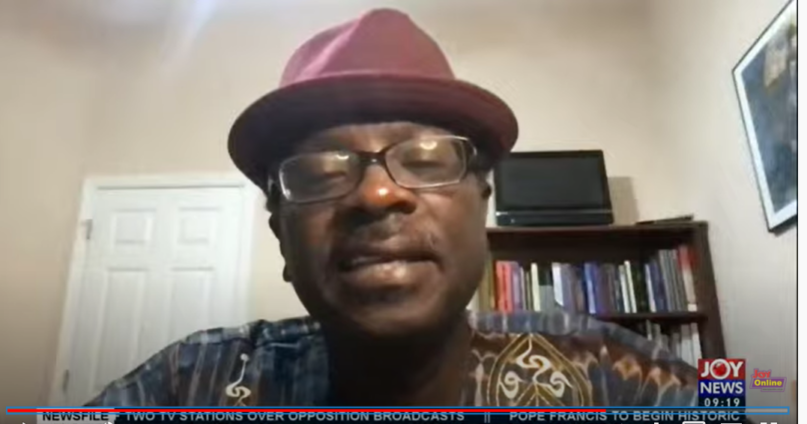
Legal scholar Professor Kwaku Asare has cautioned Chief Justice Paul Baffoe-Bonnie against making public comments that could be perceived as partisan political assessments, following remarks in which the head of the Judiciary questioned what Ghana had achieved over the past eight years.
Prof Asare said while he understood the sentiment behind the Chief Justice’s comments, the reference to “the past eight years” carried an unmistakable political meaning in Ghana’s political discourse and could undermine public confidence in judicial independence.
The controversy stems from remarks Justice Baffoe-Bonnie made on Wednesday, September 2, during visits to the Minerals Income Investment Fund (MIIF) and the Social Security and National Insurance Trust (SSNIT).
“I must congratulate you. I mean, you have done marvellously well. Sometimes, when we hear about the things that you have done and the things that some organisations are doing now, we wonder. Some of us keep wondering what we really have been doing in the past eight years,” the Chief Justice said during the MIIF visit.
He also referenced SSNIT’s previous consideration of selling prized assets, saying: “If you compare that to the fact that not too long ago, SSNIT was preparing to sell its prized assets like Labadi Beach Hotel, you wonder how Ghana could have sunk so low”.
‘That is territory the head of Judiciary should avoid’
Reacting in a Facebook post on Wednesday, Prof Asare said his concern was not whether the Chief Justice’s observation was accurate but the political interpretation that could be attached to his choice of words.
“I understand the sentiment. But I worry about the language,” he wrote.
He argued that the phrase “the past eight years” had a strong partisan connotation in Ghana’s political discourse and, coming from the head of the Judiciary, could be interpreted as a comparison between two political administrations.
“‘The past eight years’ carries an unmistakable partisan meaning in our political discourse. Coming from the Chief Justice, it can therefore easily be understood, fairly or unfairly, as an assessment of one administration relative to another,” Prof Asare said.
“That is territory the head of the Judiciary should avoid,” he added.
The burden of the robe
Prof Asare acknowledged that judges do not cease to be citizens when they assume office, but argued that the judicial robe necessarily constrains their public speech, particularly in the case of the Chief Justice, whose words carry the institutional weight of the Judiciary.
“Judges do not cease to be citizens when they assume office. But the robe necessarily constrains their public speech. This is especially so for the Chief Justice, whose words inevitably carry the institutional weight of the Judiciary,” he said.
The legal scholar stressed that the expectation of judicial restraint should complement demands on politicians to respect the independence of the Judiciary.
“We rightly insist that politicians respect judicial independence and stay out of the judicial arena. The obligation is reciprocal,” he said.
“Judges, particularly the Chief Justice, must also exercise the restraint necessary to stay out of the partisan political arena. The point is not whether the observation is right or wrong. Nor is it about the motives of the speaker. It is about protecting an institution,” he added.
Concerns over perception of judicial neutrality
Prof Asare warned that the comments could become particularly consequential because cases involving decisions of both the previous and current governments could come before the courts.
“There will be cases before our courts involving the acts and omissions of the previous government. There will be cases involving this government,” he said.
“No litigant should have reason to wonder whether the head of the Judiciary has formed a favourable or unfavourable view of any administration,” he stated.
Prof Asare concluded: “Judicial independence requires political restraint, from politicians toward judges, and from judges toward partisan politics. The higher the judicial office, the heavier the burden of restraint”.
Political context
The controversy comes against the backdrop of the politically contentious circumstances surrounding Justice Baffoe-Bonnie’s elevation to Chief Justice.
He became Acting Chief Justice in April 2025 after President John Dramani Mahama suspended then-Chief Justice Gertrude Torkornoo following the determination of a prima facie case against her under Article 146 of the Constitution.
Justice Torkornoo’s removal in September 2025 marked the first time a sitting Ghanaian Chief Justice had been removed through the constitutional mechanism, triggering widespread debate about judicial independence and the procedures for appointing and removing the head of the Judiciary.
The suspension followed three citizen petitions alleging “stated misbehaviour” against the former Chief Justice, with the central accusation focusing on the misuse of public funds.
Justice Baffoe-Bonnie, then the most senior Justice of the Supreme Court, assumed the acting position before President Mahama nominated him as substantive Chief Justice.
Parliament subsequently approved his nomination by 163 votes to 69 in November 2025, following a contentious process during which the New Patriotic Party (NPP) Minority raised objections and boycotted his vetting.
The Minority argued that the appointment should not proceed while legal challenges relating to Mrs Torkornoo’s removal were pending, and raised concerns about Justice Baffoe-Bonnie’s involvement in Supreme Court proceedings connected to the removal process.
During his vetting, Justice Baffoe-Bonnie rejected suggestions that his elevation was politically motivated and pledged to uphold judicial independence and provide leadership that would command confidence across the political divide.


