



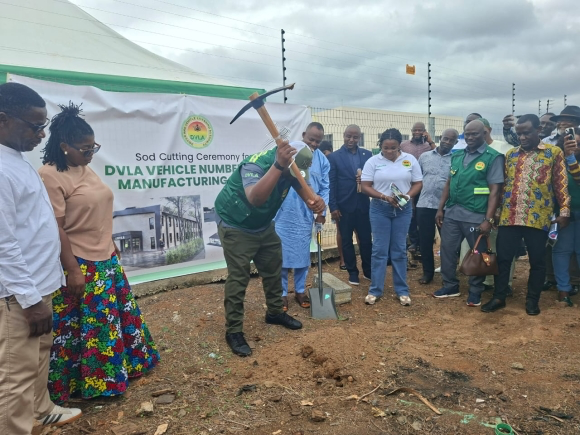
The Driver and Vehicle Licensing Authority (DVLA) has initiated the construction of a state-owned vehicle number plate manufacturing centre in Accra, marking a decisive shift away from its long-standing reliance on imported plates and third-party producers.
The facility, located on the premises of the DVLA’s Greater Accra Regional office, is expected to be completed within three months and will produce number plates embedded with Radio Frequency Identification (RFID) technology . Chief Executive Officer Julius Neequaye Kortey cut the sod on Friday, August 28, 2026, to signal the formal commencement of construction works .
Ending an era of third-party production
The DVLA currently neither manufactures nor embosses number plates. Plates are either imported or produced by external contractors, a system that has drawn criticism over quality concerns and the proliferation of counterfeit plates in the system .
Mr Kortey explained that the manufacturing centre initiative forms part of the Authority’s broader transformational reforms aimed at strengthening the security and integrity of vehicle number plates used in Ghana .
“The sod that has been cut today demonstrates the government’s commitment to reposition the DVLA as a key institution in the road transport sector,” he stated .
Decentralised embossment planned
Under the new arrangement, number plates manufactured at the centre will be distributed to DVLA offices nationwide for embossment . The CEO disclosed that each region across the country would receive an embossment machine, while Greater Accra and Ashanti regions would get five and three machines respectively, reflecting the higher volume of vehicle registrations in those areas .
“When we manufacture our plates, we will distribute them to our offices for embossment. This move will take the service closer to the people,” Mr Kortey said .
Regulation, not elimination of private embossers
Mr Kortey stressed that the DVLA’s decision was not intended to deprive private embossers of their source of livelihood, but rather to bring greater regulation and accountability to the sector .
“What we are saying is that the era where anyone gets the means to manufacture or emboss number plates is a thing of the past. DVLA will regulate embossers to do things right,” he emphasised .
He added that embossers would be spread across the country to ensure that only qualified individuals embossed standardised and quality number plates .
Background: counterfeiting and legal battles
The move comes against the backdrop of significant security concerns. The DVLA CEO previously revealed that about five per cent of number plates in the system are fake, with some counterfeit plates originating through corrupt practices at police stations . The DVLA has also uncovered widespread use of fake and expired DV number plates, warning offenders of impending prosecutions .
The reforms have not been without controversy. A High Court dismissed an application by 26 vehicle embossment companies seeking to halt the DVLA’s number plate contract, following a legal challenge that claimed the contract violated procurement laws and threatened over 3,000 jobs .
The new RFID-enabled plates will allow electronic tracking of vehicles and are part of a broader overhaul of Ghana’s vehicle registration system, which includes scrapping the registration year displayed on plates and tying registration numbers to owners rather than vehicles .


