



For generations, the River Oti has been both a lifeline and a barrier. It has nourished communities, sustained fishing livelihoods, and carved its way through the landscape of the Oti Region. But for the millions who have needed to cross it—traders with perishable goods, families heading to school or hospital, truck drivers hauling produce from Ghana’s northern breadbasket to southern markets—the river has also been an excruciating bottleneck.
The only connection has been the ferry. For decades, the Ndewura Jakpa—named after the legendary Gonja warrior whose name means “conqueror through the spear”—has plied the waters, carrying vehicles, goods, and passengers from one bank to the other. But the ferry, operating since the 1980s, has been unreliable at best and deadly at worst. Breakdowns have stranded travellers for hours or even days. In August 2024, a staff member drowned while trying to fix a broken ferry mid-river. Another diver lost his life that same week, trapped by a ferry propeller. For residents, the ferry has been a symbol of neglect—a daily reminder that their region had been left behind.
Not anymore.
A Promise Fulfilled
In July 2025, President John Dramani Mahama stood before the chiefs and people of the Oti Region and made a pledge: the Dambai Bridge would commence before the end of the year. “I can assure you that this bridge will commence this year,” he declared. He described the Oti Region as “a key transit zone for food and goods from the north to the south” that “deserves focused and targeted investments”.
True to his word, preparatory works began, and by September 2025, Maripoma Enterprise Limited had been awarded the contract. The project officially commenced in January 2026. By the end of June 2026, physical progress had already reached six percent—slightly ahead of schedule. Foundation works are underway, and a temporary steel launching bridge is expected to be installed across the River Oti by the end of July 2026, providing a stable platform for the main column placement.
The bridge will span 1.5 kilometres across the river, a dual-carriageway corridor built with premium Ultrabridge technology and ultra-high-performance concrete designed to secure an operational lifespan exceeding 100 years. It is being financed entirely by the Government of Ghana through domestic resources under the flagship $10 billion “Big Push” Infrastructure Programme.
More Than Concrete and Steel
For the people of Dambai and surrounding communities, however, this is not just about engineering. It is about transformation.
The Dambai Bridge will connect Abongo and Dream Village, opening up both the east and west sides of the town. A new fish market is planned behind Dream Village to boost trade. A military barracks will be located on the Monkrati route. The Municipal Chief Executive of Krachi East, Safo Nketia, has said these projects will “open up the town, encouraging development, investment and making Dambai a hub”.
For residents like James Mawutor and Abubakar Wahab, the arrival of construction equipment has sparked genuine excitement. “Traveling will be faster, trading easier, no more ferry queues—this bridge is a game-changer,” they told the Ghana News Agency.
The economic implications are profound. The Oti Region is a primary national food basket. For years, smallholder farmers have watched their perishable produce—yam, grains, and vegetables—rot while waiting hours for an unreliable ferry. The bridge will replace rigid ferry schedules with a continuous, 24/7 dual-lane highway corridor, slashing cross-river transit times from several erratic hours to under three minutes.
A Test of National Accountability
The project carries political weight as well. For years, infrastructure development in Ghana has suffered from what critics call a “culture of uncompleted election-year promises”. The Dambai Bridge is a litmus test for a new era of administrative accountability.
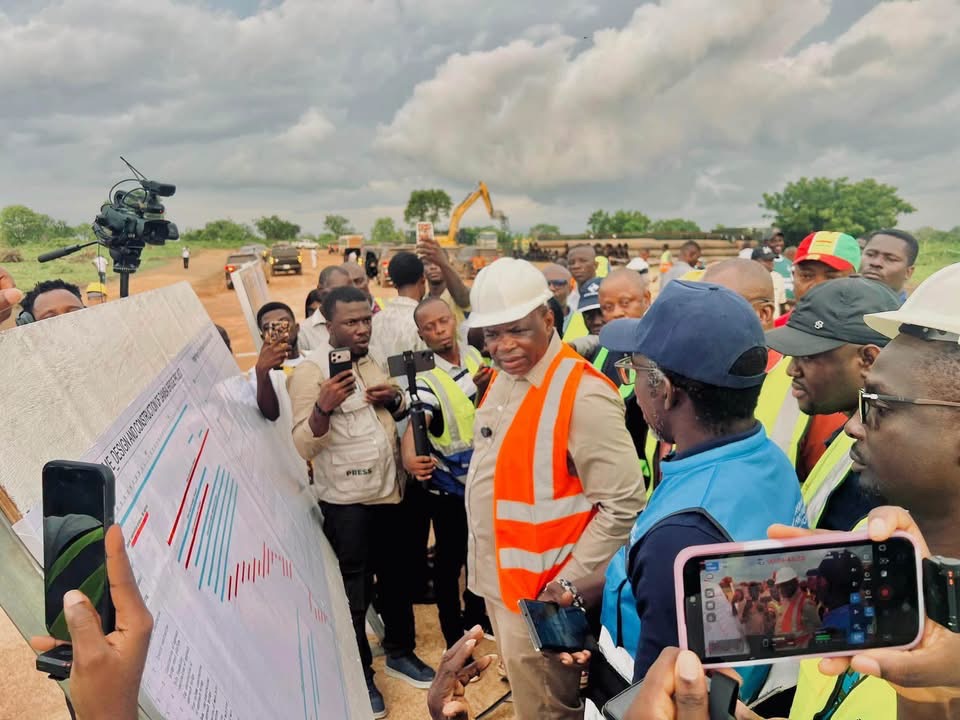
During an inspection tour in July 2026, Roads and Highways Minister Kwame Governs Agbodza made the government’s position unequivocal: “We will not sit down for anybody to delay this project. This project must be completed on schedule”. He charged Maripoma Enterprise Limited to deliver the bridge on time, on budget, and without compromising on quality.
The Minister also revealed a significant shift in how the government approaches such projects. For the first time in years, the contract was awarded on time and an early mobilisation payment was made to the contractor—a practice that had “not been common on some previous government projects”. Regular site inspections are being conducted to quickly resolve any challenges that arise.
“We are doing this with our own resources,” Agbodza said. “No amount of it is a loan we took from other countries, so Ghanaians must be proud that for once we are spending our own money to do something like this”.
The Bigger Picture
The Dambai Bridge is one half of a historic infrastructure push. Together with the 3.6-kilometre Afram Bridge in the Eastern Region, it represents the construction of two of the longest bridges over water bodies in Ghana’s history. Both projects are flagship components of the government’s “Big Push” agenda, a $10 billion infrastructure programme aimed at accelerating national development.
Beyond the bridge, the Oti Region is set to receive its own university within the President’s tenure, alongside extensive road projects including the upgrading of the Okadjakrom–Kwamikrom Road, Abotoase–Atonkor Road, and Kpasa–Tinjase Road, as well as rehabilitation of the Hohoe–Jasikan roads and the Eastern Corridor Road.
By May 2029, when the Dambai Bridge is scheduled for completion, a new chapter will have been written for the Oti Region. The river that once divided communities will finally connect them. The ferry that symbolised neglect will be relegated to memory. And a 1.5-kilometre stretch of concrete and steel will stand as a testament to what is possible when a nation commits to bridging its divides—literally and figuratively.


