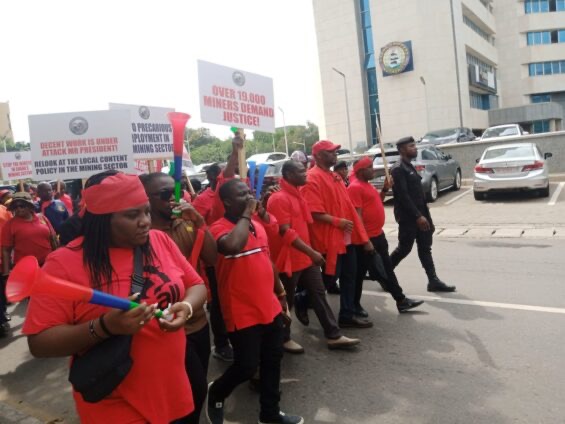
ACCRA — The Ghana Mineworkers’ Union (GMWU) has issued a stark warning to the government, threatening widespread industrial action across the country’s mining sector unless authorities immediately unlock over GH¢380 million in funds belonging to more than 19,000 workers.
In a formal petition dated August 20, 2026, addressed to the Finance Minister, the union demanded urgent intervention to resolve a protracted crisis involving distressed Specialised Deposit-taking Institutions (SDIs) that have held workers’ funds inaccessible since the Bank of Ghana’s financial sector cleanup exercise.
The affected funds encompass Provident Fund contributions, Welfare Funds, Leave Savings, Personal Investments, and Severance Packages — savings that represent years of hard work and financial planning for thousands of mineworkers across Ghana.
Background: The Financial Sector Cleanup
The crisis traces back to the Bank of Ghana’s sweeping financial sector reforms initiated between 2017 and 2019, aimed at sanitizing the banking and non-banking financial institutions. The cleanup exercise led to the revocation of licenses of several banks, savings and loans companies, and microfinance institutions due to undercapitalization, governance failures, and liquidity challenges.
While the central bank has consistently defended the exercise as necessary for financial stability, the cleanup created a category of “distressed institutions” whose depositors — including individuals, pension funds, and corporate entities — have been left in limbo. The Seed Funds Savings & Loans Limited (TSF) and Jislah Financial Services Limited are among the institutions where mineworkers’ funds remain trapped.
Years of Unfulfilled Assurances
The GMWU’s petition reveals a frustrating multi-year engagement with regulators that has yielded little concrete results. The union noted that it first raised concerns with the Bank of Ghana in 2021, holding meetings with the Head of Banking Supervision on April 8 and June 11 of that year.
“At those meetings, we received assurances that the central bank was aware of the challenges and working toward a solution,” the union stated in the petition.
However, despite requesting a follow-up meeting with the Governor of the Bank of Ghana, the union says “the meeting was never arranged, nor have the issues been resolved.”
The union further pointed to public statements made by the Bank of Ghana Governor between 2022 and 2025, as well as International Monetary Fund (IMF) Country Reports published in 2023 and 2024, which recognized the need to resolve outstanding legacy issues in the SDI sector, including longstanding undercapitalization.
Yet, five years after the cleanup began, affected workers remain without access to their funds.
Human Cost: Retirees, Redundant Workers Bear the Brunt
The union highlighted the devastating human impact of the prolonged fund freeze, particularly on workers who have been made redundant or retired.
“Many of our members who have been laid off or retired rely on these funds to support their families, pay medical bills, and meet essential living expenses,” the petition read. “The prolonged inability to access these funds has caused immense hardship and distress.”
The GMWU emphasized that workers have exercised remarkable patience, trusting repeated assurances from the government, the Bank of Ghana, and international partners that solutions were forthcoming.
Government’s Position Raises Concerns
The union’s frustration has been compounded by recent statements attributed to the Finance Minister, suggesting that the Bank of Ghana, as regulator, should recover assets of weak or insolvent institutions and use the proceeds to settle depositors.
Most concerning to the union was a reported statement on July 24, 2026, indicating that the government had “no immediate plans to provide recapitalization support to savings and loans companies.”
The GMWU argues that this position appears inconsistent with previous assurances that remaining legacy issues would be addressed through deliberate policy interventions. The union contends that government support is essential, given the systemic nature of the crisis and the scale of funds trapped in distressed institutions.
Industrial Harmony Under Threat
The union warned that continued delays are increasingly threatening industrial peace in the mining sector — a critical component of Ghana’s economy.
The GMWU cited previous instances of industrial unrest involving workers at Ghana Manganese Company Limited, Future Global Resources (now Heath Goldfields Limited), and Golden Star Wassa Mine, noting that its leadership has worked diligently to prevent further action since 2021.
“The situation is becoming increasingly difficult to manage due to the continued delays and recent statements suggesting that no immediate resolution is in sight,” the union stated.
If the government fails to intervene urgently, the union warned of demonstrations and strikes across the mining sector, which could have far-reaching consequences:
· Production disruptions at major mining operations
· Reduced government revenue from mineral exports
· Damage to investor confidence in Ghana’s mining sector
· Broader economic implications given mining’s contribution to GDP
Union’s Demands
The GMWU is making two clear demands:
- Full refund of all locked-up deposits belonging to affected workers
- An urgent meeting with the Finance Minister to chart a path forward
“Denying these workers access to their legitimate life savings undermines industrial harmony and social stability across mining communities in Ghana,” the petition declared.
A Test for Government Commitment
The mining sector remains one of Ghana’s most important economic pillars, contributing significantly to export earnings, employment, and government revenue. The current impasse presents a significant test for the government’s ability to balance financial sector reforms with protecting citizens’ savings.
As the August 20 deadline for the petition passes, all eyes will be on the Finance Ministry and the Bank of Ghana to see whether they will respond to the union’s demands before tensions escalate into disruptive industrial action.
The GMWU has made it clear: workers have waited long enough, and patience is wearing thin.
For further updates on this developing story, stay tuned to [News Outlet].
Contact: [Email/Phone]
END
Editor’s Note:
This story has been compiled from the GMWU’s official petition dated August 20, 2026, supplemented with background information on Ghana’s financial sector cleanup and the mining industry’s economic significance. The Finance Minister and Bank of Ghana have been contacted for comment.