



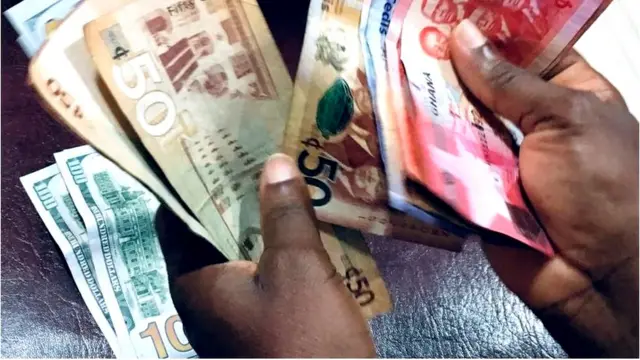
After weeks of sustained pressure that saw the local currency tumble past the GH¢12 mark, the Ghana cedi has mounted a formidable recovery against the US dollar, recording four consecutive days of gains between Tuesday, August 11, and Friday, August 14, 2026.
Data monitored by JOYBUSINESS indicates that the currency’s resurgence is underpinned by a combination of aggressive central bank intervention, improved foreign exchange inflows from the extractive sector, and a noticeable softening of demand from corporate importers.
By the close of trading on Friday, indicative rates at major commercial banks had settled around GH¢11.30 per dollar, while Bloomberg data quoted the cedi at approximately GH¢10.96. The Bank of Ghana’s own reference rate stood at GH¢10.98. This marks a sharp correction from the volatile conditions earlier this month, when some banks were quoting the greenback at over GH¢12—a level that had sparked panic among businesses and importers.
A Central Bank Stepping In with Force
The turnaround appears to have been catalyzed by a deliberate and substantial injection of liquidity by the central bank. Market data compiled by JOYBUSINESS reveals that the Bank of Ghana has deployed over US$8.2 billion into the foreign exchange market between January and July 2026 to stabilize the currency.
This figure comprises approximately US811 million in direct interventions between January and June. With the central bank reportedly planning to sell up to US9.2 billion by the end of this month.
The impact of this sustained intervention was palpable last week. On Tuesday, August 11, the Bank of Ghana offered US85 million. A similar scenario played out on Thursday, August 13, when a second US94 million.
Why Demand Is Cooling
Market participants attributed the reduced demand to several factors. The extractive sector—particularly mining and oil—has seen a steady pipeline of foreign currency inflows, while offshore investors have been increasingly active in purchasing local bonds, lured by attractive yields and the stabilization of the macroeconomic environment.
At the same time, businesses that had been aggressively hoarding dollars in anticipation of further depreciation appear to be scaling back their purchases, a shift that has helped ease the supply-demand imbalance.
Regulatory Measures and the Outlook
It remains unclear whether recent regulatory changes affecting commercial banks’ foreign currency holdings have also contributed to the improved conditions. However, bankers engaged by JOYBUSINESS expressed cautious optimism, predicting that the cedi’s recovery would likely be sustained in the coming weeks.
“We are seeing a fundamental shift in market sentiment,” one treasury official remarked. “Inflows are improving, and the panic buying that characterized the past few weeks has subsided. If the central bank maintains its current level of intervention, we could see further appreciation.”
Adding to the positive outlook is the prospect of additional donor inflows in the near term, which are expected to bolster Ghana’s already robust reserves. At the end of June, the country’s gross international reserves stood at US$12.9 billion—a level authorities have repeatedly cited as adequate to defend the currency against temporary shocks.
BoG Assures Public on Currency Stability
The Bank of Ghana has described the recent recovery as consistent with its Exchange Rate Management Framework, which emphasizes a market-driven approach supplemented by targeted interventions. Sources close to the central bank have indicated that they expect the cedi to strengthen further in the coming week.
In a message to the business community, the central bank urged calm, noting that temporary pressures on the currency were not unusual and that the country’s strong reserve position provided ample firepower to stabilize markets.
“We have the resources and the resolve to support the foreign exchange market whenever necessary,” a senior official said. “Businesses should not panic; the fundamentals remain sound.”
A Fragile but Encouraging Turn
While the cedi’s recent performance offers a welcome reprieve, analysts note that the currency remains vulnerable to external shocks, including fluctuations in commodity prices and global interest rates. However, the combination of sustained central bank support, easing demand, and improved inflows appears to have restored a measure of equilibrium—at least for now.
For many Ghanaians and businesses who have endured months of uncertainty at the forex bureau and bank counters, the four-day rally is a rare sign of hope that the worst may be behind them. Whether that hope endures will depend on the central bank’s continued vigilance and the resilience of the underlying economy.


