



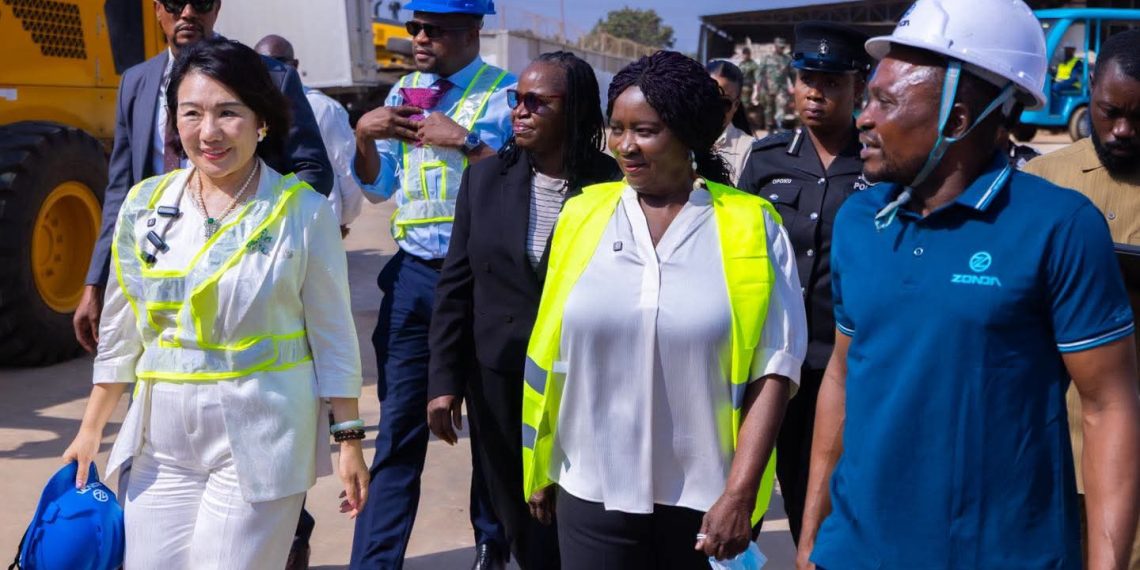
Vice President Professor Jane Naana Opoku-Agyemang has called on Zonda Tec, a leading vehicle assembly company operating in Ghana, to accelerate the local production of vehicle components, as the government moves to deepen local content retention and capture a greater share of the automotive industry’s value chain.
During a working visit to the Zonda Tec assembly plant in Tema, the Vice President inspected the company’s production lines for trucks, specialised vehicles, and machinery, and urged management to move beyond the current Completely Knocked Down (CKD) assembly model toward fuller domestic manufacturing of parts. “I encouraged the company to expand its operations by exploring opportunities to manufacture additional components locally,” Prof. Opoku-Agyemang stated. She emphasised that increasing local content would strengthen domestic supply chains, create sustainable jobs, and ensure that a larger portion of the revenue generated by the automotive sector remains within Ghana’s economy.
A Strategic Pivot to Localisation
The Vice President’s call aligns with Ghana’s broader industrialisation strategy, which prioritises import substitution and the development of local supply networks. Under the country’s Automotive Development Programme, launched in 2019, Ghana has attracted major assemblers including Volkswagen, Toyota, Suzuki, and Zonda Tec, offering tax incentives and reduced import duties on CKD kits. However, critics have noted that most assembly plants still rely heavily on imported parts, with local content often falling below 15 per cent—well short of the government’s target of 50 per cent localisation by 2030.
Zonda Tec, a subsidiary of the Zonda Group, has been operating in Ghana since 2021, assembling commercial vehicles, pickup trucks, and buses. The company also produces specialised machinery for agriculture, construction, and mining sectors. During the tour, Prof. Opoku-Agyemang observed the CKD assembly process, where imported semi-knocked-down parts are welded, painted, and fitted with locally sourced tyres, batteries, and upholstery. She also witnessed quality-control tests covering braking performance, suspension dynamics, and water resistance—critical standards for Ghana’s often rugged road conditions.
The Vice President further inspected the company’s light vehicle assembly line, which includes hybrid and electric vehicle models, underscoring the growing adoption of lower-emission technologies. She noted that as Ghana seeks to meet its transport needs while reducing carbon emissions, domestic production of cleaner vehicles is both an environmental and economic imperative.
Linking Industry to the 24-Hour Economy
Prof. Opoku-Agyemang linked the expansion of local manufacturing to the government’s flagship 24-Hour Economy initiative, which aims to boost industrial output by encouraging round-the-clock operations in manufacturing, services, and logistics. “The 24-Hour Economy can create opportunities for enterprises like Zonda Tec to increase production capacity and employment, particularly for shift workers,” she said. The policy is designed to maximise the use of existing infrastructure, reduce idle time, and provide flexible work schedules for Ghanaians—especially the youth.
She also stressed the importance of bridging the skills gap between education and industry. “Our training institutions and industries must work more closely so that the skills we develop align with the opportunities available within our economy,” she said. She commended Zonda Tec for its investment in in-house apprenticeship programmes and on-the-job training, but urged the company to deepen partnerships with technical universities and vocational schools to produce a pipeline of locally trained engineers, welders, and mechatronics technicians.
Background: Ghana’s Automotive Ambitions
Ghana’s push into vehicle assembly is part of a continental trend. Neighbouring countries such as Nigeria, Kenya, and Morocco have also established automotive hubs, competing for foreign direct investment. The government has set a target of producing 100,000 vehicles annually by 2027, with exports to the West African sub-region under the African Continental Free Trade Area (AfCFTA) framework.
However, the sector faces challenges: high cost of electricity, inconsistent supply of raw materials, and the need for a robust ecosystem of component suppliers—tier-1 and tier-2 manufacturers that can produce glazing, wiring harnesses, seats, and even engine parts locally. Currently, Ghana imports over 90 per cent of its automotive components, contributing to a persistent trade deficit in machinery and transport equipment, as highlighted in the Ghana Statistical Service’s two-decade trade review released earlier this week.
A Call for Investment and Collaboration
Prof. Opoku-Agyemang’s visit signals the government’s intent to move beyond assembly to full-scale manufacturing. She urged Zonda Tec to explore the production of more components such as chassis frames, suspension systems, and electrical wiring—items that could be manufactured using local steel, aluminium, and copper, which are already produced in Ghana by companies like B5 Plus and Western Cluster. She also encouraged the company to source raw materials from local suppliers to reduce import dependency and shorten supply chains.
In response, Zonda Tec management expressed willingness to expand local sourcing, but cited challenges including the absence of local suppliers with the required quality certifications, the high cost of local steel compared to imports, and the need for government support in establishing industrial parks with shared utilities. The Vice President acknowledged these concerns and assured that the Ministry of Trade and Industry is working on a revised local content policy for the automotive sector, including preferential procurement for locally assembled vehicles, expanded tax incentives for component manufacturers, and the establishment of a national automotive testing laboratory.
Commitment to Skills and Technology
Prof. Opoku-Agyemang concluded by reiterating the government’s commitment to creating an enabling environment for industrial growth. She praised Zonda Tec for its investment in technology and training, and urged the company to continue scaling up local production, not only for the domestic market but also for export to other African countries.
“We must build an automotive ecosystem that creates jobs, transfers technology, and retains value,” she said. “That is how we transform Ghana from a consumer of imported vehicles to a producer of made-in-Ghana vehicles—with more and more of the parts made right here in our own factories.” Her visit comes as the government prepares to release a new National Automotive Policy, which is expected to mandate higher local content thresholds and provide stronger incentives for component manufacturers, marking a pivotal step in Ghana’s journey toward true industrial self-reliance.


