



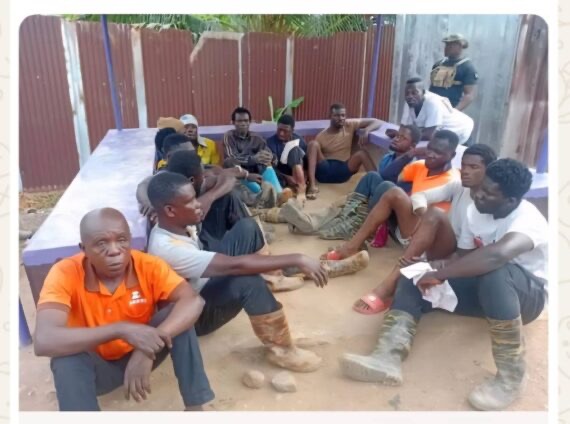
The National Anti-Illegal Mining Operations Secretariat (NAIMOS) has arrested 40 suspects and seized a vast array of mining equipment in a week-long, intelligence-led operation across six of Ghana’s most heavily affected mining regions, marking one of the most expansive crackdowns on illegal small-scale mining—commonly known as galamsey—in recent years.
The operation, conducted from July 27 to August 2, 2026, targeted riverine and forest areas in the Western North, Western, Ashanti, Ahafo, Savannah, and Eastern Regions. According to a report released by NAIMOS, the task force concentrated its efforts along the Ankobra, Bia, Torya, Tano, and Butre rivers, as well as in the Desire Forest Reserve and around the Birim River and the Tepa-Goaso District—areas notorious for illicit mining that has devastated water bodies and farmlands.
Major Arrests and Seizures
In a high-profile raid on July 29 at Sikaniasem, in the Western North Region, security personnel arrested eight individuals, including two Chinese nationals identified as Luo Xiaoqiang, 47, and Fuxue Qiang, 48. The six Ghanaians arrested alongside them—Lushao Adam, 29; Razak Alhassan, 24; Abdul Majeed Dauda, 26; Bilal Yakubu, 18; Mangel Yankey, 19; and Iddrisu Alhassan, 26—were handed over to police for further investigation.
The operation yielded one excavator, a Toyota Land Cruiser, an excavator monitor, a generator, three motorbikes, nine water pumps, and a single-barrel 12-gauge short gun. In addition, the task force destroyed 14 water pumps, seven chanfang machines (Chinese-designed sluice boxes used for gold recovery), four generators, and five makeshift structures that served as operational bases for the illegal miners.
Meanwhile, in the Western Region, a separate sweep on July 29 at Tarkwa Nsuaem, Mpohor, and Ellembelle led to the arrest of 19 Ghanaian suspects, who were also handed over to the Esiama Police Station.
Intelligence and Community Challenges
The NAIMOS report noted that the task force conducted extensive reconnaissance in and around Dadieso, Sefwi Ahibenso, Sefwi Dwenase, Kramokrom, Adjakaa, KKB Village, and surrounding cocoa farms. The patrols uncovered clear evidence of prospecting and test excavations, and identified several financiers believed to be bankrolling the operations, including Nana Osei Bonsu, Ezana Kasei Awudu, and Emmanuel Amoah.
However, the operation was hampered by a wall of silence from local communities. “Community members were generally reluctant to provide information for fear of intimidation and reprisals by illegal miners,” NAIMOS stated in its weekly report, underscoring the entrenched nature of galamsey syndicates and the climate of fear they cultivate.
Background: A National Crisis
The crackdown comes as Ghana grapples with a decades-old illegal mining crisis that has ravaged the environment, poisoned rivers with mercury and cyanide, and destroyed vast swathes of forest reserves and agricultural land. Despite multiple government interventions—including military-led task forces like Operation Vanguard and the more recent Operation Halt—galamsey has persisted due to high gold prices, widespread unemployment, and the involvement of politically connected financiers.
NAIMOS was established in early 2026 as a dedicated secretariat to coordinate and sustain anti-galamsey operations, moving beyond episodic raids to a continuous, intelligence-driven approach. This latest operation is seen as a test of the secretariat’s ability to maintain pressure across multiple fronts simultaneously.
The environmental toll has been staggering. The Ankobra and Birim rivers, once vital sources of drinking water and irrigation, now run heavily silted and polluted. The illegal mining has also encroached on cocoa-growing regions—the backbone of Ghana’s agricultural exports—threatening the livelihoods of thousands of farmers. The recent surge in gold prices, which has buoyed Ghana’s overall trade surplus (as reported earlier this week), has paradoxically incentivised more illegal activity, making enforcement a delicate balancing act.
Sustained Campaign Ahead
NAIMOS has vowed to continue these joint operations, stressing that the seizures and arrests are only the beginning. “The task force will not relent,” a senior official said, speaking on condition of anonymity. “We are mapping out financiers, tracing supply chains, and working with local authorities to break the cycle of impunity.”
Yet the challenge remains formidable. With illegal mining often involving foreign nationals and local collaborators, and with communities heavily dependent on the income from even illicit operations, the secretariat faces an uphill battle to win both the enforcement war and the hearts of residents. The 40 arrests and equipment seizures are a significant blow, but as the report itself admits, the fear of reprisals and the deep-rooted economic incentives mean that this battle is far from over.


