



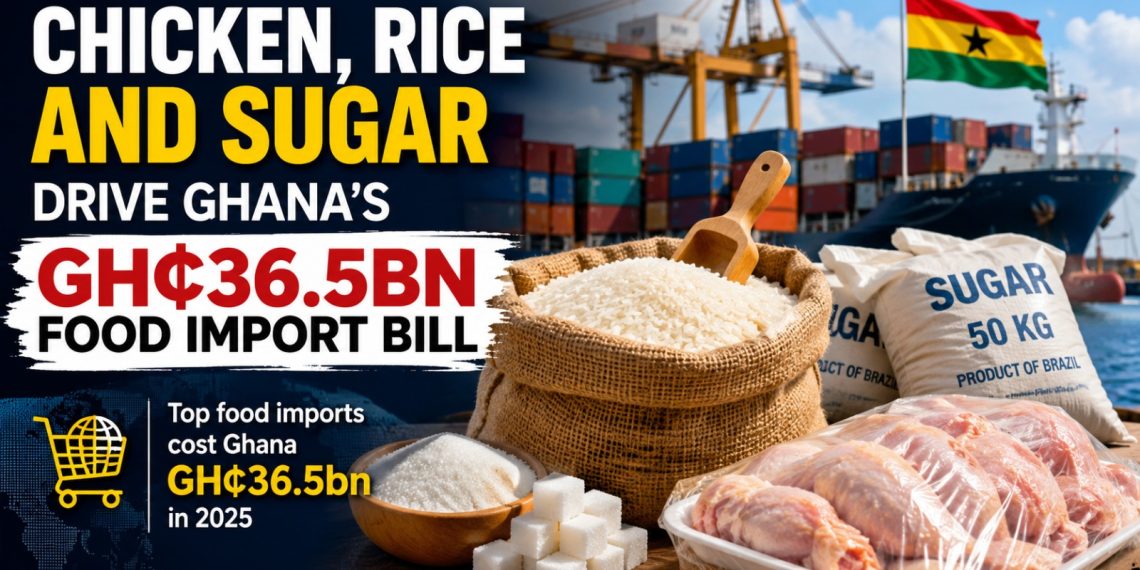
Ghana spent more than GH¢36.5 billion importing food products in 2025, with processed cereal grains, frozen chicken and animal products accounting for a significant share of the country’s food import bill, the latest Annual International Merchandise Trade Statistics Report by the Ghana Statistical Service (GSS) has revealed.
The report puts the value of food imports at GH¢36.46 billion, highlighting the country’s continued dependence on foreign supplies to meet demand for key food commodities.
Rice, chicken dominate import bill
Processed cereal grains were Ghana’s largest food import, valued at GH¢2.94 billion and accounting for 8.1 per cent of total food imports.
Frozen chicken ranked second at GH¢2.84 billion, followed by animal guts, bladders and stomachs, which were imported at a cost of GH¢2.72 billion.
Rice featured twice among the country’s top food imports. Semi-milled or wholly milled rice was valued at GH¢2.39 billion, while broken rice accounted for another GH¢1.19 billion.
Other major food imports included sugar, frozen fish, palm oil, mangoes and shea nuts.
The four leading food imports — processed cereal grains, frozen chicken, animal products and rice — collectively accounted for 30 per cent of Ghana’s food import bill.
Ghana’s poultry deficit
The figures underscore the scale of Ghana’s food import dependence even as the country continues to expand agricultural production and promote import substitution.
According to the Ministry of Food and Agriculture, Ghana produces merely 4.6 per cent of its poultry needs, out of the total 324,000 tons of poultry consumed in the country, only 15,000 tons are produced locally. The country spends between US400 million on poultry imports annually.
President John Dramani Mahama has described the situation as “unsustainable”, revealing that Ghana spent US$350 million in 2023 alone on chicken imports. In response, the government launched the Nkokɔ Nkitinkiti programme in November 2025, targeting 100 per cent local chicken production within three years.
Rice imports hit one million metric tonnes
Ghana’s rice imports are projected to hit one million metric tonnes in the 2025/2026 season, covering more than half of national demand, according to the US Department of Agriculture’s Grain and Feed Annual Report.
The USDA forecasts milled rice production at 900,000 metric tonnes, an 18 per cent increase from the previous year, driven by favourable weather and improved farmer participation. However, consumption is expected to reach 1.80 million metric tonnes, up from 1.75 million, driven by population growth and changing dietary habits.
With 70 per cent of rice sold in Ghana imported — largely from Vietnam, India and Thailand — local producers struggle to compete on cost and quality. The USDA warns that structural challenges, including poor irrigation, low mechanisation and weak processing capacity, continue to undermine local rice competitiveness.
Sugar imports cost US$350 million annually
Ghana spends about US$350 million annually on sugar imports, a situation the government is determined to change through local production of sugarcane and stevia. A sugar processing factory has already been established, with efforts underway to operationalise it following renewed commitment from the President.
Government rolls out interventions
The government, through the Ministry of Food and Agriculture, has launched the Feed Ghana Programme, a flagship initiative aimed at transforming the agricultural sector, reducing import dependency, and boosting both domestic production and exports.
The programme targets value chains where Ghana has both high demand and untapped potential, including rice, maize, soybean, poultry, cattle and vegetables. It aims to substitute imports with domestic production, saving the country foreign currency while creating opportunities for farmers and processors.
Additionally, the government is expanding irrigation infrastructure to ensure year-round farming and a consistent supply of raw materials for processing industries.
Export opportunities
On the export side, the GSS report points to growing opportunities in value-added agriculture and agro-processing, with processed cocoa products, cashew nuts, tuna and shea-based products emerging as important contributors to Ghana’s food export profile.
Ghana remains the second-largest producer of cassava globally, and the government is determined to leverage that achievement to strengthen agro-industrial growth. “Our goal is to add value to our raw materials,” said Minister for Food and Agriculture, Eric Opoku. “The challenge is that we export raw materials and earn very little, only to buy back finished products at higher prices.”
Way forward
The contrast between Ghana’s food imports and exports highlights both the opportunities and challenges facing the agricultural sector. While Ghana continues to earn from cocoa, cashew and other export products, the country remains heavily reliant on foreign markets for staples and protein products consumed locally.
The report identifies stronger domestic production, agro-processing and value addition as critical to reducing food import dependence and improving the resilience of Ghana’s agricultural economy.
With food inflation having dropped from 28.3 per cent to 9.5 per cent by October 2025 following targeted support programmes, stakeholders remain optimistic that sustained investment in agriculture can gradually reverse the country’s heavy reliance on imported food.


