



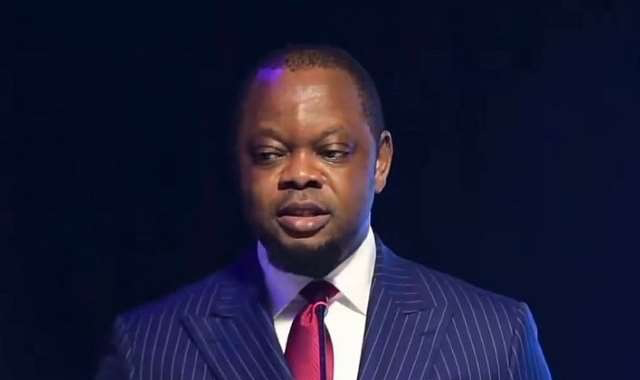
Deputy Attorney-General and Minister for Justice, Dr. Justice Srem-Sai, has firmly restated that the Office of the Special Prosecutor (OSP) was established through ordinary parliamentary legislation under Article 106 of the 1992 Constitution, and not via a constitutional amendment process. His remarks come just days before the Supreme Court is set to deliver a landmark judgment on whether the OSP’s independent prosecutorial powers are constitutionally valid.
Speaking on JoyNews’ The Law with Samson Lardy Anyenini on Sunday, July 26, Dr. Srem-Sai argued that the OSP Act (Act 959) was passed following the standard legislative procedures outlined in Article 106, and therefore cannot be construed as having amended or overridden Article 88, which vests the authority over public prosecutions solely in the Attorney-General.
“The OSP Act is an ordinary legislation passed under Article 106, not under the constitutional amendment procedures,” he said. “It is difficult for me to say or to accept the view that the OSP Act has changed the provision of the Constitution, especially when the provision that we are even standing on says ‘subject to’.”
The Constitutional Battle: A Fight Over Prosecutorial Independence
The Deputy AG’s intervention comes amid a high-stakes legal challenge before the Supreme Court, which is expected to rule on July 29, 2026. Private legal practitioner Noah Adamtey filed the suit, seeking a declaration that sections of Act 959—specifically Sections 3(3) and 4—which grant the OSP independent authority to initiate, conduct, and terminate prosecutions without the Attorney-General’s oversight, are inconsistent with Articles 1(2), 88(3) and (4), 93(2), and 296 of the 1992 Constitution. He argues that these provisions effectively carve out a parallel prosecutorial apparatus outside the constitutional framework, thereby rendering them null and void.
The Attorney-General, represented by Dr. Srem-Sai, has maintained that Article 88(3) unambiguously vests prosecutorial authority in the Attorney-General. He contends that Parliament overstepped its bounds by requiring the Attorney-General to delegate parts of that constitutional power to the OSP, effectively limiting the Attorney-General’s responsibility for criminal prosecutions.
A Decade of Anti-Corruption Ambition vs. Constitutional Fidelity
The OSP was established in 2017 under the NPP government as a flagship anti-corruption institution, designed to be independent of political interference. Its creation was hailed by civil society as a major step toward tackling endemic graft. However, from its inception, legal scholars and political commentators have debated whether its independence contravenes the clear wording of Article 88, which states that “the Attorney-General shall be responsible for the initiation and conduct of all prosecutions of criminal offences.”
The controversy has deepened over the years as the OSP, under successive Special Prosecutors, has pursued high-profile cases—including allegations against public officials—often drawing criticism from government quarters. The current legal challenge, if successful, could strip the OSP of its prosecutorial teeth, reducing it to an investigative body reliant on the Attorney-General for any formal charges.
Civil Society Piles In, Court Rejects OSP’s Own Bid to Join
In January 2026, the Supreme Court unanimously rejected an application by the OSP itself to join the case as an interested party, holding that the constitutional questions could be fully determined between the plaintiff and the Attorney-General. However, the court did grant a motion by 14 civil society organisations (CSOs)—including Transparency International Ghana, CDD-Ghana, IMANI Africa, and the Ghana Anti-Corruption Coalition—to intervene. Their lawyer, Kizito Beyuo, argued that the groups had played a central role in advocating for the OSP’s establishment and possess specialised expertise that would assist the court in understanding the broader implications of the case. Their presence signals the deep public interest at stake, as a ruling against the OSP could deal a severe blow to Ghana’s anti-corruption efforts.
The “Subject To” Clause: A Key Legal Nuance
Dr. Srem-Sai’s repeated emphasis on the phrase “subject to” in Article 88 is pivotal. The full text of Article 88(3) reads: “The Attorney-General shall be responsible for the initiation and conduct of all prosecutions of criminal offences, subject to the provisions of this Constitution or any other law.” Proponents of the OSP’s independence argue that the phrase “subject to … any other law” allows Parliament to create exceptions through ordinary legislation. The Deputy AG, however, contends that this does not empower Parliament to wholly remove prosecutorial authority from the Attorney-General—it only permits limited modifications that do not undermine the constitutional structure.
What’s at Stake for Ghana’s Anti-Corruption Fight
The upcoming verdict has riveted the nation. If the Supreme Court rules in favour of Noah Adamtey, the OSP would be stripped of its independent prosecution powers, effectively making it a subordinate office under the Attorney-General’s department. Critics fear this could politicise corruption cases, while supporters of the Attorney-General argue it would restore constitutional order and prevent the creation of a “state within a state.”
Conversely, if the court upholds the OSP’s independence, it will validate the interpretation that Parliament can establish specialised prosecution bodies through ordinary legislation—a precedent that could encourage the creation of other independent offices outside the traditional constitutional hierarchy.
A Divided Public, a Unanimous Court?
The seven-member panel, chaired by Chief Justice Paul Baffoe-Bonnie, has heard extensive arguments from both sides. While the court is known for its rigorous constitutional interpretation, observers are watching closely to see whether the justices will prioritise a textual reading of Article 88 or give weight to the policy objectives behind the OSP’s creation.
For now, Dr. Srem-Sai has made his position unequivocal: the OSP is a creature of statute, not the Constitution, and cannot claim powers that the Constitution reserves for the Attorney-General. His comments have reignited debate among legal practitioners, with some hailing his clarity and others accusing him of trying to pre-empt the court’s ruling.
As July 29 approaches, the nation holds its breath. The judgment will not only define the future of the OSP but will also test the boundaries between legislative creativity and constitutional supremacy—a question that has echoed through Ghana’s legal corridors since the 1992 Constitution came into force. Whatever the outcome, the debate over prosecutorial independence is far from over.


