



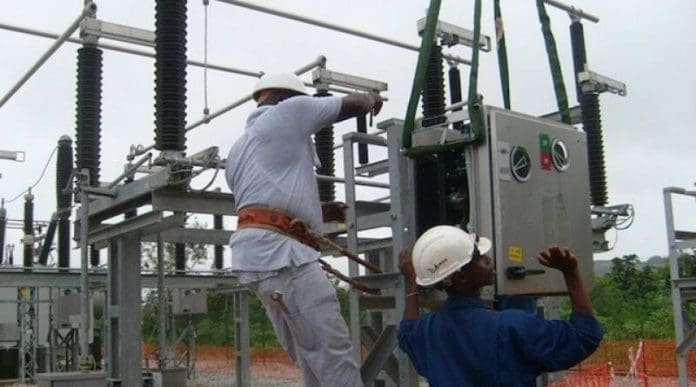
Residents and businesses across Ashaiman and parts of the Greater Accra Region will endure a 15-hour power disruption today, Sunday, August 16, as the Ghana Grid Company Limited (GRIDCo) undertakes emergency repairs on a severely damaged transmission tower—an incident triggered by a fuel tanker explosion within a protected power corridor.
The planned outage, which commenced at 3:30 a.m. and is scheduled to last until 6:00 p.m., is necessary to allow engineers to safely replace the compromised tower on the 161kV Tema–Achimota transmission line. This high-voltage artery is a critical backbone of the national grid, supplying electricity to the capital’s central business districts, industrial hubs, and densely populated residential areas. The extended duration of the outage—spanning the entire daylight hours—will inevitably disrupt commercial activities, hospital operations, water supply systems, and small-scale businesses that rely heavily on refrigeration and continuous processing.
Root Cause: Welding Mishap at Ashaiman Middle East
According to a statement issued by GRIDCo on Saturday evening, the disaster occurred when a fuel tanker, parked within the Right-of-Way (RoW) of the transmission line at Ashaiman Middle East, exploded while welding work was being carried out on its tank. The blast triggered a fire that compromised the structural integrity of the steel transmission tower, leaving it dangerously unstable and requiring immediate replacement.
The incident underscores a recurring and deadly risk: the unregulated occupation of buffer zones beneath high-tension lines. The 161kV lines carry lethal voltages, and conducting volatile welding repairs on a fuel-laden vehicle directly beneath them represents a catastrophic safety breach that could have resulted in far worse casualties.
Economic and Social Ripples
For the affected zones, the 15-hour blackout is more than an inconvenience. Sunday is a peak day for church services, family gatherings, and the hospitality sector, all of which will be forced to rely on expensive diesel-powered generators—if available. In the Tema industrial enclave, which is fed by this line, production schedules are being shelved. Meanwhile, healthcare facilities in Ashaiman have been advised to activate backup systems ahead of the morning peak hours.
Legal Backdrop and Ministerial Ultimatum
This incident has reignited urgent concerns over the persistent encroachment on transmission corridors. GRIDCo has cited the Transmission Line Protection Regulations, 1967 (L.I. 542), as amended by L.I. 1737 of 2004, which explicitly prohibit unauthorised construction, excavation, welding, and commercial activities—including garages and lorry parks—within the designated buffer zones.
GRIDCo’s warning is buttressed by a recent directive from the Minister for Energy and Green Transition, Dr. John Abdulai Jinapor, who issued a one-month ultimatum to all persons, businesses, and land users unlawfully occupying the Rights-of-Way. The directive demands the immediate cessation of such activities and the vacation of the affected areas. The minister has made it clear that the corridors are designated infrastructure zones, not land for commercial exploitation.
Enforcement on the Horizon
Following the expiration of the one-month grace period, GRIDCo has announced that it will collaborate with Metropolitan, Municipal, and District Assemblies (MMDAs), alongside statutory institutions and security agencies, to enforce the directive. This means unauthorised structures within the corridors could be demolished, and offenders may face legal prosecution.
In its appeal to the public, GRIDCo stressed that the safety of lives and the reliability of the national power grid depend on strict adherence to these regulations. The company has urged traditional authorities, landowners, and local assemblies to assist in keeping the transmission lanes free of encroachment.
“These Rights-of-Way are protected zones for critical national infrastructure,” GRIDCo noted. “They are not intended for unrestricted occupation or commercial gain.”
As emergency crews race against the clock to complete the tower replacement by 6 p.m., the incident serves as a stark reminder of the fragile relationship between urban expansion, economic activity, and the integrity of Ghana’s power transmission network. Residents are advised to unplug sensitive electronic appliances and prepare for a long Sunday without mains electricity.


