



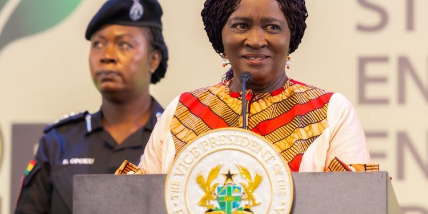
Vice President Professor Jane Naana Opoku-Agyemang has urged countries of the Global South to draw lessons from China’s development experience while resisting the assumption that they must adopt its political system, arguing that the next chapter of developing-world progress must be defined by effective governance and economic capacity rather than political sovereignty alone.
She made the call in her opening address at the 2026 Global South Academic Forum in Shanghai, China, held under the theme “Global South Political Parties: Governance and Modernisation.” The forum, initiated by the International Communication Research Institute of East China Normal University, brought together scholars, policymakers and media professionals from Africa, Asia and Latin America to discuss governance, economic transformation and the evolving role of developing countries in global affairs.
The Vice President’s participation was expected to place Ghana’s development priorities within broader discussions on governance, international cooperation and the influence of the Global South.
Political independence ‘only the preliminary phase’
Reflecting on the historical struggles that shaped the Global South — including the Pan-African vision of Osagyefo Dr. Kwame Nkrumah and liberation movements across Asia, Africa, Latin America and the Caribbean — Professor Opoku-Agyemang stressed that winning political independence represents only the preliminary phase of nation-building.
She noted that the primary task confronting developing countries remains the establishment of robust institutions, competitive economies and administrative structures capable of addressing the needs of their citizens. Electoral success and effective governance, she said, represent two distinct responsibilities, urging political parties, governments, universities and statutory bodies to continuously adapt, bolster transparency and build capacity to respond to changing global dynamics.
“Our task is to develop the intellectual confidence to compare experiences, identify lessons, and recognise that institutions must ultimately reflect the societies they are intended to serve,” she said.
China as a development reference point
Professor Opoku-Agyemang described China’s transformation over the past several decades as one of the most consequential development stories of the modern period, pointing to long-term strategic planning, industrialisation, poverty reduction and institutional synergy as areas warranting closer study.
“China has pursued a modernisation pathway shaped by its history, institutions, political system, and national priorities,” she said. “For scholars and policymakers across the Global South, China’s experience invites closer examination.”
But she was careful to draw a distinction between learning and emulation. Genuine South-South cooperation, she argued, must rely on mutual learning rather than forcing nations to adopt identical growth models, adding that unique historical realities demand customised solutions.
“The most productive principle for South-South dialogue is that we should learn from one another without assuming that we must become one another,” she said. “We can, however, sit across from one another with sufficient confidence and humility to compare what worked, what failed, which institutions enabled progress, and which mistakes others might avoid.”
A fairer global financial architecture
Beyond governance, the Vice President used the platform to press for reforms to the international financial system, arguing that global financial arrangements must respond to the needs of developing countries without deepening their economic vulnerabilities.
She noted that although Global South countries account for a substantial share of the world’s population, natural resources and economic activity, their representation in international institutions remains a concern. The global order, she said, must evolve to reflect contemporary realities and give developing countries a meaningful voice in decisions affecting their economies and populations.
She also called for global climate arrangements to reflect the different circumstances and capacities of developing countries, rather than treating their development challenges as identical.
Education, technology and the next generation
Professor Opoku-Agyemang urged accelerated partnerships in research, higher education, technology and innovation, emphasising that universities across the Global South must actively collaborate to share critical knowledge on artificial intelligence and emerging technologies.
South-South cooperation, she added, should extend beyond infrastructure development to strengthen local productive capacity, support research and innovation, and create opportunities for young people.
On the domestic front, she highlighted the role of political parties in shaping national development and sustaining democratic institutions, saying they must strengthen policy development, political education and democratic accountability while creating greater opportunities for women and young people to participate in political processes.
The Ghana-China backdrop
Her remarks come against the backdrop of steadily deepening Ghana-China relations. In January 2026, the two countries signed a US$30 million grant for the construction of a new university in Damongo, part of China’s continued support for Ghana through grants, concessional loans and technical cooperation. In September, Chinese Vice-President Han Zheng pledged to advance cooperation with Ghana in mining, green energy, vocational training and youth development, and encouraged Ghana to make full use of China’s zero-tariff measures for African countries.
The Vice President’s central message in Shanghai was that the Global South’s next chapter must be defined not only by political sovereignty, but by the capacity to govern effectively, innovate and shape a fairer global order. As she put it, constructive partnerships do not require total consensus — only principled dialogue and a willingness to learn from both shared successes and missteps.


