



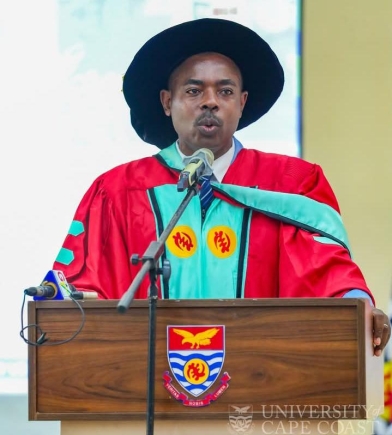
A Professor at the University of Cape Coast (UCC) has developed a revolutionary handheld device capable of detecting unsafe food within seconds, marking a major breakthrough in Ghana’s food safety architecture.
Professor Ernest Teye, an expert in Agri-food Integrity Engineering at the Department of Agricultural Engineering, led a team to create the tool which uses advanced light-based sensing technology to analyse the chemical composition of food without destroying samples.
The innovation operates on near-infrared spectroscopy, scanning food items to detect hidden substances such as harmful chemicals, toxins, and adulterants that are invisible to the naked eye. Once scanned, the device cross-references the data with an inbuilt database and delivers instant feedback on a connected screen or mobile application, indicating whether the food is safe or contaminated.
Delivering his inaugural lecture in Cape Coast on Thursday, Prof. Teye said the technology could be a game-changer for regulators, farmers, and consumers by enabling early detection of unsafe food and preventing health risks.
Call for National Food Integrity Framework
The professor used the occasion to call for the establishment of a national framework to safeguard food integrity, warning that food fraud remains a largely hidden threat to public health.
He expressed concern that deliberate substitution, addition, tampering, or misrepresentation of food for economic gain could be silently endangering lives. He urged stakeholders to treat food safety as a national priority, backed by greater public awareness.
“We already have the oracle within us through our senses, but science has enhanced that oracle through technology to help us detect unsafe food quickly and accurately,” he said.
Prof. Teye also raised alarms over the widespread use of substandard agricultural inputs, particularly counterfeit fertilisers and poor-quality seeds, which he said continue to undermine productivity across Africa. Despite the continent’s vast arable land, output remains low due to weak monitoring systems.
“Garbage in, garbage out. If the inputs are not right, the output will never be right,” he stressed.
He noted that his team has also developed portable technologies capable of analysing soil nutrients, detecting fake fertilisers, and verifying seed quality within seconds—tools that could be deployed directly on farms to boost yields and reduce losses.
Plans for AfriFood Integrity Centre
Prof. Teye disclosed plans to establish an AfriFood Integrity Centre at UCC to promote research, training, and policy development in food safety and agricultural innovation. The centre, he said, would support efforts to train farmers, develop rapid detection technologies, and strengthen regulatory systems.
“Food is not just what we eat; it is medicine, it is health, and it is life. If we protect the integrity of our food, we protect the future of our nation,” he said.
He expressed confidence that with the right mix of policy support, technology, and innovation, Ghana could emerge as a major food producer and exporter. He encouraged young people and researchers to explore opportunities in agricultural innovation to build a resilient food system capable of withstanding climate change and global food challenges.
Commitment to Academic Excellence
Chairing the lecture, the Acting Vice-Chancellor of UCC, Prof. Denis Worlanyo Aheto, said inaugural lectures form part of the university’s efforts to promote academic excellence and showcase research that addresses national development challenges.
He reaffirmed the university’s commitment to providing platforms for scholars to share innovations that could inform policy, support industry growth, and contribute to national progress.


