



In the court of public opinion, the Director General of the National Sports Authority, Yaw Ampofo Ankrah, has faced relentless attacks over the state of Ghana’s national stadia. Critics have been quick to paint the leadership as negligent—an authority asleep at the wheel .
But those who have followed developments closely know a different story is unfolding.
Behind the scenes, a quiet but determined transformation is taking place. The NSA chief, who has largely refrained from engaging in public spats with his detractors, has instead chosen to let the work speak for itself. And for the first time in years, the evidence is becoming impossible to ignore.
The Technical Reality
Sources close to the NSA leadership indicate the decision to stay above the fray stems from a sober recognition that most critics lack the technical understanding required to appreciate the complexity of modern stadium maintenance. Pitch technology, irrigation systems, floodlight upgrades, and turf management are specialised disciplines that demand time, expertise, and significant capital investment.
“The Director General understands that responding to every criticism would be a full-time job in itself,” a senior NSA official told me. “He has chosen instead to channel that energy into actual results. People will see, not just hear.”
Esipong Stadium: A Case Study in Persistence
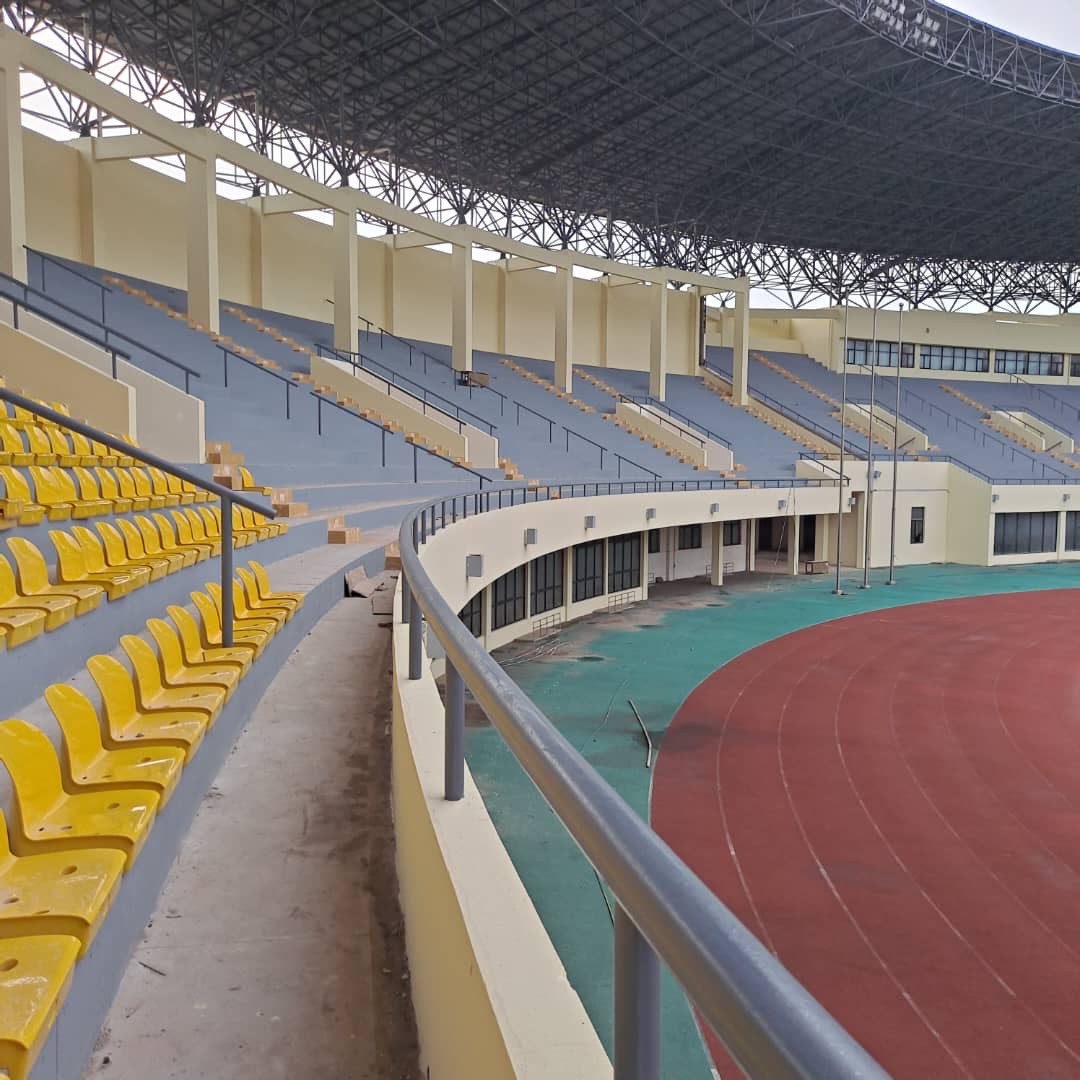
Perhaps the most compelling evidence of the ongoing reset can be found in the Western Region, where the Essipong Sports Stadium—once the pride of the region —is rising from years of neglect.
For close to three years, the facility lay in a state described as a “national disgrace” . Torn roofing exposed steel frames to corrosion, washrooms were dilapidated, office spaces and hostels had run down, and businesses that once thrived around the stadium had suffered . The cost of renovation, initially estimated at GH¢17.9 million in 2023, had ballooned to over GH¢35 million—more than double—due to inaction .
Today, that narrative is being rewritten.
Phase 1 of the refurbishment is now complete. The roofing has been fixed, washrooms have been restored, and seating is being replaced . Work is actively progressing on the scoreboard , and the pitch itself is being brought back to international standards. The annex facilities at Gyandu, Essikadu, and Fijai are also slated for upgrades to serve as training pitches.
For the first time in many years, Essipong is almost back to its former glory—ready to host major sports events once again.
A National Reset, Not a Quick Fix
The Essipong project is just one piece of a much larger puzzle. Across the country, the NSA is quietly laying the groundwork for a comprehensive revival of sports infrastructure.
In the Northern Region, the authority has finally secured prime land at the famous Tamale Kaladan Park following a protracted legal battle. In Accra, the abandoned Azumah Nelson Sports Complex at Kaneshie is being cleared and restored. In the Volta Region, President Mahama has announced plans to redevelop the Ho Sports Stadium into a modern, CAF-certified facility—with work expected to be completed around the stadium’s 70th anniversary next year .
The President’s recent inspection of the Ho Stadium, the NSA Director General noted, “is just one example of his vision to spread development across the country” .
These are not the actions of a negligent authority. They are the moves of an institution that has finally been given the mandate, resources, and political backing to address problems that have festered for decades.
The Bigger Picture
The Director General has been careful not to make promises that cannot be kept. He has repeatedly cautioned that the challenges facing Ghana’s sports infrastructure did not emerge overnight and will not be solved in a matter of months.
“It is not realistic to expect solutions to problems that have been with us for decades after just 17 months,” he has been quoted as saying. That realism has been interpreted by some as defensiveness, but those with a deeper understanding see it for what it is: honesty.
President Mahama has been “totally committed to the transformation of sports infrastructure in Ghana,” the NSA boss stated, but he urged Ghanaians to appreciate the scale of the undertaking .
Meanwhile, the establishment of the Ghana Sports Fund—with a governing board inaugurated earlier this year and chaired by Prof. Koryoe Anim-Wright, with Mr Ankrah as a member—is expected to introduce “structured, predictable and accountable funding” for the sector . As Sports Minister Kofi Adams put it, the Fund’s purpose is to “introduce planning where there was uncertainty, equity where there was imbalance, and accountability where there was discretion” .
Trust the Process
The hashtag #RESET has become more than just a slogan—it is a commitment to breaking the cycle of build, neglect, and rebuild that has defined Ghana’s approach to sports infrastructure for too long.
The Director General may not be winning the public relations battle, but he appears to be winning the war on the ground. And if the transformation at Essipong is anything to go by, it may not be long before the critics are forced to acknowledge what the work is already beginning to show.
In the end, the stadiums will speak for themselves.
Trust the #RESET process.


