



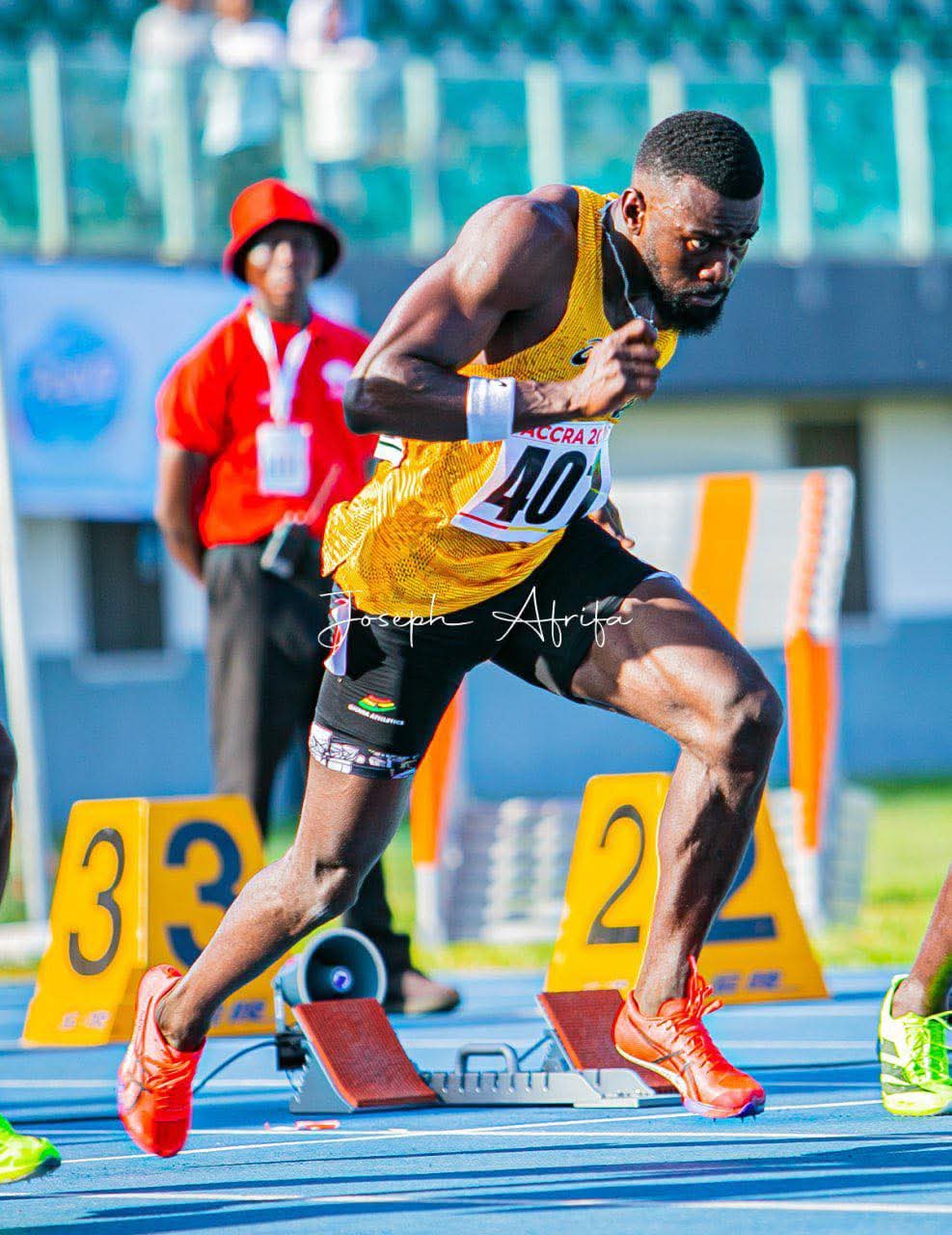
A major athletics, the African Senior Athletics Championships which started on May 12 at the Legon Sports Stadium in Accra descended into farce over the weekend as a cascade of organisational failures — including a malfunctioning starting gun, the absence of finish times, and a media tribune overrun by musicians — left athletes bewildered and journalists unable to do their jobs.
In scenes more reminiscent of a neighbourhood sports day than a professional meeting, the completion which climaxes on May 17 saw competitors were seen crossing the finish line only to wander through the mixed zone in stunned silence, pleading with officials for their results.
No finishing times were recorded. No media centre was provided. And for the reporting staff attempting to cover the event, the experience was summed up by a single, farcical image: the media tribune was not occupied by journalists — but had been taken over by Jama singers, whose relentless performances made it impossible to hear, concentrate, or conduct a single coherent interview.
“We came to tell stories, to make comparisons, to do our jobs,” one frustrated reporter said. “Instead, we were left guessing. No times, no access, no silence. How are we supposed to compare this meet with any other when we don’t even know who won?”
Gun failures rattle sprinters
Nowhere was the dysfunction more acutely felt than on the track itself.
The starting gun — reportedly an electronic model — proved catastrophically unreliable throughout the men’s 100m heats, failing on four separate occasions across just seven races.
For sprinters, whose entire performance is calibrated to the millisecond, a faulty gun is not merely an inconvenience. It is a psychological grenade. When an electronic starting system fails, athletes are forced to reset, repeatedly loading their blocks while their nervous systems oscillate between heightened alertness and exhausting let-down.
Multiple delays meant that runners who had prepared for a single, sharp signal were instead subjected to false starts, recalls, and the lingering uncertainty of whether the next “bang” would be the real one or another technical failure.
False start rules in professional sprinting are famously unforgiving. Since 2010, World Athletics has enforced a “one-and-done” rule for individual events: a single false start results in immediate disqualification, regardless of whether the athlete was at fault or reacting to a malfunction . At the Paris Olympics, Canada’s Aaron Brown was disqualified from the 100 metres after reacting to what he believed was the gun — a devastating end to a campaign built over years . Similarly, Mozambique’s Steven Sabino saw his Olympic heat end before it began after he jumped at an external noise, telling reporters: “I sacrificed everything for this” .
The situation on Saturday — with four gun failures across seven heats — created a brutal lottery for the athletes. Each failure forced them to walk a razor’s edge: react too cautiously on the next start and lose precious hundredths of a second; react too eagerly and risk a season-ending disqualification for a false start that may not have been their fault.
A malfunctioning electronic gun also erodes the most fundamental principle of fairness in sprinting: equal reaction opportunity. Modern starting blocks are equipped with sensors that measure force against the pads 4,000 times per second . But those systems are only as reliable as the gun that triggers them. When the signal is inconsistent — too quiet, delayed, or absent entirely — the integrity of the race collapses.
A lost story
The absence of official finish times compounded the confusion. For journalists, times are the bedrock of track and field reporting — the data points that allow performances to be contextualised against historical standards, seasonal bests, and rival marks. Without them, comparisons across meets become guesswork.
One veteran athletics writer, speaking on condition of anonymity, described the scene as “uniquely hostile to coverage.”
“We’re used to cramped mixed zones and noisy stadiums,” they said, referencing the famously tight quarters at major championships like the USATF Outdoor Championships . “But this was different. There was no information flow at all. Just silence from the athletes, noise from the tribune, and a starting gun that couldn’t do its job.”
Efforts to reach meet organisers for comment were unsuccessful.
For the athletes, many of whom have spent the northern hemisphere summer chasing qualifying standards and personal bests, the weekend represented lost opportunity — and lost data. For the journalists, it was a simple equation broken: no times, no stories. No access, no context. And no silence, no sense.


