


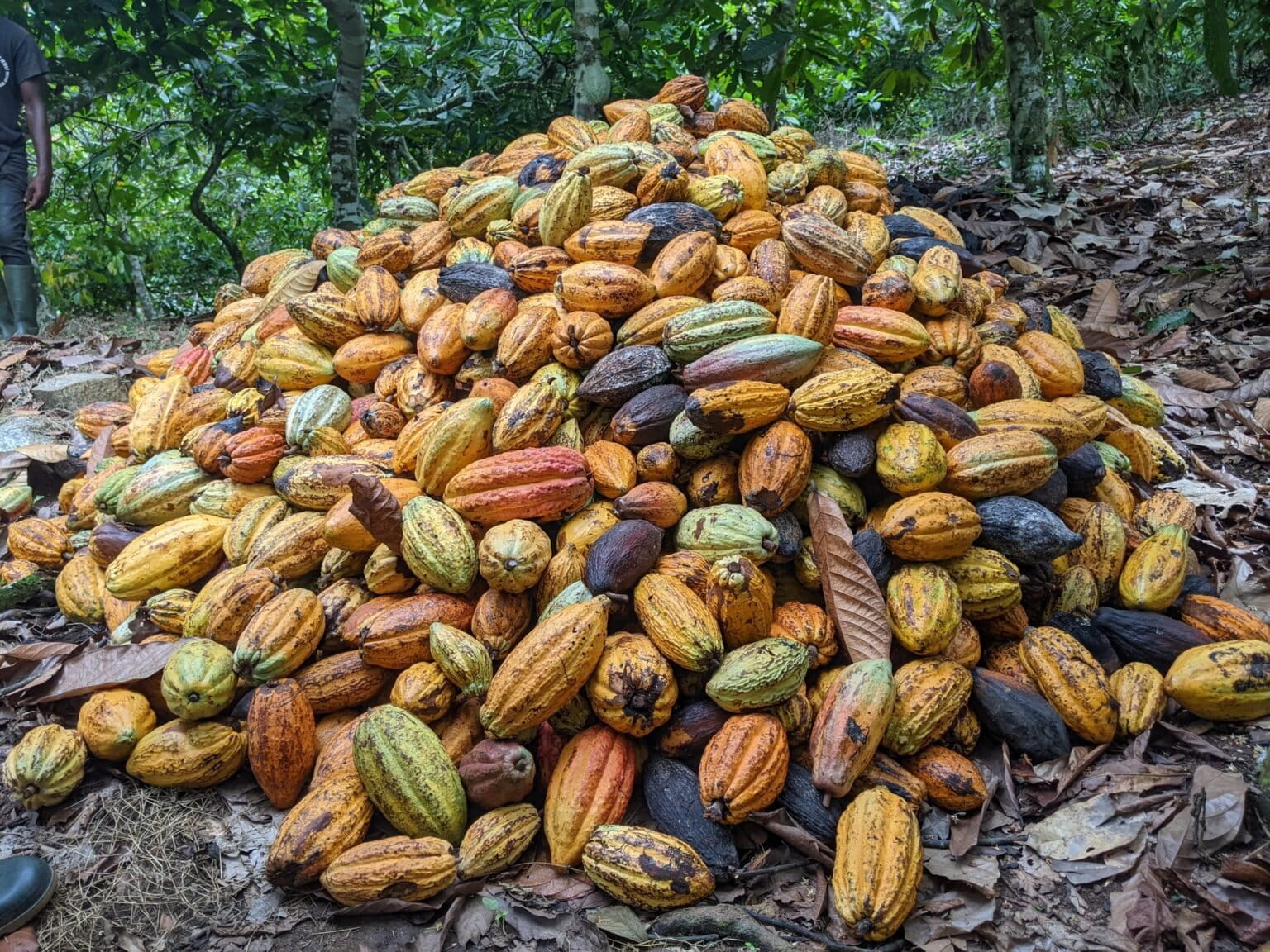
A new study using two decades of district-level data from Ghana’s cocoa regulator finds that short bursts of heavy rainfall during cocoa’s flowering and early pod development — combined with dry-season drought — explain roughly two-thirds of year-to-year fluctuations in the country’s cocoa production. The findings challenge analytical frameworks that focus on temperature or seasonal average moisture, and point to a more difficult reality: the climate risk is not whether a season is wetter or drier, but when the rain falls and how hard it hits.
Published in the Proceedings of the National Academy of Sciences (PNAS), the research was led by Anna Lea Albright of Harvard University’s Center for the Environment. Her team combined production records from the Ghana Cocoa Board covering 66 administrative districts across the 2000/01 to 2022/23 seasons with daily rainfall and temperature observations, identifying meteorological signals driving yield fluctuations at a district scale for the first time.
The study’s central conclusion has clear operational implications: short, intense rainfall events that land within the critical window of cocoa flowering and early pod formation are far more damaging than temperature extremes or seasonal average wet-dry shifts. “Along with dry-season drought, those two factors alone explain about two-thirds of the year-to-year variability in Ghana’s production,” Albright told Mongabay in an email.
Why “When It Rains” Matters More Than “How Much”
Cocoa flowering coincides with the main rainy season. Ghana’s primary cocoa harvest typically runs from October to March, accounting for 70–80% of annual output. Flowers and newly formed pods (cherelles) are highly fragile: intense rain and wind can physically knock off flowers and damage young pods, while also disrupting the insects that pollinate cocoa flowers. The research further found that rainfall extremes are significantly associated with yield fluctuations in Ghana, Indonesia, and Ecuador — three major cocoa-producing countries — indicating the vulnerability is not unique to Ghana.
Eric Opoku Mensah, a research scientist at Ghana’s Plant Genetic Resources Research Institute who was not involved in the study, corroborated the mechanism in an email. Severe rainfall coupled with high winds damages “the fragile flowers and the cherelles,” ultimately reducing the number of pods that develop into harvestable cocoa, he said. He also noted that rain splash spreads spores of black pod disease, exacerbating fungal spread under humid conditions.
The policy implication is that conventional “total seasonal rainfall” metrics may significantly underestimate climate risk. Albright’s team stresses that the core challenge for farmers is not whether a season is overall wetter or drier, but the timing and intensity of rainfall. That non-randomness is precisely what makes improved forecasting and adaptation measures feasible.
Structural Constraints Behind the Volatility
The study’s time window coincides with the most dramatic swings in Ghana’s cocoa sector in recent years. In the 2023/24 season, Ghana’s cocoa output plummeted to about 600,000 metric tons, down from a peak exceeding 1 million tons in 2021/22. The collapse, compounded by extreme weather, disease, and structural problems in West Africa, pushed global cocoa prices to record highs in 2024.
Yet weather is only part of the picture. Ghanaian cocoa farms broadly face aging trees, underinvestment, and spreading disease. Cocoa swollen shoot virus (CSSV) and black pod disease continue to erode productive capacity, while illegal mining (galamsey) has directly destroyed cocoa-growing land. Industry analyses estimate that illegal mining has cost Ghana more than 100,000 acres of rehabilitated, high-yielding plantations.
In the 2025/26 season, Ghana’s output rebounded. The U.S. Department of Agriculture’s Foreign Agricultural Service projected production of 750,000 tons for the season, up 25% from the previous year. The recovery was partly attributed to favorable weather and improved tree management, but industry observers widely view the rebound as fragile. The Ghana Cocoa Board’s preliminary field survey for the 2026/27 season estimated output at about 650,000 tons, roughly 13% below 2025/26, with more pessimistic forecasts ranging from 450,000 to 550,000 tons, citing swollen shoot disease, aging farms, and adverse weather risks.
Limits and Possibilities of Adaptation
The study authors recommend improving access to seasonal weather forecasts and early-warning systems, facilitating access to fungicides, planting more climate-resilient cocoa varieties, and improving drainage and reducing rain splash where heavy rainfall is becoming more frequent. But none of these measures can be implemented without coordination and investment.
Mensah added the potential of agroforestry systems: retaining shade trees in cocoa farms can help protect against high temperatures and strong winds. But he acknowledged that the effectiveness of this strategy depends on local climate conditions. A 2025 study published in Agricultural Systems, analyzing 365 farming households across five major cocoa-producing regions in Ghana, found that agroforestry significantly buffers yield losses from reduced rainfall in wetter areas, but in drier regions shade trees may compete with cocoa for limited water, with less clear benefits.
For the Ghana Cocoa Board, the urgency of climate adaptation coexists with fiscal constraints. In February 2026, the government cut the cocoa producer price from 51,660 cedis per ton to 41,392 cedis, citing falling international market prices. In October, the Cocoa Board raised the 2026/27 season price by 2.4% to 42,400 cedis per ton (about $3,647), but this remains well below the effective returns farmers in neighboring Côte d’Ivoire are expected to receive, potentially intensifying cross-border smuggling pressure.
Albright acknowledges that weather variability and longer-term climate change are not the same thing. El Niño, for example, drives year-to-year swings in rainfall patterns rather than long-term trends. But her research raises an unavoidable question: if climate change is altering the frequency or intensity of the extreme rainfall events identified as key destructive factors, the existing vulnerabilities of Ghana’s cocoa sector will be further amplified.
The Ghana Cocoa Board did not respond to Mongabay’s request for comment by the time of publication. For the hundreds of thousands of Ghanaian farmers who depend on cocoa income, the study’s message is both clear and harsh: what they need to guard against is not a prolonged drought, but a downpour that arrives at the wrong time.