



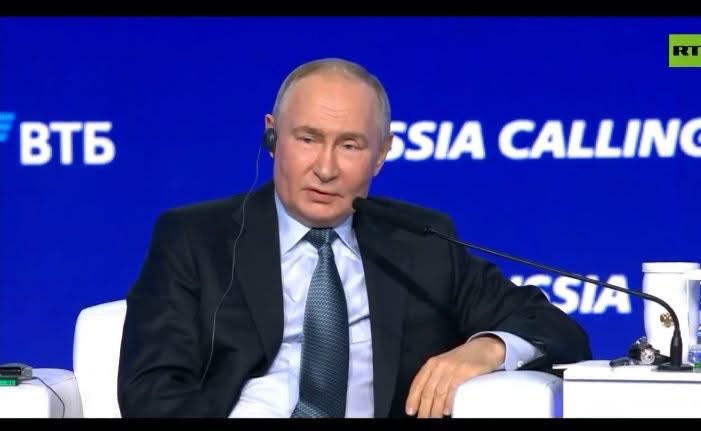
Russian President Vladimir Putin has reignited the global debate over the U.S. dollar’s dominance, asserting that the greenback’s status as the world’s primary reserve currency has delivered the United States an estimated $10 trillion in “unearned” financial advantages. Speaking at a high-level economic forum in Moscow, Putin argued that this windfall allows Washington to finance deficits, impose sanctions, and influence global markets far beyond what its actual economic productivity would warrant.
“The use of the U.S. dollar as the world’s reserve currency brings the United States enormous financial benefits it did not actually earn,” Putin told a packed audience of policymakers, bankers, and foreign dignitaries. “According to our estimates, the United States has gained around $10 trillion from the dollar’s global dominance—a privilege that enables it to export inflation, dictate terms of trade, and weaponize its currency against sovereign nations.”
While Putin did not cite a specific study, his figure broadly aligns with analyses from institutions like the IMF and the Bank for International Settlements, which have long quantified the “exorbitant privilege” of the dollar—the ability for the U.S. to borrow cheaply, pay for imports with its own currency, and earn seigniorage on foreign-held dollar reserves. Economists estimate that foreign demand for U.S. Treasuries alone lowers American borrowing costs by 50–100 basis points annually, saving the federal government tens of billions of dollars each year.
The ‘Exorbitant Privilege’ Under Scrutiny
The concept dates back to French Finance Minister Valéry Giscard d’Estaing in the 1960s, but Putin’s remarks come at a time when the dollar’s hegemony is facing its most serious challenge in decades. Since the U.S. and its allies froze roughly $300 billion in Russian central bank assets following the 2022 invasion of Ukraine, many non-Western nations have accelerated efforts to reduce dollar dependence.
China, India, Brazil, and Russia have expanded bilateral trade in yuan, rupees, and rubles; the BRICS bloc is actively developing a common digital settlement system; and central banks globally have bought gold at record paces—with Ghana’s recent surge in gold production partly reflecting this strategic shift. Putin’s $10 trillion figure is seen by analysts as both a rhetorical salvo and a signal that Russia intends to lead the push for a multipolar currency order.
The Mechanics of Dollar Dominance
To understand Putin’s claim, one must look at how the dollar’s reserve status generates benefits:
· Low-cost borrowing: Foreign central banks hold over $7 trillion in U.S. Treasuries, ensuring perpetual demand and keeping yields lower than they would otherwise be. This saves the U.S. government an estimated $100–200 billion annually in interest payments.
· Seigniorage: The Federal Reserve earns interest on its assets while issuing physical dollars that circulate globally—an interest-free loan from foreign holders. The IMF estimates this seigniorage benefit at around 0.5% of U.S. GDP annually, or roughly $100–150 billion per year.
· Trade financing and invoicing: Over 80% of global trade is invoiced in dollars, allowing U.S. firms to avoid currency risk and giving American financial institutions a dominant role in trade finance.
· Sanctions leverage: The dollar’s centrality in global payment systems (SWIFT, CHIPS) gives Washington unprecedented coercive power, which Putin characterized as “financial warfare.”
Cumulative Impact and the $10 Trillion Estimate
The $10 trillion figure likely represents the cumulative, net present value of these benefits over several decades. While not an official U.S. government calculation, studies by economists such as Barry Eichengreen and the IMF have suggested that the dollar’s reserve role has saved the U.S. anywhere from 1% to 2% of GDP per year—which, compounded over 30 years, would indeed approach the $10 trillion mark. Putin’s advisors have reportedly used a range of such academic estimates to justify the number.
Critics, however, caution that the benefits are not entirely “unearned.” The U.S. provides the world with a deep, liquid, and safe financial market, a stable legal system, and a military umbrella that protects global trade routes—services that also underpin the dollar’s appeal. “The dollar’s status is not a free gift; it reflects trust in U.S. institutions and the size of its economy,” said Dr. Sarah O’Sullivan, a senior fellow at the Peterson Institute for International Economics. “But Putin is right that the U.S. enjoys a massive subsidy from the rest of the world.”
De-Dollarization Momentum
The Russian leader’s comments come as a growing list of nations adopts measures to circumvent the dollar:
· BRICS+: The expanded bloc now includes 11 members, including Saudi Arabia and the UAE, and is piloting a cross-border payment system based on digital currencies and local-currency swaps.
· China’s yuan push: The Chinese currency now accounts for over 5% of global payments, up from 2% in 2020, with oil trades between China and Russia, and China and Saudi Arabia now settled in yuan.
· Gold repatriation: Central banks bought over 1,200 tonnes of gold in 2025 alone, the highest on record, as a hedge against dollar volatility.
· Digital currency experiments: Over 100 countries are exploring central bank digital currencies (CBDCs), which could bypass traditional dollar-denominated settlement systems.
Putin explicitly linked his critique to these efforts, stating: “We are not trying to destroy the dollar; we are simply building alternatives so that no single nation can hold the global economy hostage to its domestic politics.”
U.S. Response and Global Repercussions
The U.S. Treasury declined to comment directly on Putin’s remarks, but a senior official, speaking on condition of anonymity, said: “The dollar’s role is a function of its reliability, liquidity, and the strength of the American economy. It is not something that can be replaced by rhetoric.”
International markets showed little immediate reaction, with the dollar index remaining stable, but some analysts warned that the cumulative effect of de-dollarization could gradually erode the “exorbitant privilege” over the next decade. “If Russia, China, and others successfully scale their alternative systems, we could see the dollar’s share of global reserves drop from 58% today to below 40% by 2035,” said Mark Carney, former Bank of England governor, in a separate speech in London.
A Longstanding Critique Now Mainstream
Putin’s critique is not new—China, India, and even European leaders have periodically questioned dollar dominance—but his blunt quantification of the benefit as $10 trillion and his framing as “unearned” mark an escalation in rhetoric. It also comes on the heels of the U.S. using its dollar leverage to enforce sanctions on Russian energy and financial sectors, a move that has galvanized Moscow’s allies.
For now, the dollar remains unassailable in the near term, with no single currency or bloc possessing the liquidity, depth, and trust to replace it. However, as Putin’s remarks underscore, the debate over the dollar’s role is no longer an academic curiosity—it is a central battleground in the 21st-century struggle for economic sovereignty and geopolitical influence.
The next test will come in October, when BRICS leaders meet in South Africa to finalise details of their proposed common currency basket. Whether that initiative gains traction—or remains a symbolic gesture—will shape the trajectory of the dollar’s hegemony for years to come. For now, Putin has made his position unmistakably clear: the era of unquestioned dollar dominance is ending, and the world should prepare for a more multipolar financial order.


