



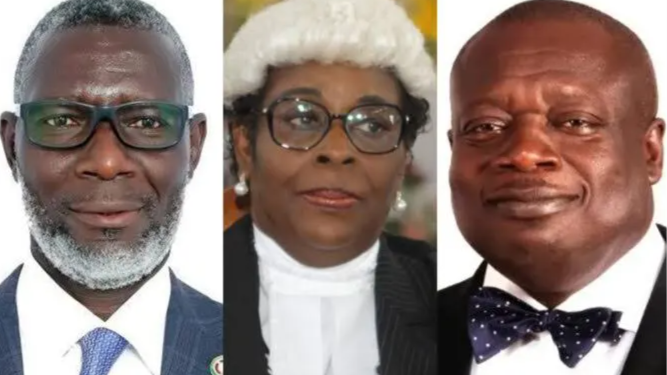
Parliament has approved the nominations of three individuals for appointment as Justices of the Supreme Court, despite a dramatic boycott of the vetting process by the Minority Caucus who raised concerns about the speed and procedure of the exercise.
The nominees—Justice Sophia Rosetta Bernasko-Essah, Justice Edward Amoako Asante, and private legal practitioner Anthony Forson Jnr—were all recommended by the Appointments Committee and subsequently endorsed by the full House. Their approval will expand the Supreme Court’s membership from 18 to 21 Justices .
Constitutional Process Completed
The nominations followed the constitutional requirements under Article 144(2) of the 1992 Constitution. President John Dramani Mahama first submitted the names to the Judicial Council on July 15, 2026, which advised that the nominees were suitable for appointment in a letter dated July 22, 2026 . The President then submitted the nominations to the Council of State, which on August 20, 2026, informed the President that it had found the three nominees qualified and suitable to serve on the apex court .
Minority Walkout Over Process
The vetting process became contentious when Minority Leader Alexander Afenyo-Markin raised a preliminary objection to the decision to fast-track the consideration of the nominees during Parliament’s five-day emergency recall from recess (August 24–28) .
Mr. Afenyo-Markin argued that the process was being rushed and that there was no vacant position on the Supreme Court requiring urgent appointment . He noted that the nominations were intended to expand the court’s membership rather than fill vacancies caused by retirement, death, or removal .
The Minority Leader also questioned the decision to proceed without allowing the public the customary opportunity to submit memoranda on the nominees. “We say no, because the people of Ghana must participate,” he stated .
He stressed that the Minority’s objection was not directed at the qualifications or competence of the nominees, but rather at the procedure and timeframe adopted. “Our stance is not a partisan stance. It is a stance for the people of Ghana,” he added .
Majority Proceeds Despite Objection
The Chairman of the Appointments Committee, Bernard Ahiafor, rejected the Minority’s objection, describing the grounds as “flimsy,” “hollow,” and “baseless” . He directed that the vetting proceed, prompting the Minority Caucus to walk out of the committee proceedings .
With the walkout leaving only Majority members present, the committee continued with the vetting and consideration of the nominees, subsequently recommending all three for approval just hours after the sitting concluded .
Profile of the Nominees
Justice Sophia Rosetta Bernasko-Essah currently serves as a Justice of the Court of Appeal with extensive judicial experience. She was previously nominated for appointment to the Supreme Court in 2024, but the process was not completed before the change of administration .
Justice Edward Amoako Asante, also a Court of Appeal Justice, previously served as President of the ECOWAS Court of Justice for three terms, totaling six years, until October 2024 . His judicial career includes experience in human rights and international law . During his vetting, he urged suspects detained beyond the constitutionally mandated 48 hours to sue the police, arguing that such legal action would help enforce constitutional protections .
Anthony Forson Jnr is a private legal practitioner and former President of the Ghana Bar Association who brings extensive experience from private legal practice . During his vetting, he rejected proposals to cap the number of Supreme Court Justices, arguing that the court’s broad constitutional jurisdiction and workload make a fixed limit impractical. “Because of the jurisdictions which have been given to the Supreme Court, which is so wide, capping will bring a problem,” he stated .
Context of Emergency Recall
The dispute unfolded against the backdrop of Parliament’s emergency recall, which was requested by President Mahama to deal with urgent government business, including the Supreme Court nominations, two ministerial nominations, and the Banks and Specialised Deposit-Taking Institutions (Amendment) Bill .
With the committee’s recommendation now adopted by the full House, the approval clears the way for the three nominees to complete the constitutional process for their appointment. They will take the required judicial oaths before officially joining the Supreme Court bench .


