



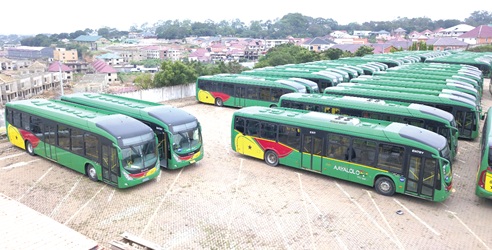
A preliminary investigation has found no trace of revenue from 60 Aayalolo buses transferred from Accra to Kumasi eight years ago, the Greater Accra Passenger Transport Executive (GAPTE) has disclosed.
The probe into the buses’ operations over the past eight years also uncovered poor accountability and a lack of proper operational planning, resulting in 44 of the fleet being grounded.
GAPTE’s Managing Director, Awudu Dawuda, has since commissioned an independent audit to establish the circumstances surrounding the transfer of the 60 buses to Kumasi, how they were operated, and what revenue, if any, was generated. The audit is expected to be completed within one month.
The decision followed the discovery that since the buses were relocated to Kumasi in 2018, no revenue had been paid into GAPTE’s account.
In an exclusive interview, Mr. Dawuda said the audit is part of a broader transformation agenda aimed at recovering all assets and reviving the bus rapid transit (BRT) system to improve urban mobility.
He explained that when he assumed office six months ago, he learned that 60 of the 245 Aayalolo buses procured for designated corridors in the Greater Accra Region had been moved to Kumasi, while another 10 had been taken to Takoradi in the Western Region.
“The problem is that ever since the buses were taken to Kumasi in 2018, not even a single pesewa was received as revenue by GAPTE. There was no proper plan for these buses – they were sent there without recourse to law, and revenues never came to GAPTE since 2018,” Mr. Dawuda said.
Initial findings indicate the Kumasi Metropolitan Assembly (KMA) was given the buses to manage in 2018, while GAPTE engineers largely carried out repairs in Kumasi, with the cost borne by the Council.
“The audit team will establish the circumstances under which the buses got to Kumasi: who received them; how revenues were managed; and the circumstances under which six of the buses got burnt,” he added.
With support from the Minister of Local Government, Chieftaincy and Religious Affairs, Ahmed Ibrahim, GAPTE has taken over management of the remaining 54 buses in Kumasi and has begun the process to retrieve the 10 buses in the Western Region. Upon taking control, only 16 of the 54 buses were found to be functional.
“Since we started operating those 16 buses two weeks ago, we are getting very good revenue; so, we are taking steps to fix the other buses and put them to use,” Mr. Dawuda said.
He described the situation in Kumasi as symptomatic of a collapsed system inherited by the current management. Out of 245 BRT buses procured by the government in 2016, he said, only 80 were functional, largely due to poor maintenance. Several GAPTE terminals, including those at Kasoa, Adenta, Kinbu and Achimota, have also faced serious encroachment.
Mr. Dawuda noted that GAPTE has since refurbished 60 broken-down buses, raising the functional fleet from 80 to 140. All encroached terminals have been recovered, and operating hours have been extended from 5 p.m. to 11 p.m.
He added that GAPTE is working to reintroduce dedicated lanes for Aayalolo buses, with a €1 million grant from the Spanish government secured for a feasibility study. In the interim, collaboration with the Accra Mayor and the Motor Traffic and Transport Division of the Ghana Police Service will enable enforcement of dedicated BRT lanes in the near future.


