



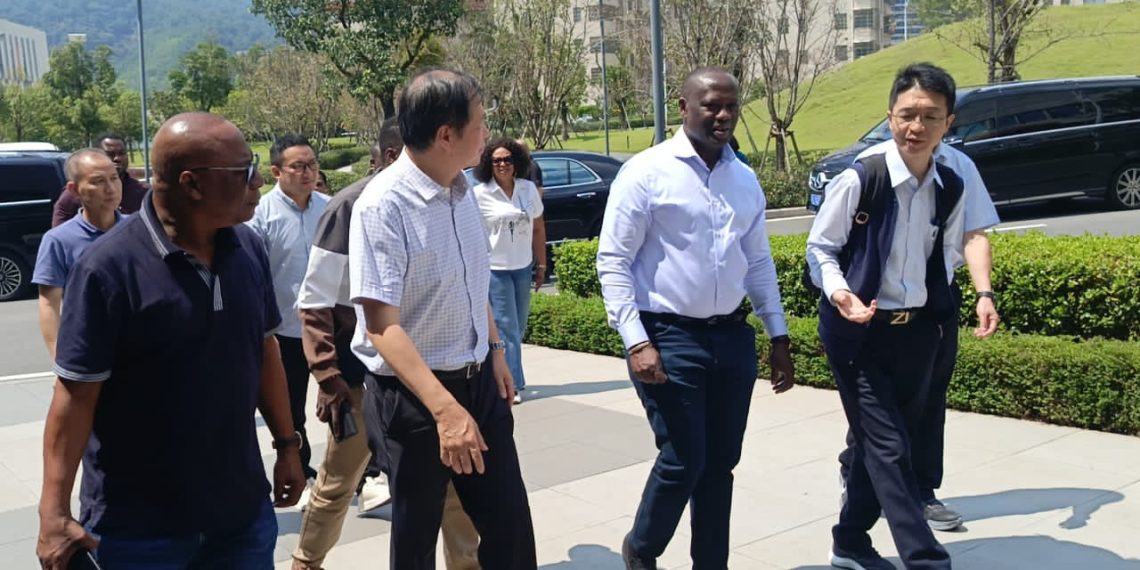
Lands and Natural Resources Minister Emmanuel Armah-Kofi Buah has called for the establishment of a specialised Electric Vehicle (EV) Capacity Building Centre to train Ghanaian mechanics in the maintenance and repair of electric vehicles, as the country prepares for a major shift towards cleaner mobility.
The Minister made the proposal during an official visit to China, after touring the showroom and operations of Longking, a Chinese electric vehicle manufacturer . He emphasised that Ghana must begin preparing its technical workforce for the emerging EV industry, equipping mechanics with the specialised knowledge required to diagnose, maintain and repair next-generation electric vehicles entering the local market .
Ghana’s EV momentum
Mr Armah-Kofi Buah’s call comes as Ghana positions itself as a leader in West African e-mobility. The government has extended a zero-import duty policy for fully electric vehicles until 2032, while introducing a dedicated EV charging tariff of GH¢2.016 per kWh from April 2026 to provide transparency for owners . The country now has the highest number of electric vehicles in Africa, according to Energy Minister Dr John Abdulai Jinapor .
In January 2026, the government signed a memorandum of understanding with China’s Shenzhen New Jekyll to establish an EV assembly plant in Ghana, with development “far advanced” for the factory to begin operations . Discussions are also ongoing with Chery International, one of China’s major automobile exporters, for a second assembly plant . The government is further reviewing legislation to regulate EV charging stations, requiring operators to obtain Energy Commission approval before establishing facilities, to prevent pressure on electricity infrastructure .
Skills development initiatives underway
The proposed EV Capacity Building Centre would complement existing skills development programmes. In April 2026, the Ministry of Education launched the five-year Hyundai-KOICA NextGen Project, in partnership with Plan International Ghana, KOICA and Hyundai Motor Company, to equip Ghanaian youth with specialised skills in electric vehicle technology, hybrid systems and digital diagnostics . Two maintenance and training hubs are being established in Accra and Ho, with procurement of two electric vehicles and training equipment confirmed .
Additionally, Ghana and Japan launched the Ghana-Japan Auto Connect initiative in March 2026, providing six months of intensive automotive training leading to Level Three Automobile Mechanic Certification. The programme, supported by Toyota, aims to reskill workers in Ghana’s automotive sector, which employs approximately 300,000 people .
Heavy-duty EV potential
Mr Armah-Kofi Buah noted that China’s rapid adoption of electric heavy-duty trucks—which accounted for about 44 per cent of new heavy-truck sales in China in June 2026—presents significant opportunities for Ghana’s mining, haulage and logistics sectors . The International Energy Agency estimates the current average range of battery-electric trucks at around 300 kilometres, making short-haul operations a strong early market for the technology .
Battery-swapping technology, where vehicles exchange depleted batteries for fully charged ones at specialised stations, has helped accelerate adoption in China by reducing vehicle downtime—a crucial consideration for commercial operators .
The Minister stressed that China’s experience in developing EV manufacturing capacity, charging infrastructure and supporting ecosystems offers valuable lessons for Ghana as it transitions towards electric mobility. The proposed capacity-building centre would ensure that Ghana not only imports electric vehicles but also develops the domestic skills and technical expertise needed to service them locally .


