


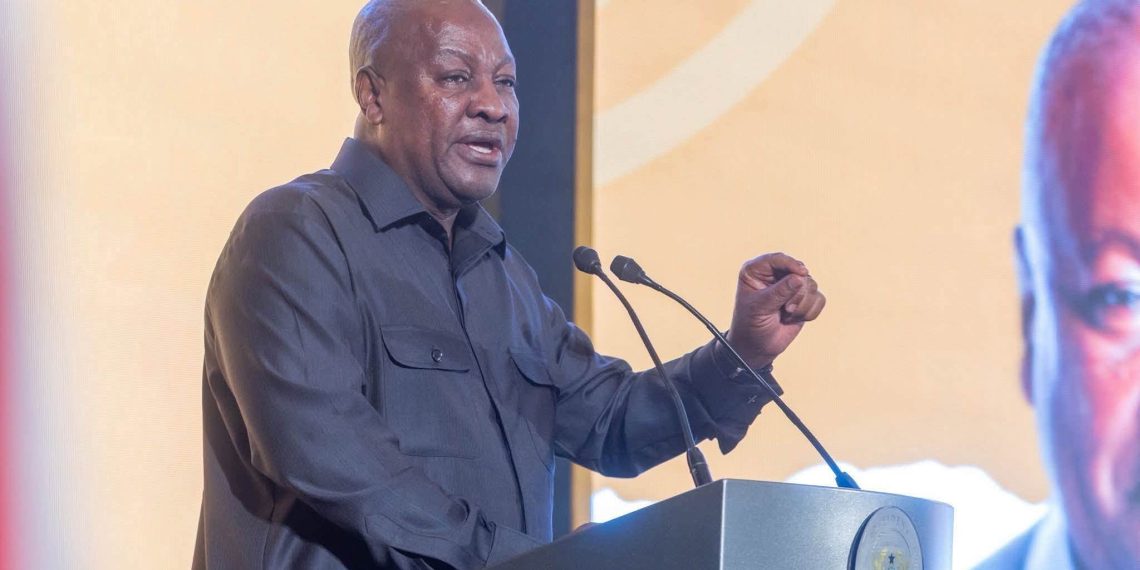
President John Dramani Mahama has reaffirmed his government’s commitment to strengthening technical and vocational education and training (TVET), declaring that expanding access to education must be matched by efforts to improve quality and relevance for the job market.
Speaking in Moscow after receiving an honorary doctorate from the Patrice Lumumba Peoples’ Friendship University of Russia (RUDN University), Mahama said the focus would be on equipping students with practical skills and the ability to solve real-world problems .
“We are committed to strengthening technical and vocational training, scientific research and digital skills,” Mahama said. “Expanding access must go hand in hand with improving quality and ensuring that what students learn equips them for the demands of work and citizenship” .
He cited the School Feeding Programme, the Free Senior High School programme, and the No-Fee Stress policy as initiatives that have widened access to education for Ghanaians . The No-Fee Stress policy alone is projected to benefit over 220,000 first-year tertiary students in 2026, up from about 152,000 the previous year .
A Sector Under Pressure
The President’s remarks come amid sustained government investment in TVET, a sector seen as critical to addressing Ghana’s youth unemployment challenge. With roughly 73.5% of the population under age 36 and youth unemployment a persistent concern, expanding technical skills training has become a policy priority .
Enrolment in public pre-tertiary TVET institutions has more than doubled in recent years, rising from about 32,000 learners in 2020/21 to over 72,000 in the 2025/26 academic year, according to the third edition of the Ghana TVET Report . The government has attributed the growth to the Free TVET policy and related reforms, including the rollout of Competency-Based Training and the National TVET Qualifications Framework.
Education Minister Haruna Iddrisu said earlier this year that the government had engaged over 1,800 private sector and state-owned enterprises to facilitate industrial attachments for TVET learners, and that construction was underway on regional TVET Centres of Excellence in Salaga and Kumasi .
Quality Gaps Remain
Despite the enrolment gains, significant challenges persist. The TVET Report notes infrastructural deficits, outdated equipment in workshops, and uneven industry collaboration as continuing constraints . A separate study by the African Center for Economic Transformation and Africa Education Watch found that 75% of TVET curricula were outdated and funding remained below 2% of the national education budget, well short of the recommended 5% .
Mahama acknowledged the need for closer ties among universities, industry, and government to ensure that research translates into practical solutions. “A university qualification should give its holder the confidence to ask certain questions and the ability to solve real-world problems,” he said .
Russia Ties and a New Scholarship
The honorary doctorate was conferred in recognition of Mahama’s public service and commitment to education and international cooperation . The President, who studied in Russia as a postgraduate student nearly 40 years ago, described the return to campus as “a sense of nostalgia” .
RUDN Rector Professor Oleg Yastrebov announced a new scholarship named after Patrice Lumumba that would support seven students each year . Mahama welcomed discussions on a proposed Russian-African studies programme and an invitation for outstanding Ghanaian students to pursue specialised studies at the institution, while expressing appreciation for Russian government scholarships already extended to Ghanaian students .
He also invoked the legacies of Patrice Lumumba and Ghana’s first President, Kwame Nkrumah, saying present-day African leaders had a responsibility to translate their forebears’ aspirations into practical outcomes through quality education and stronger institutions .
“Our responsibility as present-day African leaders is to give practical expression to that aspiration,” Mahama said. “This should be seen in the quality of our schools, in the strength of our institutions, and in the opportunities that we create for our young people” .