



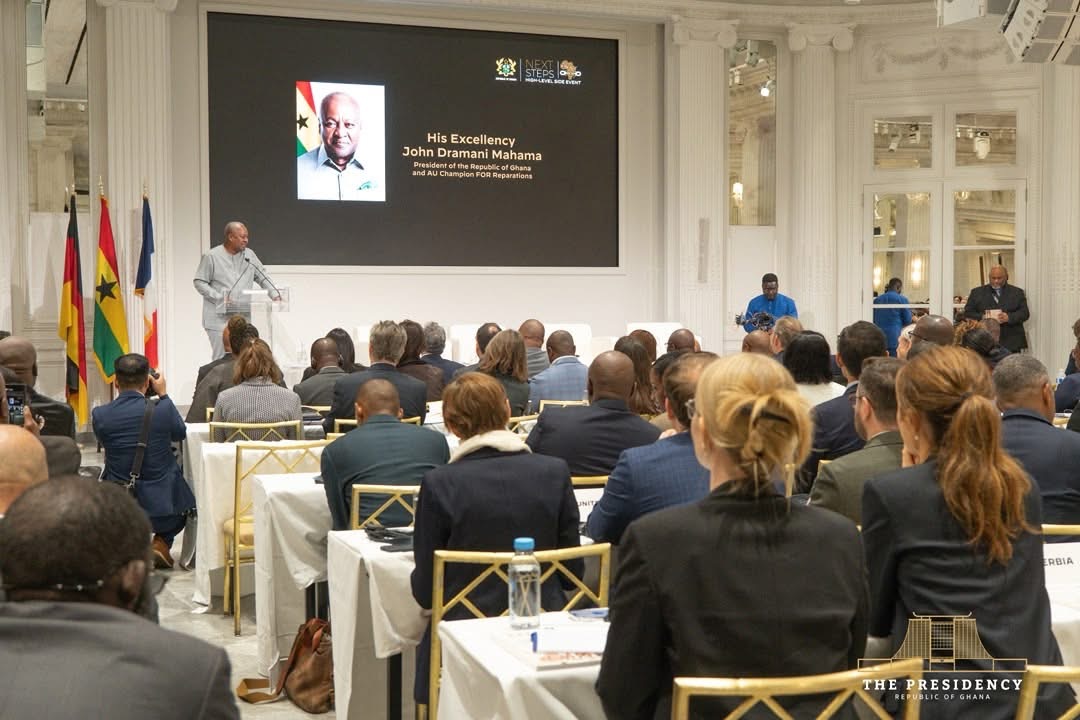
President John Dramani Mahama has called for a decisive global shift from acknowledging the loss of Africa’s cultural heritage to taking concrete action to secure its return, declaring that the restitution of looted artefacts and human remains is “a fundamental test of our shared human dignity”.
Speaking at a high-level side event on the return and restitution of cultural property and heritage on the sidelines of the 81st United Nations General Assembly in New York on Wednesday, Mahama stressed that Africa’s cultural treasures are not merely objects in museums, but living links to the continent’s history, identity and dignity.
The event, co-hosted by Ghana, France and Germany, brought renewed focus to the need for permanent, institutionalised mechanisms for restitution, greater investment in Africa’s cultural infrastructure, and the unconditional return of human remains.
‘Not Collectibles. Not Specimens. Our Ancestors.’
In his address, Mahama drew a sharp moral line on the question of human remains, which he said must become the starting point of a broader global restitution process.
“Human remains are not collectibles. They are not specimens. They are our ancestors. They are fathers and mothers. They are kings and elders,” he said. “Restoring them is not a matter of legal ownership. It is a fundamental test of our shared human dignity”.
The President recalled the execution of Ahanta King Badu Bonsu II by Dutch colonial authorities in 1838, whose head was removed after his execution and preserved in formaldehyde for 170 years before being rediscovered and returned to Ghana in 2009. He described the episode as one of the most painful examples of the treatment of African heritage during the colonial era.
He also referenced the 1874 attack on Kumasi by British forces, during which the palace of the Asantehene was looted. Although some sacred objects, including the Mpomponsuo Sword, were returned in 2024, many priceless artefacts remain abroad. Similar stories of cultural loss, he noted, could be found across Benin City, Magdala in Ethiopia and Abomey in Benin, where royal treasures were removed during military expeditions.
“Africa’s history was never confined to written records alone,” Mahama said. “It was carved into sacred wood, cast in royal bronze, forged in iron, woven into kente, preserved in manuscripts and embodied in sacred objects that carried the memory of generations”.
‘Capacity Must Be a Bridge to Return, Not a Barrier to Justice’
The President rejected the long-standing argument that African countries lack the capacity to preserve returned cultural artefacts, insisting that infrastructure challenges can never justify the continued possession of Africa’s heritage by foreign institutions.
“Capacity constraints must never be used as a justification for continued possession,” he declared. “Capacity must serve as a bridge to return, but not as a barrier to justice”.
He pointed to ongoing continental initiatives under the African Union’s Agenda 2063, including the development of the Great African Museum, as evidence that Africa is investing in world-class institutions capable of preserving its cultural legacy. He also announced that Ghana is constructing a state-of-the-art national and traditional institution dedicated to preserving, researching and exhibiting returning cultural treasures.
Where technological, conservation or digitisation gaps exist, Mahama said, the appropriate response should be investment through genuine multilateral partnerships rather than withholding restitution. He called on UNESCO, the United Nations and countries holding African artefacts to establish clear and standardised legal and diplomatic procedures that simplify provenance research, improve archival transparency and remove legal obstacles to unconditional restitution — starting immediately with the unconditional return of all human remains.
Three Pillars for Reparatory Justice
Mahama outlined Ghana’s “Next Steps” agenda, anchored on three pillars: institutionalising restitution, strengthening Africa’s capacity to preserve returning heritage, and recognising cultural heritage as an engine for education, tourism, identity and creative-sector development.
The first pillar calls for a permanent and institutionalised global system for restitution. The President urged the United Nations and countries holding African cultural property to develop clear and standardised legal and diplomatic procedures to support provenance research, improve access to historical archives and address legal obstacles hindering restitution.
The second pillar focuses on strengthening Africa’s ability to receive, preserve and manage returned artefacts. The President appealed to multilateral development banks, international financial institutions, global foundations and private sector partners to make deliberate investments in Africa’s cultural infrastructure, including regional archives, conservation laboratories, digital preservation systems and professional training for African curators and historians.
The third pillar seeks to position cultural heritage as a driver of economic growth. Mahama argued that properly preserved and presented heritage could contribute significantly to education, national identity, tourism and the creative economy.
Western Support Growing
The high-level side event was co-hosted by Ghana, France and Germany, a configuration that Ghanaian Foreign Minister Samuel Okudzeto Ablakwa described as evidence of growing Western support for the reparatory justice agenda.
Ablakwa told the event that support is increasing among Western countries for the campaign, which focuses first on the restitution of looted artefacts. Later stages could include formal apologies, debt relief and financial compensation under a 19-point plan adopted by the African Union and the Caribbean Community Commission on Reparatory Justice at a conference in Ghana in June.
“Virtually all the European countries that abstained during the vote have reached out and have said they are going to work with us on this journey,” Ablakwa said, referring to the UN resolution passed in March recognising trans-Atlantic slavery as “the gravest crime against humanity” with 123 votes in favour and three — from the US, Israel and Argentina — against. Fifty-two other countries, including European Union members and the UK, abstained.
The UK and Portugal have offered support, and the US has also said it is willing to work with the Ghana-led effort, Ablakwa said. France, Germany and the Netherlands have pledged their willingness to return artefacts.
“Restitution is very important to this journey,” the minister said. “These artefacts ought to be returned to the motherland”.
Building on the Accra Next Steps
The UN side event builds on the Accra Next Steps Consultative Conference held in Ghana in June 2026, where President Mahama — as African Union Champion on Advancing the Cause of Justice and Reparations for Africans — announced the establishment of three global panels: the Global Advisory Panel on Reparatory Justice, the Expert Panel on the Restitution of Cultural Artefacts, and the Global Legal Panel on Reparatory Justice.
The conference, which brought together representatives from over 80 countries, including the Presidents of Senegal, Namibia, Liberia and São Tomé and Príncipe, as well as the Prime Minister of Barbados and a video message from French President Emmanuel Macron, adopted the Accra Next Steps Commitments on Reparatory Justice — a framework for turning the UN’s recognition of historical injustices into practical action.
“We must move from acknowledgement to action, from commitments to implementation,” Mahama told the UN audience on Wednesday, echoing the message he delivered in Accra.
The Accra outcome document addresses reparatory justice, cultural restitution, education, historical preservation and global inequality, and identifies key pillars for action including truth and acknowledgement, legal justice, compensatory reparations, restitution of cultural artefacts, global governance reforms, debt relief, financial justice, technology transfer, public health, gender justice, climate justice and diaspora engagement.
A Continent’s Heritage, a Continent’s Future
The restitution agenda is embedded in the African Union’s Common African Position on the Restitution of Heritage Resources, adopted in 2023, which sets out recommended measures to effectively address the continuous loss of African heritage resources including human remains. The African Union Model Law on the Protection of Cultural Property and Heritage (2022) supports the process of protection and restitution of Africa’s illicitly acquired heritage resources.
Ghana has already taken concrete steps. In 2024, the Mpomponsuo Sword was returned to the Asante Kingdom, and in 2025, more than 130 gold and bronze artefacts taken between the 1870s and the early 20th century were returned from the United Kingdom and South Africa to the Asantehene, Otumfuo Osei Tutu II, at the Manhyia Palace in Kumasi.
“The story of Africa’s cultural heritage cannot end with its removal,” Mahama said in his closing remarks. “It must continue with its return”.
As the 81st UN General Assembly continues, the message from Ghana’s President was unmistakable: the era of symbolic gestures is over. What Africa demands now is not just recognition of what was taken — but the unconditional return of what is rightfully hers.


