



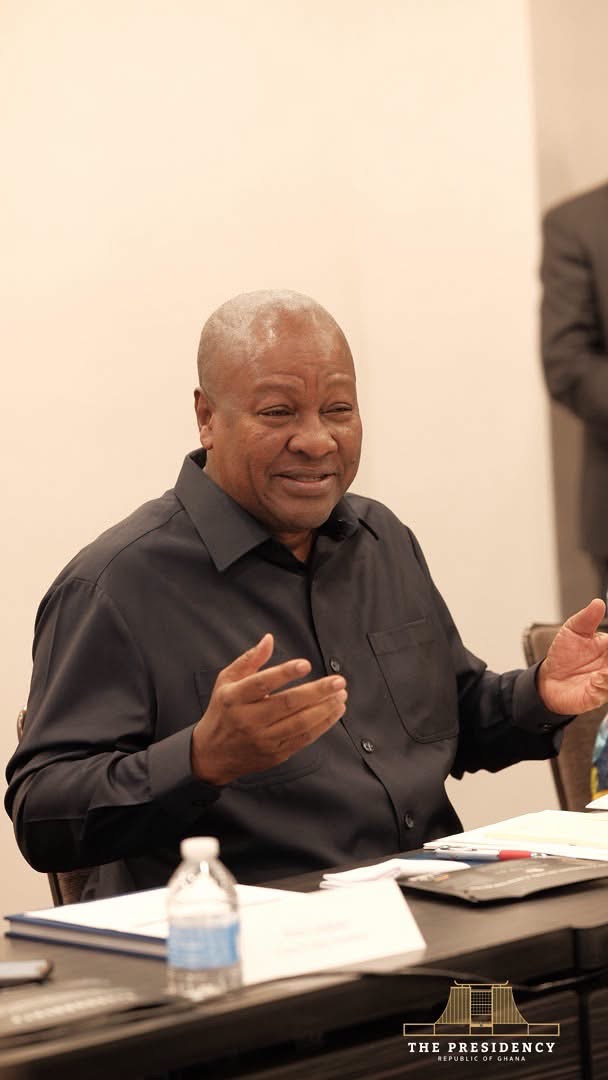
President John Dramani Mahama has called on countries of the Global South to prioritise domestic capacity building, institutional strengthening and sustainable financing models as they confront growing debt pressures and disruptions in the international development landscape.
Speaking at a Presidential Roundtable organised by the Open Society Foundation in New York on Monday, on the sidelines of the 81st United Nations General Assembly, President Mahama said the priority must be to create jobs, improve public services, build infrastructure and expand opportunities, particularly for young people.
The roundtable brought together presidents and chief executives of major global foundations, including representatives from the Gates Foundation, Ford Foundation, Open Society Foundation, Hewlett Packard, Hilton, Rockefeller, Humanity United, Anglo American, Chandler and UBS Optimus, among others.
A Global Development Landscape Under Strain
President Mahama’s remarks come amid what the United Nations has described as a worsening finance crisis for developing countries. According to the Financing for Sustainable Development Report 2026, official development assistance fell by 23.1 per cent in 2025 to $174.3 billion — the largest annual decline on record — and is projected to decline by a further 6.9 per cent in 2026. Foreign direct investment to developing countries dropped 11 per cent to $1.5 trillion, marking a second consecutive year of decline, while average tariffs on exports from least developed countries surged from 9 per cent to 28 per cent in 2025.
Debt service in developing countries reached a 20-year high in 2024, with developing nations collectively spending nearly $1.4 trillion annually on debt servicing. More than 3.4 billion people live in countries that spend more on interest payments than on health or education, according to UN Deputy Secretary-General Amina Mohammed.
The UN has warned that global development financing is “moving in the wrong direction,” citing weakening international cooperation, rising trade barriers, geopolitical tensions and climate shocks.
From Short-Term Programmes to Long-Term Capability
President Mahama urged international partners and philanthropic organisations to shift from short-term programmes to long-term capability building in their support for developing countries.
“Can international cooperation do more to build national capability and work through local systems when they meet required standards? Can we reduce unnecessary duplication while protecting accountability?” the President asked.
He called on foundations to use their unique flexibility to fund public goods and institutional capacity where commercial finance cannot.
“Foundations have room to operate differently because they can support institutional capability, early programme development, public goods and social priorities,” he said. “Where an approach proves successful, the next step should be its adoption into public systems, local delivery institutions, and long-term financing models”.
The President acknowledged that Ghana still has significant progress to make to exercise full ownership over its development trajectory. He said this would require stronger coordination across government, better preparation of programmes and projects, greater domestic resource mobilisation, sound financial management and institutions that can demonstrate clear results.
“We must carry our share of the responsibility if we want greater room to lead,” he stated.
Sovereignty as Capacity to Act
President Mahama stressed that sovereignty must be understood in practical terms.
“When I speak about sovereignty in this context, I am speaking about the capacity to act. A country needs to be able to set its priorities, negotiate effectively, mobilise resources, and follow through on its decisions,” he said.
He pointed to the African Union’s Agenda 2063 as a framework for building productive economies, strengthening institutions, deepening regional integration and increasing Africa’s influence in global affairs.
“Africa has already defined its long-term strategic pathway through Agenda 2063, a framework focused on building productive economies, robust institutions, deeper regional integration, expanded opportunities, and a stronger African voice in global affairs,” he said.
He also called for stronger partnerships between governments and other stakeholders, including civil society, businesses, academia and local communities.
“We must also leverage capabilities outside government, including civil society, business, academia, and local communities,” he stated.
Accra Reset and the Path Forward
The roundtable formed part of President Mahama’s broader engagements at the 81st UN General Assembly, where he is leading discussions on Africa’s renewal and global development under the Accra Reset initiative. Launched in late 2025, the Accra Reset is a strategic blueprint aimed at reshaping international development cooperation, with an initial focus on health sovereignty and a shift from aid dependency toward economic self-reliance for nations in the Global South.
Speaking at a related high-level event on the Accra Reset, President Mahama emphasised the principle of equal partnership.
“We are seeking pragmatic interdependence, a mature, equal partnership where we see one another as equals. Stronger, self-reliant partners are not a threat to the Global North,” he said.
He also stressed that greater control must go hand in hand with strong domestic accountability.
“If we demand control, we must earn it through uncompromising domestic accountability,” President Mahama said, citing efforts by his administration to tighten fiscal controls, combat corruption and improve accountability for public funds.
The roundtable was attended by Minister for Trade, Agribusiness and Industry Elizabeth Ofosu-Adjare; Minister for Government Communications Felix Kwakye Ofosu; Senior Advisor and Special Aide to the President Joyce Bawah Mogtari; Ghana’s Ambassador to the United States Victor Smith; and other senior government officials and dignitaries.
President Mahama is also scheduled to host a high-level side event on reparatory justice on September 23, deliver Ghana’s official statement at the main General Debate on Thursday, September 24, and meet with the Ghanaian community in New York.


