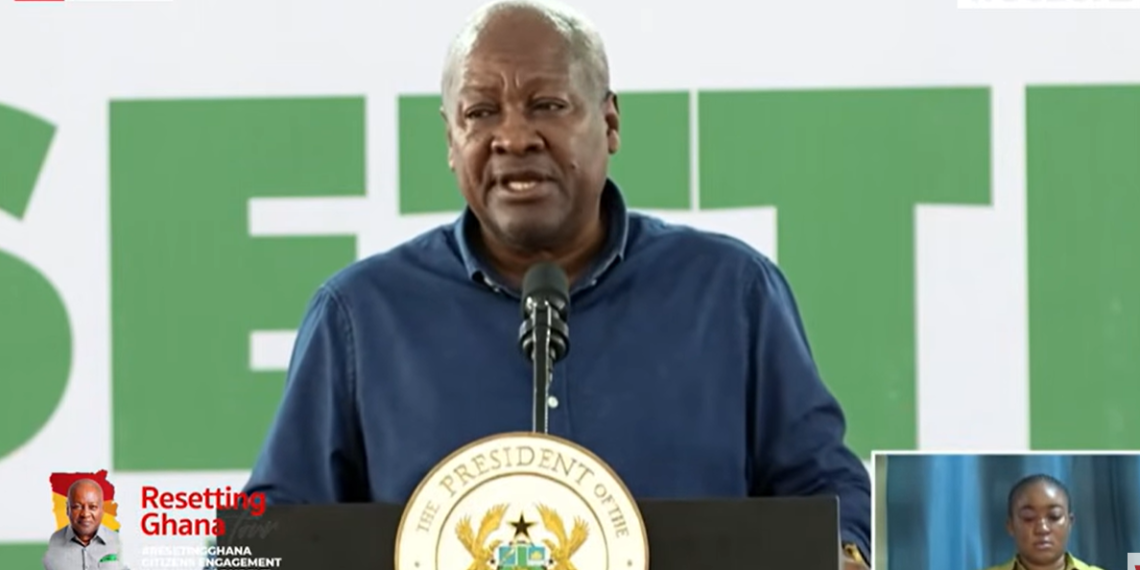
President John Dramani Mahama has announced plans to establish a maize processing plant in the Sissala area of the Upper West Region, in a move aimed at addressing the persistent glut that has plagued maize farmers in the area for years.
The President made the announcement on Saturday, September 12, during a citizens’ engagement at the University of Business and Integrated Development Studies (UBIDS) in the Upper West Region, as part of his Resetting Ghana Tour. The tour is designed to bring governance closer to the people and assess regional development priorities firsthand.
“We are going to set up a maize processing plant in the Sissala area. The plant will not only buy the maize, but it will also process the maize for the market and for export, and so I believe that this glut will become a thing of the past,” President Mahama told the gathering.
Value Addition at the Core
The President emphasised that the facility would go beyond mere purchasing to add value to the crop, creating a sustainable market that would incentivise increased production. The initiative aligns with the government’s broader strategy of promoting agricultural industrialisation and reducing the export of raw commodities.
The announcement comes after months of mounting pressure from stakeholders in the Sissala enclave. Earlier this year, the Upper West Regional Minister, Charles Lwanga Puozuing, expressed grave concern over the poor patronage of maize and other agricultural produce in the region, calling for sustainable solutions through local processing capacity.
The Sissala Paramount Traditional Council and the Sissala Union had also repeatedly appealed to the government to intervene, revealing that a 100-kilogramme bag of maize was selling for as low as GH¢350 due to the absence of a reliable market. Farmers in the area had threatened to boycott maize cultivation in the coming season if no urgent action was taken.
Buffer Stock Company to Receive More Funding
In addition to the processing plant, President Mahama announced plans to increase funding for the National Food Buffer Stock Company (NAFCO) to enable it to purchase more surplus maize from farmers.
He said inadequate storage capacity had limited the company’s ability to absorb excess production, and announced plans to construct silos at all of its storage centres.
“Aside from that, we are increasing the amount of money that we are giving to Buffer Stock to off-take the excess maize. The problem that the Buffer Stock has had is that they don’t have enough storage, so when they buy some maize, their warehouses are all full and they have nowhere to keep the excess maize. So we are building silos for them in all their storage centres,” he said.
The President’s remarks directly address concerns raised by Sissala stakeholders, who had noted that despite the government releasing GH¢100 million to NAFCO in 2025 to purchase excess farm produce, farmers in the area had not seen any Buffer Stock officials come to buy their maize.
Broader Storage Expansion Underway
The silo project forms part of a wider effort by NAFCO to expand its storage infrastructure across the country. In the Northern Region, the company has completed the rehabilitation and expansion of its Yendi depot, adding 250 metric tonnes of storage capacity to bring the total to at least 4,400 metric tonnes. The facility currently holds nearly 40,000 bags of national reserve food.
NAFCO is also actively sourcing and renovating additional storage facilities in the Volta, Oti, and other regions to strengthen its national food security mandate.
A Test of Policy Delivery
Analysts say the combination of a processing plant and expanded storage capacity represents a two-pronged strategy to tackle the maize glut: providing immediate relief through NAFCO purchases while creating long-term demand through value addition. However, the effectiveness of the plan will depend on the speed of implementation — the construction timeline for the processing plant, the actual amount of additional funding for NAFCO, and the pace of the silo projects will determine when farmers in Sissala and beyond can finally escape the cycle of bumper harvests without commensurate returns.