



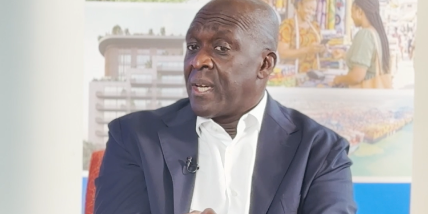
The Managing Director of the International Finance Corporation (IFC), Makhtar Diop, has declared Ghana “a totally different” country from the one that teetered on the brink of default just three years ago, pointing to a dramatic turnaround in macroeconomic fundamentals that has unlocked a US$1.2 billion pipeline of potential investments.
“I assess a post-recovery as an upward trajectory because what I found is the confidence of the private sector is much higher today,” Diop told Bernard Avle on Channel One TV’s The Point of View on Wednesday, September 23, 2026. “We are seeing more and more investment coming here from foreign direct investment.”
“It’s a totally different Ghana,” he said. “So I say that it’s good; it’s not the difficult Ghana.”
A Dramatic Turnaround
Diop’s assessment caps a remarkable two-year transformation for an economy that in 2022 was grappling with inflation at 54.1 percent, a collapsing cedi, depleted foreign reserves, and a debt burden that forced Ghana into a $3 billion IMF bailout and a painful restructuring of its sovereign bonds.
The turnaround has been swift and sweeping.
Real GDP growth rose to 6.0 percent in 2025, up from 5.8 percent in 2024, and accelerated further to 6.4 percent year-on-year in the first quarter of 2026. Inflation, which peaked at 54.1 percent in 2022, was brought down to 5.4 percent by the end of 2025 and further eased to 5.3 percent in June 2026.
The cedi appreciated by more than 40 percent against the US dollar in 2025, with gains continuing into 2026. International reserves strengthened to cover 5.8 months of imports, well above the IMF’s three-month benchmark. The primary fiscal balance shifted from a deficit of 4.3 percent of GDP in 2022 to a surplus of 2.1 percent in 2025, while the debt-to-GDP ratio fell from 61.8 percent to 45.3 percent at the end of 2025 — well ahead of the initial 2034 target.
Ghana Exits IMF Bailout, Enters PCI Era
Diop highlighted Ghana’s transition from the IMF’s Extended Credit Facility to a 36-month Policy Coordination Instrument (PCI) — a non-financing arrangement that signals market confidence rather than distress.
“It can serve as a seal of approval for the country’s economic policies and help demonstrate to the market that the reforms are being driven domestically,” he said.
Ghana completed its sixth and final review under the ECF in July 2026, receiving a final disbursement of approximately $371 million. The IMF’s Executive Board approved the PCI on a non-financing basis, with staff noting that the arrangement “provides an appropriate framework to consolidate macroeconomic stability, entrench policy credibility, advance structural reforms, and support Ghana’s transition to sustained, inclusive growth”.
Diop, who previously served as Senegal’s Minister of Economy and Finance in the late 1980s, said Ghana’s approach reminded him of Senegal’s own experience with a similar IMF programme without disbursement.
IFC Ready to Scale Up Lending
The IFC chief said the improved macroeconomic environment had created significant room for the corporation to expand its lending to Ghana.
“My own assessment is that today I have a situation where we can really increase our lending in Ghana significantly,” he said.
That expansion is already underway. In the fiscal year to date, the IFC has financed and mobilized approximately $505 million in private investments in Ghana, building on $410 million delivered in fiscal year 2025. The corporation currently has a $1.2 billion pipeline of potential investments in the country.
The pipeline includes $100 million for a project in the Volta Ecological Zone and $50 million for a railway project aimed at improving the movement of goods towards northern Ghana and connecting the country to Burkina Faso. The IFC has also announced partnerships with Absa Bank Ghana and Complete Farmer to expand agricultural finance, and with Access Bank Ghana to provide up to $134 million in financing to licensed cocoa buying companies.
IFC’s broader programme in Ghana focuses on export-led manufacturing, agribusiness, renewable energy, and financial sector development, including support for up to 200 MW of solar energy with LMI Holdings to reduce industrial energy costs.
Strategic Partnerships at the Highest Level
Diop’s television interview followed a week of high-level engagements in Accra. On September 16, he met Finance Minister Dr. Cassiel Ato Forson to discuss the government’s next phase of economic transformation, with particular emphasis on commercial agriculture, value addition, and job creation.
The following day, he was hosted at the Presidency by President John Dramani Mahama, where discussions focused on scaling up commercial agriculture — particularly cocoa, oil palm, and poultry — as well as infrastructure expansion under the Big Push programme, energy, digital connectivity, and education.
Diop said the Finance Minister had provided a list of priority sectors for IFC support, with energy, infrastructure, and agriculture at the top. He also said the IFC wanted to support Ghana to produce more of the goods it currently imports, particularly poultry, noting the country had the potential to become more self-sufficient if the sector could produce competitively.
The Road Ahead: Productivity, Savings, FDI
While optimistic, Diop cautioned that Ghana’s progress should be viewed against its broader ambition of becoming a well-developed middle-income economy capable of creating jobs and sustaining growth.
He stressed three priorities for sustaining the recovery: continuing to attract foreign direct investment, mobilising domestic savings towards productive investment, and improving productivity.
“You need to continue attracting foreign direct investment and mobilise domestic savings towards productive investment, improve the productivity of the economy so that you can attract investment at the same growth rate without relying too much on borrowing from outside, particularly from the DFIs,” he said.
Diop also praised the government’s efforts to align the exchange rate and eliminate the dual exchange rate system, which he said had provided greater certainty for investors.
About Makhtar Diop
Makhtar Diop has served as IFC Managing Director and Executive Vice President since March 2021, becoming the first African to lead the World Bank Group’s private-sector arm. Prior to joining the IFC, he served as the World Bank’s Vice President for Infrastructure from 2018 to 2021 and as Vice President for Africa from 2012 to 2018, overseeing a record $70 billion in delivery to Sub-Saharan Africa.
A Senegalese national and economist by training, Diop began his career in banking before joining the IMF and later the World Bank. He served as Senegal’s Minister of Economy and Finance in the late 1980s, where he played a key role in instituting structural reforms that laid the foundation for the country’s growth. He has been named one of the 100 most influential Africans in the world and holds degrees in economics from the Universities of Warwick and Nottingham.
As he concluded his Accra visit, Diop’s message to Ghana was one of both validation and challenge: the hardest part of the recovery may be over, but the work of transforming the economy into one that creates jobs, sustains growth, and reduces dependence on external borrowing has only just begun.


