


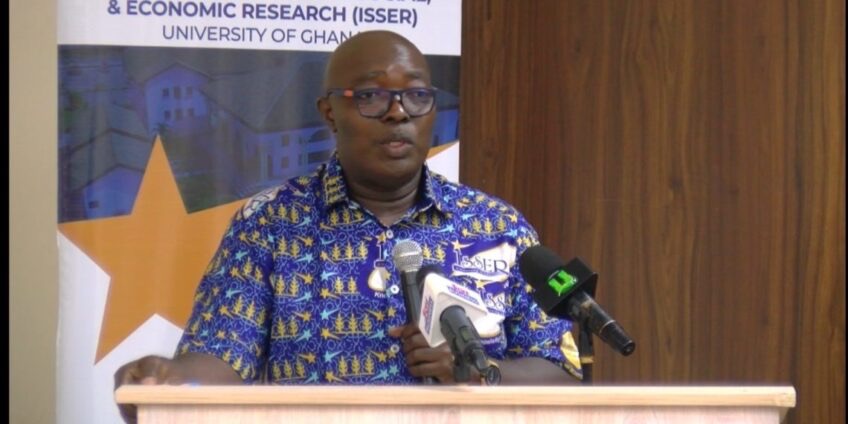
The Institute of Statistical, Social and Economic Research (ISSER) has called on the government to use the 2027 national budget as a pivot to strengthen revenue mobilization and broaden the tax base, warning that Ghana’s recent fiscal consolidation has been driven largely by expenditure restraint rather than increased revenue generation.
The recommendation was made following the launch of ISSER’s State of the Ghana Economy Report 2025, a flagship annual assessment that provides an independent analysis of the country’s economic performance and outlook. The report, widely regarded as a key reference for policymakers, civil society, and development partners, examines fiscal trends, growth dynamics, and social development indicators.
Fiscal Consolidation Driven by Spending Cuts, Not Revenue
According to ISSER, a critical examination of Ghana’s fiscal consolidation in 2025 revealed that the economy’s adjustment was achieved primarily through expenditure restraint rather than enhanced revenue mobilization. Total grants and revenue amounted to just 16.1 percent of GDP, while capital expenditure declined sharply from 2.5 percent to 1.4 percent of GDP—a development the institute flagged as a significant concern for public investment.
ISSER Director, Professor Robert Darko Osei, presented the findings, noting that while the fiscal adjustment had yielded notable results—including public debt falling from 62.7 percent to 46 percent of GDP and an appreciation of the cedi—the heavy reliance on expenditure cuts had also affected households. The institute cautioned that continued belt-tightening without corresponding revenue growth risks undermining productive public investment and social spending.
Recommendations for 2027 Budget
In its recommendations ahead of the 2027 budget cycle, ISSER outlined a three-pronged approach to sustaining Ghana’s fiscal gains:
· Strengthen revenue mobilization: Government must broaden the tax base, improve compliance, and reduce revenue leakages to ensure fiscal consolidation is not solely dependent on spending cuts.
· Enhance productive investment: Expenditure efficiency must be improved while safeguarding priority infrastructure and social spending, to prevent the erosion of public investment gains.
· Sustain fiscal discipline: Government should strengthen commitment controls, prevent arrears accumulation, and proactively manage debt refinancing risks.
Conclusion: A Balanced Path Forward
ISSER concluded that while Ghana’s fiscal consolidation was substantial in 2025, sustaining it will require stronger revenue mobilization in 2027 without sacrificing productive public investment. The institute’s recommendations come at a critical juncture as the government prepares the 2027 budget amid ongoing economic recovery efforts and mounting pressure to balance fiscal discipline with social and infrastructural needs.
The State of the Ghana Economy Report is one of ISSER’s most anticipated publications, serving as a barometer for the country’s economic health and a guide for policy direction. Its latest findings underscore the need for Ghana to move beyond expenditure-led adjustment toward a more balanced fiscal strategy that mobilizes domestic revenue and protects long-term growth prospects.
Related Stories
· Achimota Golf Club drives breast cancer awareness through ONE Pink Cup 2026
· Economic Fighters League demands independent probe into Obuasi SHTS sex scandal
· ‘We must move beyond potential’: Upper West Region courts global investors with massive tax holidays
· USTED professor calls for Ghana-backed research into locally suited drainage solutions
· GRA investigates alleged GH¢600 extortion by Customs Officer at Accra Airport