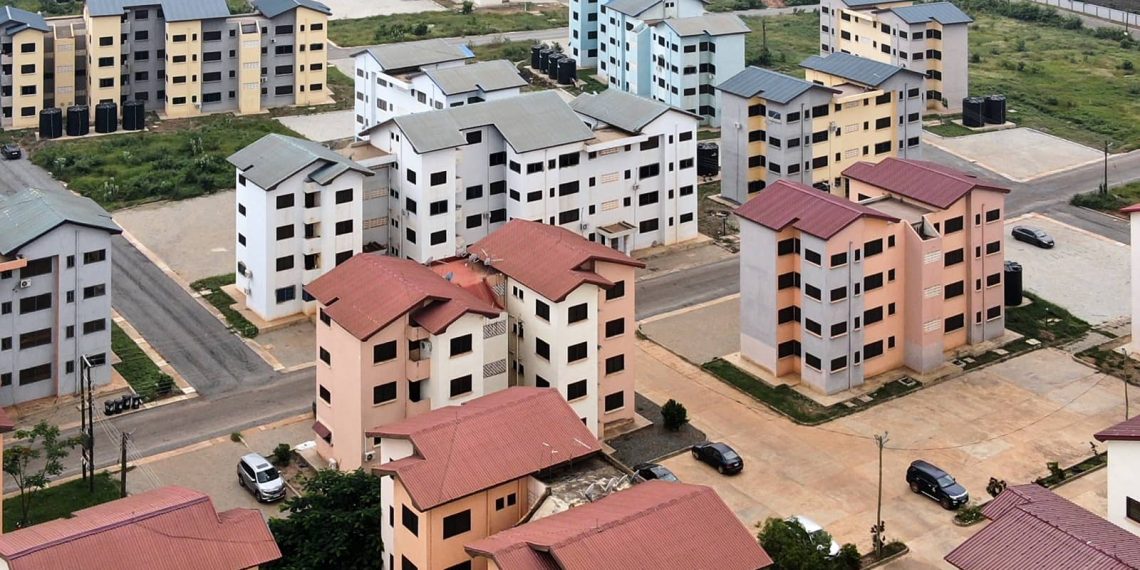
Only about five per cent of Ghanaians can secure housing without assistance, while roughly 60 per cent require state-facilitated support to access decent accommodation, the government has disclosed. A further 30 per cent remain unable to access housing even with government subsidies — a stark admission of the scale of Ghana’s housing affordability crisis.
The disclosure was made by the Ministry of Works, Housing and Water Resources and the Ministry of Local Government, Chieftaincy and Religious Affairs in a joint statement to commemorate World Habitat Day 2026, marked under the theme “Adequate Housing for All.”
The ministries attributed the challenge to high land prices, rising construction and infrastructure costs, and limited access to affordable housing finance.
“These realities underscore the need for deliberate interventions to make housing more accessible and affordable to all,” the ministries stated.
A Deficit of Over 1.8 Million Units
The affordability figures are set against a national housing deficit that has grown to more than 1.8 million units, according to the 2024 Ghana Housing Profile. Up to 37 per cent of Ghana’s urban population lives in informal settlements, and more than half of the population now resides in urban areas — a figure projected to climb to 70 per cent by 2050.
President John Dramani Mahama has himself acknowledged the gravity of the situation, noting that the deficit reflects “years of supply failing short of demand,” driven by rising land values, escalating construction costs and limited access to long-term financing.
The National Homeownership Fund (NHF), the state agency tasked with expanding access to homeownership, has consistently flagged the same reality. Its Chief Executive Officer, Prosper Hoetu, has repeatedly stated that only five per cent of Ghanaians can afford a home independently, while 60 per cent need government assistance and another 35 per cent require social housing options.
The 8.4% Mortgage Gamble
At the heart of the government’s response is the National Mortgage Scheme, implemented in partnership with the NHF and Republic Bank. Under the scheme, mortgage financing is available at an interest rate of approximately 8.4 per cent per annum, with repayment periods of up to 20 years.
The rate represents a significant intervention in a market where standard commercial mortgages typically range between 19 and 28 per cent per annum. The NHF has described the 8.4 per cent rate as the first single-digit cedi mortgage rate in more than three decades, following a comprehensive review of the scheme with Republic Bank.
At that rate, a worker with a net monthly income of GH¢2,500 is eligible to access up to GH¢143,000, with a monthly repayment of GH¢1,231.95 over 20 years.
The ministries said the initiative is intended to give more Ghanaians — particularly those excluded from traditional mortgage markets — an opportunity to own decent homes.
But the NHF has admitted that it currently lacks sufficient resources to expand its housing programmes to reach more Ghanaians, and has appealed to the Ministry of Finance for additional funding. The Fund has also proposed a levy on selected building materials to establish a sustainable financing source for affordable housing.
The Wider Policy Framework
Beyond mortgage financing, the government is pursuing the National Urban Policy and Implementation Plan 2026–2035 and the National Slum Upgrading and Prevention Strategy and Implementation Plan 2026–2035, both launched in July 2026.
The National Urban Policy, Ghana’s second such framework, builds on lessons from the country’s first urban policy introduced in 2012. It outlines key priorities including sustainable urban growth, improved land-use planning, climate resilience, affordable housing, better financing for infrastructure and equitable access to essential services.
The Slum Upgrading and Prevention Strategy seeks to improve living conditions in informal settlements while preventing the emergence of new slums, focusing on integrated upgrading, improved access to basic services, stronger land and housing management systems, and increased community participation.
The Minister for Local Government, Chieftaincy and Religious Affairs, Ahmed Ibrahim, said government alone cannot deliver the transformation needed, calling for stronger partnerships and sustained private-sector investment.
Housing Is More Than Four Walls
The joint statement stressed that adequate housing goes beyond providing housing units, requiring access to potable water, sanitation, roads, electricity, drainage and public spaces.
“Government remains committed to expanding access to decent, affordable and sustainable housing throughout the country,” the ministries added.
The government has also rolled out complementary initiatives, including the Green City Housing Project at Dedesua near Kumasi — a more than 1,000-unit development on a 200-acre parcel of land provided by the Asantehene, Otumfuo Osei Tutu II — and the Greenville District Housing Programme aimed at bridging the national deficit.
The Saglemi Affordable Housing Project, initiated under a previous NDC administration and stalled for years, is being prioritised for completion. A low-cost housing scheme for public sector workers is also in development, alongside district-level social housing initiatives designed to reduce financial barriers to homeownership.
World Habitat Day and the Road Ahead
World Habitat Day is observed annually on the first Monday of October to draw attention to the state of human settlements and reaffirm the importance of adequate housing as a fundamental component of inclusive and sustainable development.
The day coincides with World Architecture Day, which this year emphasises that “Housing is a Human Right.”
As part of activities marking the occasion, President Mahama is expected to open a National Conference on Housing Finance in Accra on October 7 and 8, 2026, organised by the NHF at the Mövenpick Ambassador Hotel. The conference will bring together government institutions, financial institutions, developers and other stakeholders to develop a framework for affordable housing finance and delivery.
The findings of a VIRAL diagnostic assessment of Ghana’s housing sector — conducted by the NHF in partnership with the Ministry of Works, Housing and Water Resources and Shelter Afrique Development Bank — are expected to be presented at the conference. The assessment is intended to lead to a Country Housing and Urban Partnership Strategy to attract investment into housing.
The Bottom Line
For the five per cent of Ghanaians who can afford a home on their own, the housing market works. For the 60 per cent who need government support, and the 30 per cent for whom even subsidies may not be enough, the gap between policy ambition and lived reality remains vast.
The government’s 8.4 per cent mortgage rate is a genuine breakthrough — the lowest cedi mortgage rate in a generation. But as the NHF’s own CEO has acknowledged, the Fund lacks the resources to scale. Without substantially larger capital mobilisation, the headline rate may remain a promise accessible to far fewer Ghanaians than the crisis demands.
As the ministries themselves put it: “These realities underscore the need for deliberate interventions.” The question is whether those interventions will be large enough, fast enough, and targeted enough to house a nation where 95 per cent of citizens cannot afford a home without help.
Source: Joint statement by the Ministry of Works, Housing and Water Resources and the Ministry of Local Government, Chieftaincy and Religious Affairs, World Habitat Day 2026. Additional reporting from Citi Newsroom, Ghana News Agency, GhanaWeb, Information Services Department, Business Week Ghana, and the National Homeownership Fund.