



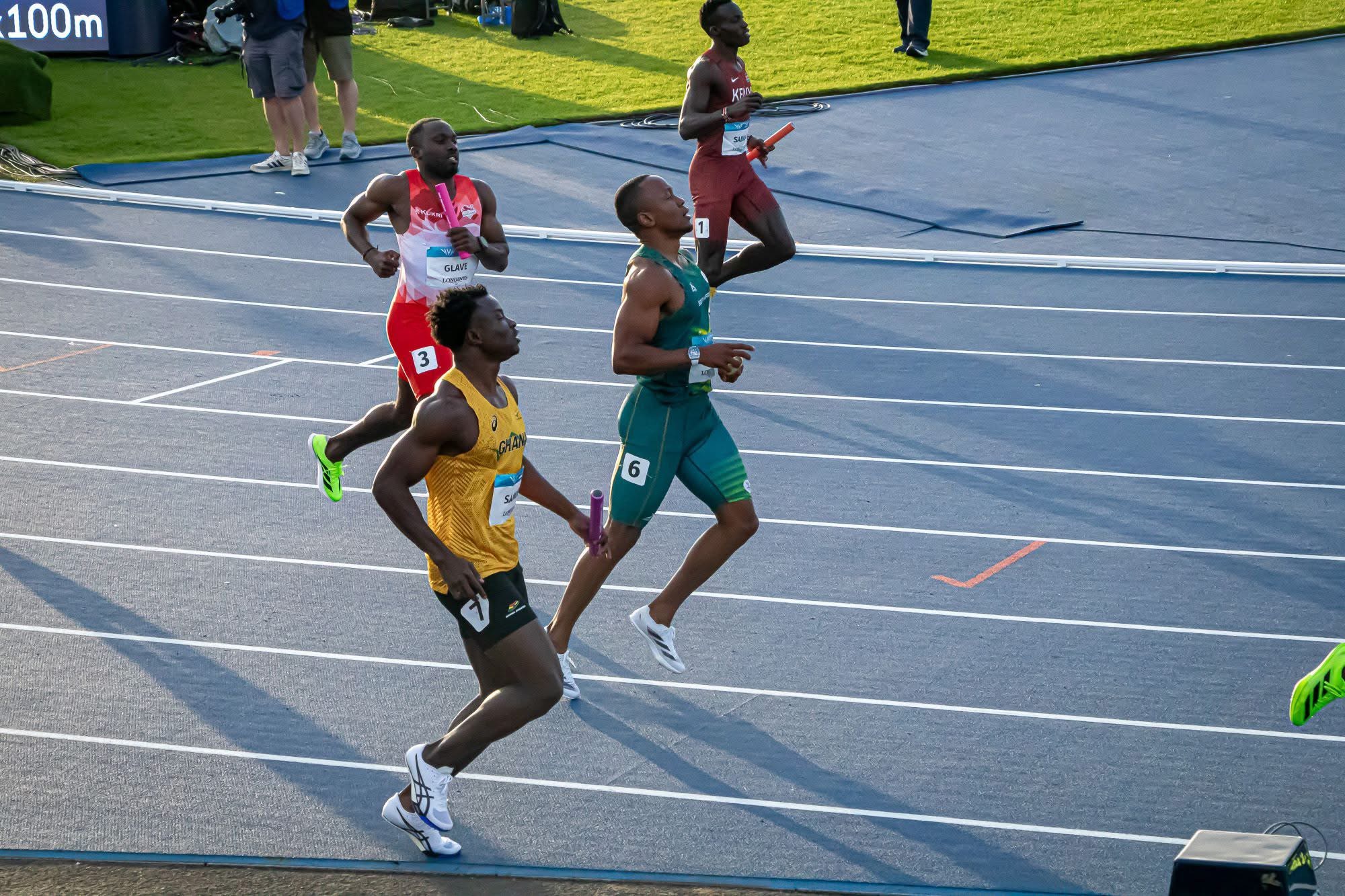
Ghana’s men’s 4x100m relay team suffered a devastating medal heartbreak on the penultimate day of the Glasgow 2026 Commonwealth Games, losing a historic bronze medal after Canada successfully overturned their disqualification following a dramatic protest.
The Ghanaian quartet of Benjamin Azamati, Captain Joseph Paul Amoah, Mustapha Bokpin, and Abdul-Rasheed Saminu had briefly tasted podium glory, ending a 52-year wait for a Commonwealth Games relay medal. However, celebrations lasted barely an hour before the decision was reversed, leaving the team in fourth place and the nation with just two medals from the Games.
A Race of Fractions
The men’s 4x100m relay final on Saturday night was a thriller decided by mere fractions of a second. Australia claimed gold in 38.07 seconds, running out of lane 8. Canada, with the star-studded quartet of Aaron Brown, Jerome Blake, Brendon Rodney, and Andre De Grasse, crossed the line second in 38.11 seconds .
Nigeria initially finished third in 38.12 seconds, with Ghana just one millisecond behind in 38.13 seconds—a breathtaking finish that saw only 0.06 seconds separate the top four teams.
The Protests Begin
The drama unfolded when race officials disqualified Canada and South Africa for an alleged lane violation during the handoff between lead runner Aaron Brown and Jerome Blake . This decision promoted Nigeria to silver and elevated Ghana from fourth to bronze—a moment of ecstasy for the Ghanaian team and their supporters.
Ghana’s time of 38.13 seconds would have secured the country’s first men’s 4x100m relay medal at the Commonwealth Games since 1974 in Christchurch, New Zealand . Ghana had previously won relay medals in 1962 (Perth), 1966 (Kingston), and 1974, with the 1966 team famously winning gold .
Canada’s Successful Appeal
The Canadian team, however, refused to accept the disqualification. Athletics Canada head coach Glenroy Gilbert revealed that the turning point was their own video evidence .
“It was our video that overturned this,” Gilbert told CBC Sports. “The video that they have [organizers] was inconclusive. You couldn’t really tell because it was very blurry. But one of our helpers here also had a video of [the shot] straight on of Aaron and Jerome and the exchange, and it showed Aaron’s foot… there was a sliver [where] you can see the blue of the track between his spike and the white line” .
The appeal was upheld, and Canada’s silver medal was reinstated. Nigeria returned to bronze, while Ghana dropped back to fourth place. Andre De Grasse described the four-hour ordeal as unprecedented. “It’s a relief,” he told CBC Sports. “Four hours later, finally, we get a chance to stand on the podium and get our medal. I’ve never experienced anything like this” .
Ghana’s Counter-Protest Fails
Ghanaian officials, led by Ghana Olympic Committee President Richard Akpokavie, desperately filed a counter-protest, arguing that even race winners Australia had violated Ghana’s spot in lane 8 on the anchor leg. However, the protest was unsuccessful, and the final results were confirmed late into the night, with the medal ceremony reportedly held in an emptying stadium .
A Bitter End to Glasgow 2026
The heartbreaking verdict left Ghana’s total podium count at a paltry two medals at Glasgow 2026. Earlier successes had come from para thrower Zinabu Issah, who won silver in the women’s F57 Shot Put, and boxer Amadu Mohammed, who claimed bronze in the men’s 55 kg boxing competition .
The nation’s disappointment was compounded by the fact that Nigeria, West African rivals, retained the bronze medal, while Ghana finished 30th overall in the medal table with just one silver and one bronze .
The 23rd Commonwealth Games, which kicked off on July 23 with an official opening by King Charles III, concludes with the closing ceremony at The Hydro in Glasgow on Sunday evening. For Ghana’s relay team, however, the Games will be remembered for a moment of glory that lasted barely an hour before being snatched away.


