



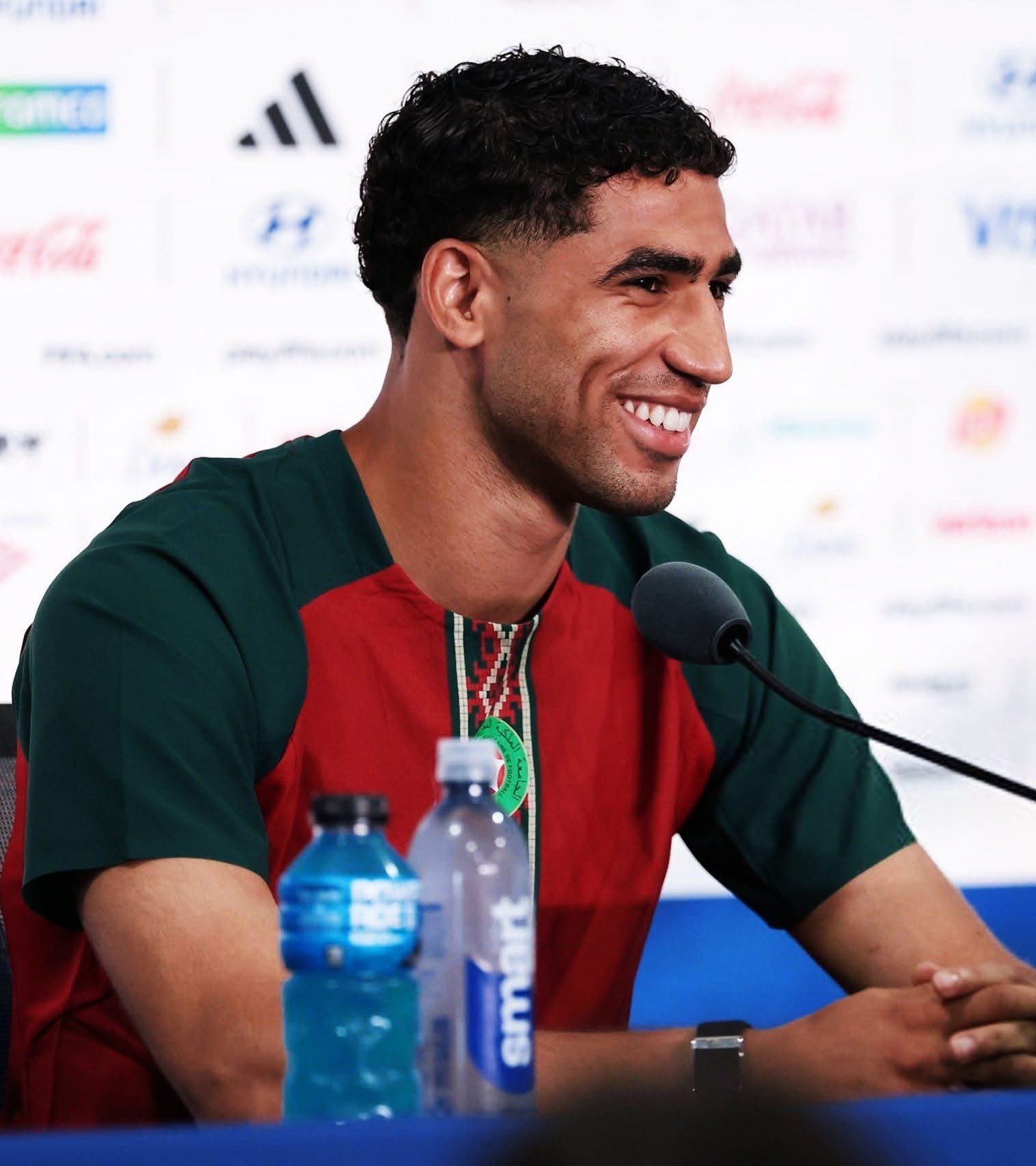
A press conference ahead of the Morocco-Brazil match at the 2026 FIFA World Cup took an unexpected turn on Friday when a Mexican journalist was instructed not to ask questions in Spanish. The incident, which quickly went viral, prompted Morocco captain Achraf Hakimi to step in and allow the question – before himself being told he could answer only in English. The controversy has since ignited a broader debate about language policies and the sidelining of one of the tournament’s host nations’ official tongues.
The moment unfolded at the pre-match media session held at MetLife Stadium in New Jersey. Rodrigo Ornelas, a reporter for the Mexican network TV Azteca Deportes, took the microphone and began addressing Hakimi in Spanish.
However, before he could finish, a FIFA press officer stepped in to cut him off, stating that only questions in the language “that we said” were permitted and that no Spanish questions were allowed. The FIFA official explained the restriction was due to a lack of Spanish interpreters available for the session, a recurring issue at several press conferences during the tournament’s opening days. “We cannot do this because of the translations,” the official was heard saying, adding, “If we start with this…” implying that allowing Spanish would lead to requests in other languages.
Hakimi, who was born and raised in Madrid and is a native Spanish speaker, attempted to intervene, telling the official that he had no problem understanding and could answer in English if necessary. He then turned to the journalist with a question that underscored the absurdity of the situation: “How do I answer? In English or Spanish?” The FIFA official instructed the player: “English”.
After the journalist repeated his question, Hakimi responded in English, expressing his affection for Mexico, one of the tournament’s three host nations alongside the United States and Canada. “I am very proud to have some fans in your country. I love your country, and I have been there. So I am happy that you love me,” the PSG defender said. He also answered a follow-up about the possibility of facing former club teammate Neymar, stating he would prefer the Brazilian star to be on the pitch because “I like to play against the best”.
The language controversy was not isolated. At the same session, Brazilian star Vinícius Júnior – who has lived in Spain for several years and speaks fluent Spanish – asked a Spanish journalist from DAZN to address him in Spanish. The reporter, Sergio Quirante, started to comply but was also interrupted, with the FIFA official again citing the lack of remote Spanish interpreters. A similar situation occurred with the Netherlands midfielder Frenkie de Jong, who was told he could not answer a Spanish-language question ahead of his team’s match against Japan.
FIFA’s language protocol for press conferences at the World Cup has faced growing criticism, with many pointing out the irony that Spanish is an official language of Mexico – one of the host nations – and is spoken by millions across North America. The governing body defended the restrictions as a matter of logistical practicality, noting that the press conference for Brazil vs. Morocco had interpreters for English, Portuguese, Arabic, French, and Italian (the latter at Brazil’s request due to coach Carlo Ancelotti), but that no one had requested Spanish translation services beforehand.
Veteran Mexican sports journalist José Ramón Fernández reacted with strong criticism, calling the situation “incomprehensible.” He argued that “The 2026 World Cup boasts of diversity, but a press conference for Brazil and Morocco did not allow questions in Spanish, the official language of one of the host countries and spoken by millions in North America. Incomprehensible”. Fernández emphasized that the issue was not about the language itself but the lack of preparation: “The problem is that there were no interpreters for the official language of one of the World Cup’s host cities”.
Hakimi, the captain of Morocco and a key figure for Paris Saint-Germain, was born in Madrid to Moroccan parents. Despite being eligible to play for Spain, he chose to represent the country of his family’s origin and has since become one of the most prominent footballers in Africa and the world.
As of Sunday morning, FIFA had not issued a formal statement explaining the lack of Spanish interpreters, but the controversy continued to gain traction across social media, with many users calling for greater inclusivity and better logistical planning for one of the world’s largest sporting events.


