



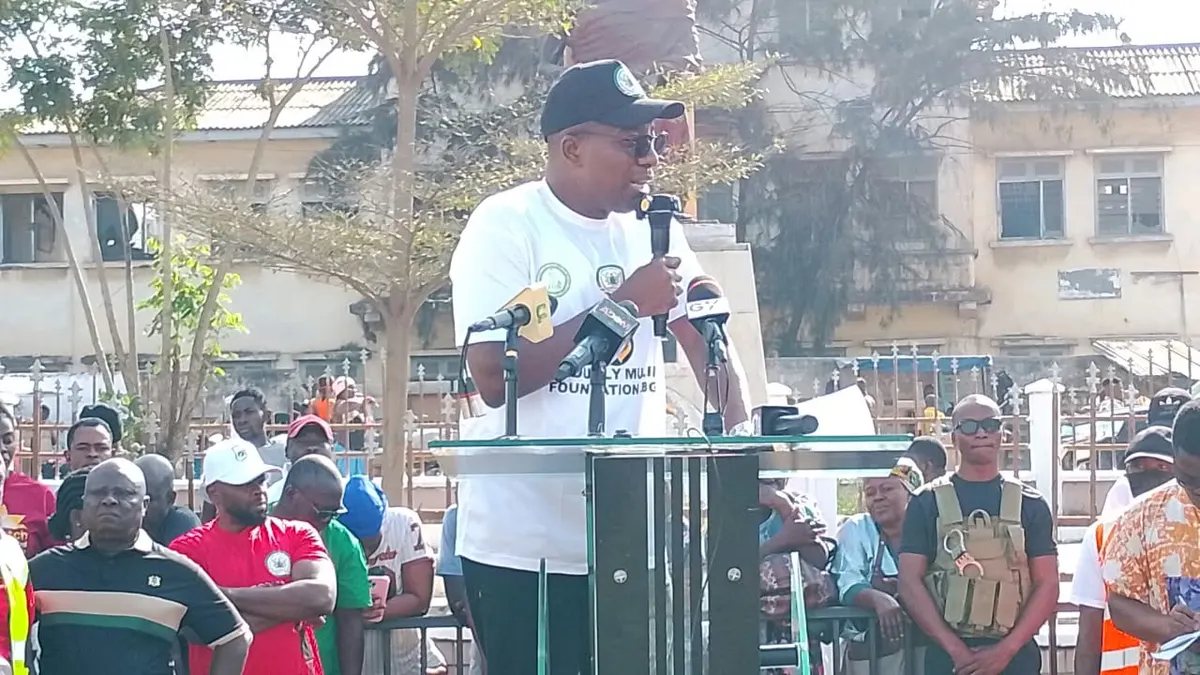
The government will replace the open waste-carrying tricycles known locally as aboboyaa with self-loading and self-sealing waste trucks and provide bins to every household across Ghana, Minister for Local Government, Chieftaincy and Religious Affairs Mahama Ayariga announced on Saturday.
Speaking at the World Sanitation Day celebration at Rawlings Park in Accra, Mr Ayariga said the current system of transporting waste in open buckets was untenable and would be phased out in favour of mechanised, enclosed vehicles designed specifically for sanitation work.
“We have decided that we will replace the current open buckets — aboboyaa — that are carrying our waste. And we are going to replace them with self-loading, self-keeping waste trucks for the young people. We will not allow you to carry waste in open buckets,” the Minister declared.
The new vehicles will enable waste to be separated at the point of collection — organic and solid — and transported in sealed compartments to landfill sites, where recyclable materials would subsequently be recovered and non-recyclable waste properly disposed of. This aligns with the Accra Metropolitan Assembly’s proposed amendment to its sanitation bye-laws, which would mandate waste separation at source and introduce a colour-coded bin system: green for organic waste, black for residual waste, and brown for recyclables.
Household Bins for Every Home
Mr Ayariga said the government plans to provide waste bins to households across the country as part of a nationwide waste management reform programme unveiled by President John Dramani Mahama in September. Under the programme, every household will receive two bins — one for solid waste and another for organic waste — to enhance segregation at source.
He emphasised that residents, particularly women and children, should not have to walk long distances to dispose of household waste, and that making disposal more convenient would encourage responsible waste management.
“The reason why we have a major challenge with waste management in this country is that we don’t even have the infrastructure. We don’t have the waste bins. We don’t have enough tricycles to carry the waste from the communities to transfer stations. We don’t even have the transfer stations. And worse still, we don’t even have enough landfill sites,” he admitted.
The nationwide reform programme will also deploy District Road Improvement Programme (DRIP) equipment to clear refuse dumps, expand waste transfer stations, and increase engineered landfill facilities across all 16 regional capitals.
Street Adoption Programme to Create Jobs
Mr Ayariga further disclosed that the government is considering partnerships with corporate organisations to support the maintenance and beautification of streets named after notable individuals and institutions. Under the proposed arrangement, companies with strong financial capacity could be assigned selected streets to maintain, including cleaning, street lighting, landscaping and upkeep of pavements.
He said the initiative would provide an opportunity for companies to contribute to urban development while creating employment opportunities for thousands of young people who would be engaged in street maintenance under the supervision of relevant authorities. The “Adopt a Street” concept has already been piloted by Zoomlion Ghana Limited, whose subsidiary UCS Facility Management undertook a community clean-up exercise in East Legon as part of the campaign.
Mayor Assures Market Women of Government Commitment
For his part, the Mayor of Accra, Michael Kpakpo Allotey, assured market women that President Mahama remains committed to improving sanitation in the Greater Accra Region. He said the President is determined to address challenges facing traders and improve conditions in markets across the region.
Mr Allotey reiterated the Accra Metropolitan Assembly’s commitment to working with stakeholders to ensure clean, safe and healthy market environments. He urged traders to make cleanliness a daily habit rather than treating sanitation as a responsibility reserved for the monthly National Sanitation Day exercises, saying maintaining clean trading spaces must become part of their everyday routine.
Background: A Nation’s Sanitation Crisis
Ghana has long grappled with severe sanitation challenges. According to a 2026 study published in Discover Sustainability, poor spatial planning, conflicts over dumpsite siting, lack of resources, and weak enforcement of sanitation bye-laws have exacerbated the crisis in Accra. The country loses more than GH¢6.2 billion annually through flood-related destruction, healthcare costs and environmental degradation caused by poor waste management.
National Sanitation Day was first launched in 2014 under President Mahama’s first term but was abandoned after 2016 and replaced with Green Ghana Day. It was relaunched in September 2025 under the “Clean Up Ghana” agenda, with sanitation now integrated as a Key Performance Indicator for Metropolitan, Municipal and District Chief Executives.
The government’s decision to integrate tricycle waste collectors into the formal waste management system follows years of informal operation. In the Greater Accra Region alone, an estimated 4,000 tricycle waste collectors operate daily, with only about 800 using the Jamestown transfer station. A 2026 study by the London School of Economics noted that while households pay informal tricycle collectors for door-to-door service, prices remain too high for universal access, and final disposal occurs largely at illegal dumpsites.
‘Polluter Pays’ Principle
Mr Ayariga has previously championed a “Polluter Pays” principle as a cornerstone of the new waste management regime, stressing that the burden of sanitation cannot fall solely on government. He projected that reorganising the system could reduce the cost per household of waste management by as much as 50%.
The Ministry is also developing a national sanitation strategy to address challenges in waste collection, including inadequate waste bins and difficulties in accessing densely populated communities.
Saturday’s event at Rawlings Park formed part of activities marking World Sanitation Day, held under the theme “National Sanitation Day: Local Actions Yielding National Impact,” in alignment with the government’s Clean Up Ghana Agenda.


